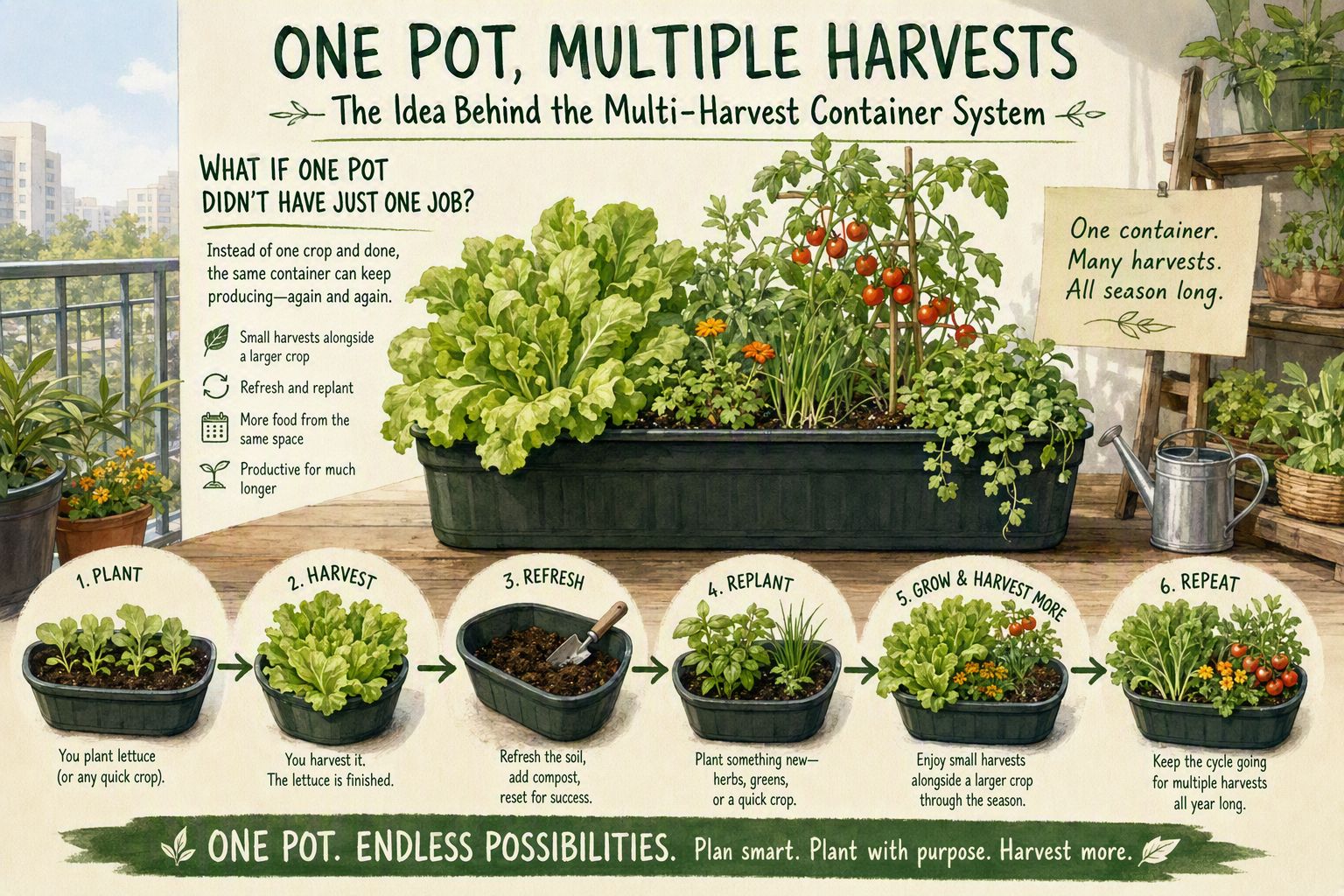
What if one pot didn’t have just one job?
You plant tomato in a container. You harvest it. The tomato is finished.
What happens next?
For many container gardeners, the answer is simply that the pot sits there until they decide what to plant in it next.
But we can do better than that.
The same container can potentially produce several different crops during the year. It can provide small harvests alongside a larger crop. It can be refreshed and replanted. And, with some planning, the same piece of growing space can remain productive for much longer than a single crop cycle.
That is the basic idea behind the Multi-Harvest Container System.
It isn’t a particular type of container.
It isn’t a list of plants that you have to grow.
And it isn’t a rigid planting schedule that everyone has to follow.
It is a different way of thinking about growing food in containers.
Instead of asking only, “What can I grow in this pot?”, you start asking:
“What can this pot produce over time?”
That small change in perspective can make a surprisingly big difference.
What Is The Multi-Harvest Container System?
At its simplest, the Multi-Harvest Container System is about using the same container repeatedly.
You combine compatible crops where that makes sense, use succession planting to move from one crop to another, maintain the soil so it can support continued production, and try to make the best possible use of the time, space and effort available to you.
The basic cycle is simple:
Sow → Grow → Harvest → Refresh → Replant
Then the process starts again.
Sometimes several crops will be growing together.
Sometimes one crop will follow another.
Sometimes a container will be productive for part of the year and rest for a while because that makes sense for the conditions.
There is flexibility built into the idea.
That is important because there is no single perfect way to grow food on a balcony.
Your climate may be different from mine.
Your balcony may receive less sun.
You may have more wind, smaller containers or less time available.
The system is designed to be adapted.
At the heart of it are four resources that every balcony gardener has to work with:
Time. Space. Soil. Effort.
You cannot necessarily increase the amount of physical space available to you.
But you can often make better use of the space you already have.
Why Traditional Gardening Thinking Doesn’t Always Work On A Balcony

Traditional vegetable gardening often follows a fairly straightforward pattern.
You prepare the soil.
You plant a crop.
You grow it.
You harvest it.
And eventually the season ends.
That approach can work perfectly well, especially when you have a large garden with plenty of growing space.
But when your entire vegetable garden consists of a limited number of containers, unused space becomes much more noticeable.
If you have ten pots, you only have ten pieces of growing space.
If several of those pots are empty for long periods, you have effectively reduced the productive size of your garden.
The solution isn’t necessarily to buy ten more pots.
Sometimes the better solution is to think differently about the pots you already have.
A container doesn’t have to be tied permanently to one crop.
And a growing year doesn’t have to be one single production cycle.
Once you start thinking in cycles, the same physical space can potentially produce again and again.
That is one of the biggest advantages a balcony gardener has.
You can’t make your balcony physically larger.
But you can make better use of the time available to you.
One Pot Doesn’t Have To Mean One Crop
This is one of the first mental shifts I want to encourage.
A container doesn’t have to contain only one crop.
That doesn’t mean you should cram as many plants as possible into every available pot.
Overcrowding can create more problems than it solves.
Instead, look at whether crops can use the available space in compatible ways.
Lettuce and radishes can sometimes share a container.
A tomato can grow with suitable companion crops such as basil.
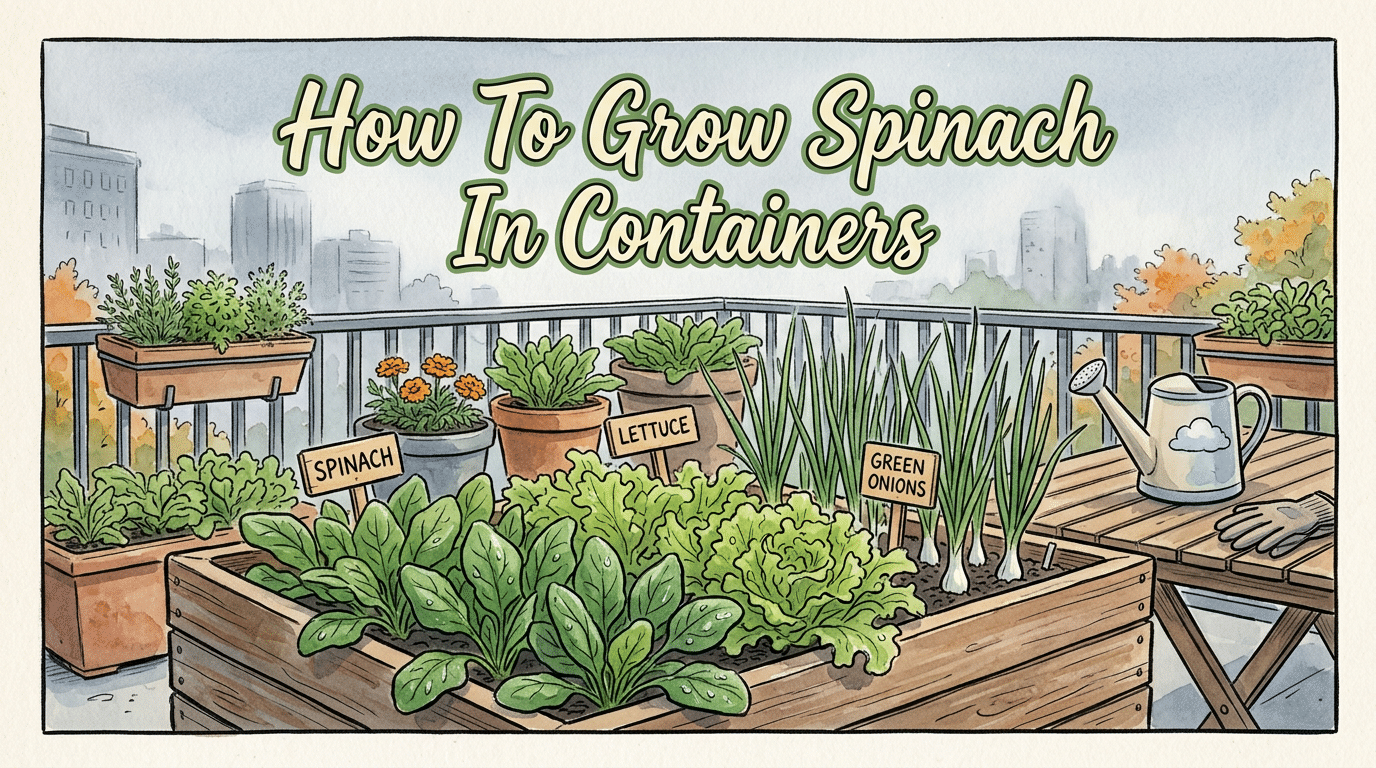
Spinach and green onions can make good use of the same growing space in appropriate conditions.
Different crops may use different parts of the container.
One may grow taller.
Another may stay low.
One may be harvested quickly.
Another may take longer.
And some crops can be harvested gradually rather than all at once.
Then there is the other half of the equation:
What comes next?
A container might hold one crop in spring and another in summer.
The summer crop might be followed by an autumn crop.
An autumn crop might continue into winter.
Suddenly the container isn’t one growing event.
It is a series of opportunities.
The Four Pillars Of The System
The Multi-Harvest Container System is built around four main ideas.
Succession Planting — Maximize Time
Succession planting is about using your growing space repeatedly.
Rather than thinking of one container as belonging to one crop, you plan for what can follow.
The basic idea is:
Sow → Grow → Harvest → Replant
The exact timing depends on your climate and growing conditions.
The important thing is to stop thinking of the year as one growing season and start thinking in terms of production cycles.
Your container has a physical size that doesn’t change.
But the number of crops that can potentially use that space over time can change.
Companion Planting — Maximize Space
Companion planting allows compatible crops to share a container.
Instead of looking only at the footprint of the pot, you start looking at how different plants use the available space.
A taller crop can occupy vertical space.
A smaller crop can grow beneath or around it.
A fast-growing crop may be harvested before a slower crop reaches its full size.
Again, this is not about filling every available inch.
The aim is to use the space intelligently while still giving each plant what it needs.
Soil Reset And Organic Feeding — Maintain Fertility
If you expect a container to produce several crops, you cannot ignore the soil.
Every harvest removes nutrients from the potting mix.
Repeated production therefore means paying attention to fertility, structure, moisture and drainage.
After a heavy crop, the container may need a refresh before the next crop goes in.
That might mean incorporating compost, replenishing nutrients or otherwise preparing the potting mix for another production cycle.
I think of this as:
Harvest → Refresh → Replant
The goal isn’t to replace everything after every crop.
It is to maintain the growing environment so that your container remains capable of producing.
Whenever I harvest a crop, I take care of the soil and add nutrients (compost, fertilizer) and then the next crop goes in.
Efficient Gardening — Low Effort, High Yield
This pillar is particularly important to me.
It is easy to interpret “grow more food” as “grow more plants.”
But more plants can also mean more watering, more feeding, more pruning, more problems and more work.
That isn’t necessarily an improvement.
The Multi-Harvest Container System is about getting more from your available resources without turning gardening into another full-time job.
The aim is sensible productivity.
More useful food without unnecessary work.
The Five Principles That Make The System Work
The four pillars describe the main areas of the system.
The five principles turn those ideas into a way of thinking about your containers.
Never Let A Pot Sit Idle
Whenever practical, think about what could follow the current crop.
You don’t have to keep every pot producing every day of the year.
But if a container is sitting empty for a long period when something could be growing, you may be missing an opportunity.
Grow In Layers
A container has more than just a surface.
Plants have different heights, root systems and growth habits.
Where appropriate, you can use those differences to make better use of the available space.
The important thing is not maximum density.
It is sensible use of the space.
Replant Immediately
When one crop finishes, the next production cycle should already be in your thinking.
You don’t necessarily have to literally plant something on the same day.
But knowing what comes next makes it much easier to keep your containers productive.
Feed The Soil, Not Just The Plant
A productive container depends on a productive potting mix.
If you repeatedly harvest from the same container, you need to maintain the soil rather than treating it as something that can be ignored once a crop has been planted.
I like to think of it this way: if I take good care of the soil, the soil will take good care of my plants.
Every Pot Must Earn Its Place
Balcony space is limited.
That means it is worth thinking carefully about what you grow.
Does the crop provide food you actually want?
Does it perform well in your conditions?
Does it contribute something useful to your system?
Or are you simply growing it because you happened to see it in a seed catalogue or on Youtube?
This doesn’t mean every pot has to produce the maximum possible amount of food.
You can grow flowers.
You can experiment.
You can grow something simply because you enjoy it.
I do all of these things, too.
But when food production is your goal, limited space should be used deliberately.
One Container Through The Year
Let’s take a simple example.
Imagine a reasonably sized container that is suitable for several different crops.
In spring, you might use it for radishes and greens.
Once those crops are harvested, you could move on to lettuce.
Later, a tomato plant with suitable companion crops could become the main summer crop.
When the tomato season finishes, the container could be prepared for an autumn crop such as spinach.
And depending on your climate and conditions, winter could bring garlic and suitable winter greens.
So instead of thinking:
One container = one crop
you have something more like:
Spring → Summer → Autumn → Winter
with several different production cycles using the same physical space.
This is only an example.
It isn’t a universal planting schedule.
The crops that work in succession will depend on your climate, the size and position of the container, your growing season and what you actually want to grow.
The principle is what matters.
The container keeps having another job.
The System Is About Production, Not Just Planting
There is an important difference between growing plants and producing food.
A person can have a balcony full of pots and still have a relatively unproductive food garden.
Why?
Because the pots may not be planned around production.
Perhaps several containers are growing crops that the gardener rarely eats.
Perhaps some are overcrowded.
Perhaps others sit empty for months.
Perhaps a crop finishes and the container isn’t replanted until much later.
The Multi-Harvest approach asks different questions.
Instead of simply asking:
What would I like to grow?
you also ask:
What do I want this container to produce?
And:
What happens after that?
That shift is subtle, but it changes everything.
You begin thinking about production cycles rather than individual plants.
You start planning the next crop before the current one has finished.
And you begin looking at your balcony as a limited production resource.
You Don’t Have To Use Every Principle In Every Pot
There is no rule saying that every container has to become a perfect example of the Multi-Harvest Container System.
Some containers will be simple.
You may have a pot dedicated to herbs.
Another might contain a tomato plant.
Another may be used for a combination of crops.
Another might only be productive during one particular part of the year because that is what makes sense for the crop.
And that’s fine.
The system is a framework, not a set of rules that you have to follow perfectly.
The best system is one that works for your balcony.
Your sunlight.
Your climate.
Your containers.
Your available time.
And the food you actually want to eat.
If one part of the system doesn’t make sense in your situation, adapt it.
There is no prize for making your balcony gardening more complicated than it needs to be, and it certainly is not what I am advocating.
Why This Can Produce More Food Without More Pots
If you want to grow more food, the obvious solution is often to add more containers.
Sometimes that is exactly what you should do.
But it isn’t the only option.
You can potentially increase production by making better use of the containers you already have.
You can:
- keep containers productive for longer
- use succession planting
- combine compatible crops
- use different layers of the growing space
- plan the next crop before the current one finishes
- maintain the soil between production cycles
- choose crops that provide real value to you
- reduce unnecessary idle time
None of those things makes your balcony physically bigger.
But they can make the existing growing space more productive.
That is a very important distinction.
The answer to “How can I grow more food?” isn’t always “Buy more pots.”
Sometimes it is:
Use the pots you already have better.
The Goal Isn’t To Grow Everything
One of the easiest ways to make balcony gardening unnecessarily complicated is to try to grow everything.
There are thousands of vegetables, herbs and varieties you could potentially grow.
You don’t need all of them.
In fact, please don’t even try.
Space is limited.
Time is limited.
And your appetite is limited too.
If you love tomatoes, grow tomatoes.
If you eat salad every day, give salad a useful amount of space.
If fresh herbs are expensive where you live and you use them regularly, herbs may deserve a place on your balcony.
If you never eat a particular vegetable, perhaps it doesn’t need to occupy one of your containers simply because it is possible to grow it.
I call this making every pot earn its place.
The goal isn’t to produce the biggest possible garden.
The goal is to produce useful food from the space you have available.
From Individual Pots To A System
One multi-harvest container is useful.
But this idea becomes much more powerful when you have several containers working together.
One container might be producing tomatoes.
Another could be supplying salad leaves.
Another might be between crops.
Another might be carrying an autumn or winter crop.
Another might be ready for replanting.
The containers don’t all have to be doing the same thing at the same time.
In fact, they shouldn’t.
That’s what creates continuity.
Instead of having a balcony that produces a huge amount of food for a short period and then very little for the rest of the year, you can work towards a more continuous pattern of production.
That is when a collection of pots begins to become something more.
It starts behaving like a system.
And that is really where the name Balcony Food Factory comes from.
Not because your balcony needs to look like a factory.
It doesn’t.
It can still be green, beautiful, relaxing and enjoyable.
The “factory” is the way the space is organised around producing food.
What The Multi-Harvest Container System Is Really About
The Multi-Harvest Container System isn’t about squeezing more plants into every pot.
It isn’t about forcing your balcony to produce food every day of the year.
It isn’t about following a complicated schedule.
And it isn’t about growing everything you possibly can.
It is about making better use of four things:
Time. Space. Soil. Effort.
You have a limited amount of each.
The system helps you think about how those resources work together.
Instead of seeing one pot as a place where one crop grows, you can start seeing it as a piece of productive growing space.
Instead of seeing a growing season as one long block, you can start seeing production cycles.
Instead of asking only what you can plant, you can start asking what you can harvest.
And instead of accepting an empty container as inevitable, you can ask:
What could this container be doing next?
That question is at the heart of everything I do with balcony food growing.
Start With One Pot
You don’t need to redesign your entire balcony to start using this approach.
In fact, I would recommend that you don’t.
Just choose one container.
Look at what is growing in it now.
Then ask yourself:
What can I harvest from this?
What could follow it?
Could I combine compatible crops without overcrowding?
Does the soil need refreshing?
Is this container earning the space it occupies?
You don’t have to answer all of those questions perfectly.
Start observing.
Try something.
See what happens.
Make an adjustment.
Then try again.
That is how a growing system develops.
And once you understand what one container can do, you can start looking at the next one.
Then the next.
Eventually, you may find that you’re no longer thinking about individual pots at all.
You’re thinking about how the whole balcony can work together.
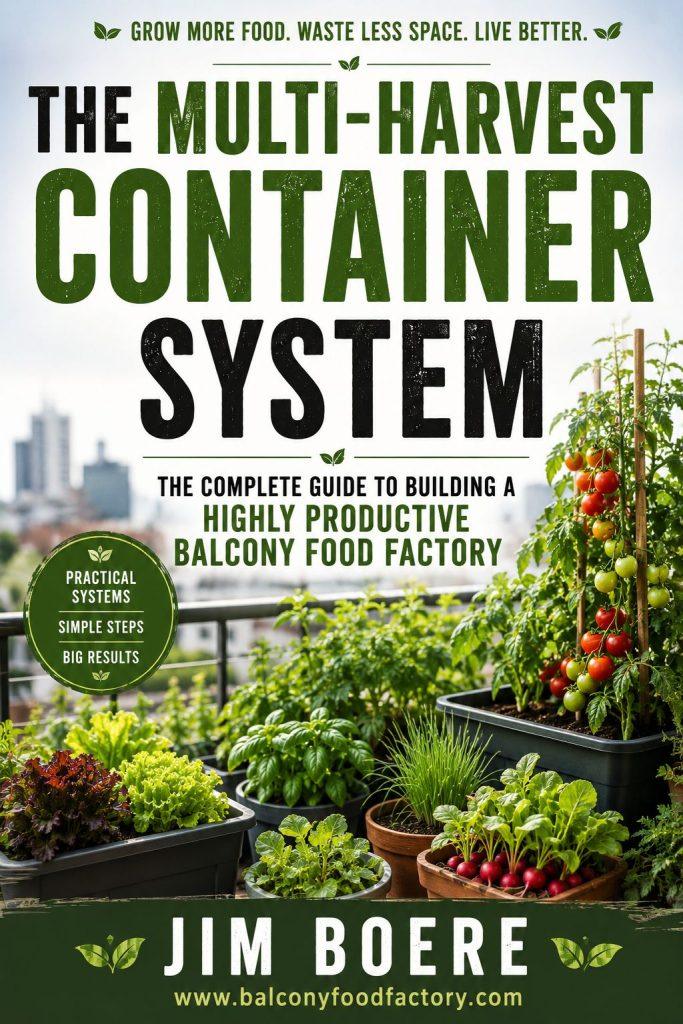
If you want to learn the complete system, my book The Multi-Harvest Container System Starter Guide brings together the principles of succession planting, companion planting, soil management and efficient container growing, along with practical high-yield container setups you can adapt to your own balcony.
Recommended Further Reading
Want to explore this idea further? These articles are a good place to continue:
Stop Thinking In Growing Seasons, Start Thinking In Production Cycles
From A Collection Of Pots To A Food-Producing System
The Tomato Companion Pot: More Than Just A Tomato Plant
About Me
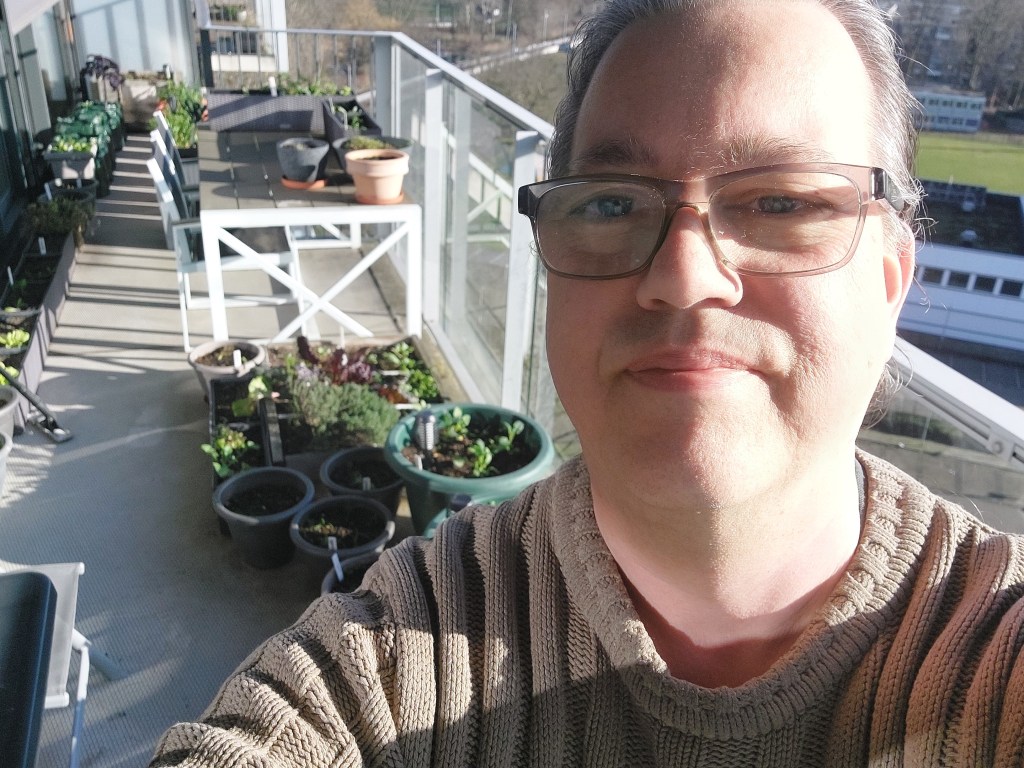
I’m Jim, the gardener behind Balcony Food Factory.
I’ve been growing food for decades, from allotments to my current 10th-floor balcony, where I’ve learned how to grow a surprising amount of food in a surprisingly small space.
Balcony Food Factory is where I share what I’ve learned about growing more food in containers, making the most of limited space, and keeping things practical and manageable.
Want more? Subscribe to the Balcony Food Factory newsletter and I’ll send you practical growing advice, ideas and lessons from my own balcony garden straight to your inbox. You’ll get the below eBook for free too, as a welcome gift. Just click on the image to sign up.
See you there!

A Note About Climate
I garden in Schiedam, the Netherlands, where we have a temperate maritime climate with mild winters, relatively cool to warm summers, and rainfall throughout the year. As a general comparison, my location is approximately USDA Hardiness Zone 8b.
Growing conditions vary considerably between regions, so planting dates, growing seasons, temperatures, and crop recommendations may differ where you live. Please adapt the advice in my articles to your own local climate, weather patterns, and growing conditions.

Leave a Reply