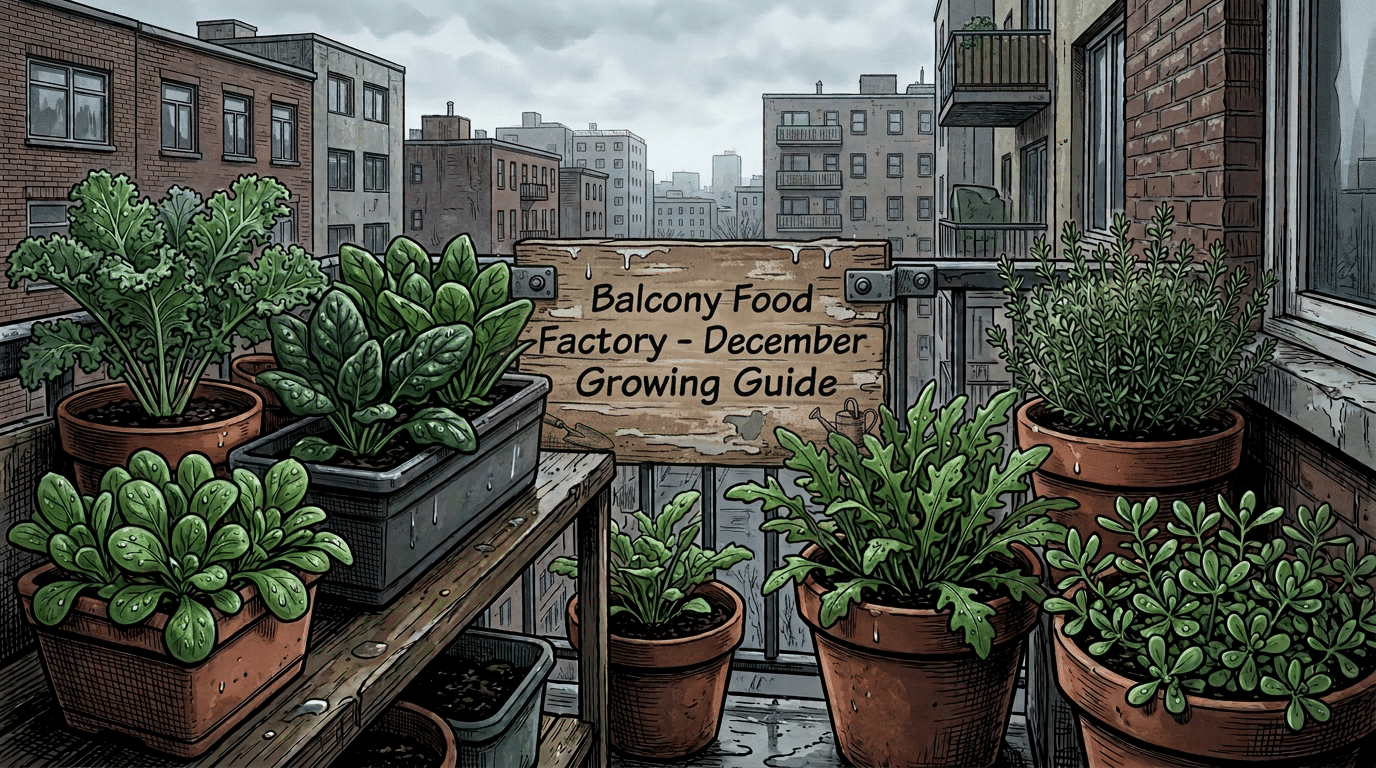
December is a month for maintaining production rather than starting new crops. Short days, low temperatures and cold, wet conditions limit growth, but a productive balcony does not need to become an empty balcony.
December is a relatively slow month in the balcony food garden, sure. But with the Multi-Harvest Container System, it never has to go to zero.
If you planned for it in summer, established winter greens may now continue to provide fresh harvests, and hardy herbs can also remain productive.
Containers can be prepared for the next growing cycle without disturbing crops that are still growing.
The priorities this month are straightforward: protect what is already growing, manage excess moisture, keep containers draining properly, harvest selectively and make sensible preparations for the approaching spring.
December At A Glance


All photos Copyright Jim Boere / balconyfoodfactory.com — Snapshots from my balcony food garden on December 1st and 2nd.
GROWING CONDITIONS
Cold and slow
Very limited daylight and slow crop development.
MAIN PRIORITY
Maintain production
Protect established crops and avoid unnecessary losses.
SOWING
New sowings are better postponed to next year.
HARVESTING
Winter greens
Harvest established crops as they become ready.
Five Priorities For December
- Protect established winter crops. Check lettuce, rocket (arugula), kale, spinach, endive and other greens for cold or wind damage.
- Keep containers draining freely. Winter rain and saturated potting mix are often a greater problem than a lack of water.
- Water selectively. Check the potting mix before watering rather than following a fixed schedule.
- Harvest carefully. Take outer leaves from established plants and leave their growing points intact.
- Prepare containers for spring. Clean up finished crops, refresh potting mix where necessary and check containers for damage.
What To Sow, Plant And Harvest
| Activity | Crops |
|---|---|
| Sow | Generally no outdoor vegetable sowing I can recommend |
| Plant | Garlic cloves and onion sets are normally already planted; replacement winter greens only when established transplants are available and conditions allow |
| Harvest | Kale, spinach, rocket, lettuce, endive, green onions, winter purslane, parsley and hardy herbs |
Things To Watch Out For
- Waterlogged potting mix and blocked drainage holes.
- Strong winds that dry out or damage exposed plants.
- Frost affecting vulnerable leafy crops and herbs.
- Rotting leaves touching wet potting mix.
- Containers cracking or becoming unstable during freezing weather.
- Overwatering plants that are barely growing.
The Most Important Growing Lesson
Winter production is about keeping healthy plants productive, not starting new ones.
A container with established kale or spinach can still provide harvests through winter. Protecting that existing production is usually more worthwhile than attempting to establish a new crop in December.
December Balcony Status And Actions
December and January are generally the quietest months of the growing year. Plants have less energy available for growth, temperatures are low and the weather is often wet and windy.
That does not mean everything stops functioning.
Established winter crops can remain healthy and provide occasional harvests, particularly when they have been given enough time to establish during autumn.
Temperature And Daylight
In the Netherlands, where I live, December has some of the shortest days of the year. Around December 21, daylight reaches its annual minimum.
The KNMI climate normals give December an average temperature of 4.2°C, approximately 83.8 mm of precipitation and 55.5 hours of sunshine.
For us balcony gardeners, this has several consequences:
- Most vegetable crops grow very slowly.
- Newly germinated seeds struggle to develop into substantial plants.
- Established winter crops are generally more valuable than new sowings.
- Wet and cold conditions make root health particularly important.
- Plants exposed to strong winds can suffer even when temperatures remain above freezing.
Do not expect winter greens to produce new leaves at the same rate as they did in September or October. The leaves already on the plants are often the main source of your December harvest.
Moisture And Watering
Watering needs to change considerably during winter.
Plants use less water because growth is slower, temperatures are lower and evaporation is reduced. Rain may supply most of the moisture needed by outdoor containers.
However, a sheltered balcony can create a different situation. Containers positioned close to a building or under an overhang may receive very little rain.
I therefore recommend you:
- Always check the potting mix before watering.
- Water only when the root zone needs moisture, so check below the surface.
- Avoid watering just because the surface looks dry.
- Water earlier in the day when possible.
- Avoid leaving containers sitting in water.
- Check smaller containers more frequently than large ones; they tend to dry out quicker.
A useful habit is to lift smaller pots occasionally. A surprisingly light container may need water even when the weather is cold. Vice versa, when very heavy it might be waterlogged.
The important distinction is between moist and waterlogged. Winter crops still need water, but roots sitting in permanently saturated potting mix are vulnerable to damage.
Wind Exposure
Wind is particularly important on balconies because buildings can create strong gusts and turbulent airflow. I am all too familiar with this, here on the 10th floor.
A balcony on an upper floor may experience much stronger wind than a sheltered garden at ground level.
Check:
- Whether taller kale plants are becoming unstable.
- Whether containers have shifted or become loose.
- Whether exposed leaves are being torn or damaged.
- Whether small pots are drying out despite the low temperatures.
Group smaller containers together in a sheltered position where possible. This also helps reduce exposure around their sides.
Do not overcrowd plants, however. They still need reasonable airflow to reduce the risk of fungal problems.
Drainage
Drainage deserves particular attention in December.
During the summer, saucers underneath pots can help retain water. In winter, they can become a problem because they may remain full for days.
Check every container:
- Make sure drainage holes are not blocked by roots, debris or compacted potting mix.
- Remove saucers that collect rainwater.
- Raise containers slightly on pot feet if water cannot escape freely.
- Make sure water can drain away without creating slippery or icy patches on the balcony.
- Check that containers are not standing in water.
Good drainage protects the roots and helps prevent unnecessary winter losses.
Frost Protection
Not every winter crop needs to be brought indoors when frost is forecast.
Established kale, winter purslane and many hardy leafy crops can tolerate cold conditions. However, plants growing in containers are more exposed than plants growing in the ground because their roots are surrounded by cold air.
Consider protecting plants when a significant frost is forecast.
Practical measures include:
- Moving vulnerable pots against a sheltered wall.
- Grouping containers together.
- Wrapping the outside of vulnerable containers with insulating material.
- Covering particularly exposed crops with horticultural fleece.
- Keeping fleece from pressing heavily against delicate foliage.
Remember that insulation around the container protects roots, while fleece over the plant protects foliage. These are two different jobs.
Pest And Disease Monitoring
Winter does not necessarily eliminate all pests and diseases.
Continue checking the underside of leaves and the centers of plants.
Look for:
- Slugs and snails hiding underneath containers if you are close enough to ground level for them to reach your space.
- Damaged or discolored leaves.
- Rot developing around the base of plants.
- Fungal growth in dense foliage.
- Aphids on sheltered herbs and leafy crops.
Remove badly damaged or rotting leaves, but avoid stripping healthy foliage unnecessarily.
Good airflow and careful watering are generally more important than intensive winter pest treatment.
Fun Fact: Why Kale Tastes Sweeter After Frost
There is an old piece of gardening wisdom that says kale tastes better after it has seen a little frost. And unlike some gardening advice passed down through generations, this one has real science behind it.
But why would a spell of cold weather make a leafy green taste sweeter?
A Natural Winter Survival Trick
When temperatures drop, cold-hardy plants such as kale begin adjusting their chemistry to protect themselves from freezing. One of these changes involves increasing the amount of soluble sugars in their tissues.
These sugars help protect the plant’s cells by making it harder for water to freeze. Think of it as a natural antifreeze system.
The welcome side effect for us gardeners is that the extra sugars can make kale taste noticeably sweeter and help balance some of its natural bitterness. Research has confirmed that cold acclimation can increase soluble sugar levels in kale leaves.
How Much Frost Does It Take?
You don’t need a severe freeze. A light frost, or even a period of consistently cold weather without temperatures dropping below freezing, can begin to influence the plant’s chemistry.
The change isn’t necessarily immediate after a single frosty night. It depends on the variety, the growing conditions, and how long the plant experiences cold temperatures. The best approach is simply to keep harvesting your kale through autumn and let the weather do its work.
Just remember that cold-hardy doesn’t mean indestructible. Prolonged or severe freezing can still damage plants, particularly in exposed containers.
Kale Isn’t the Only Vegetable That Benefits
Several other crops can develop a sweeter flavor as the weather cools. Brussels sprouts are a classic example, while parsnips are famous for developing a sweeter, richer taste after prolonged exposure to cold. Carrots, turnips, and some other root vegetables can benefit too. Leeks and certain leafy greens can also develop improved flavor in cool weather.
So, the next time a chilly night leaves a touch of frost on your kale, don’t rush to harvest the whole plant. Pick a few leaves, give them a taste, and see if you notice the difference.
Sometimes, the best gardening trick is simply knowing when to wait.
What To Sow, Plant And Harvest In December
December is not a month for filling empty containers with new vegetable seeds.
For a temperate climate such as the Netherlands, outdoor sowing of most vegetables is no longer a realistic recommendation. Growth is too slow, and newly emerged seedlings have little opportunity to develop before the coldest part of winter.
This is an important distinction between what might germinate during a mild spell and what is likely to produce a worthwhile crop.
Sowing Table
No recommended outdoor sowing.
| Crop | When And How To Sow | Container Requirements | Expected Result | Qualification |
|---|---|---|---|---|
| Winter purslane | No December sowing. Sow earlier in autumn. | Shallow planter or pot with drainage | Existing plants may continue producing leaves | December sowing is unreliable |
| Spinach | No outdoor sowing | Deep container with fertile potting mix | Harvest established plants | Sowings made in autumn are much more realistic |
| Rocket | No outdoor sowing | Planter or medium-sized pot | Harvest existing plants | Growth is extremely slow |
| Lettuce | No outdoor sowing | Container with sufficient root space | Harvest established winter varieties | Young seedlings are vulnerable to prolonged cold |
| Green onions | No outdoor sowing | Medium-depth planter | Harvest established plants | Better established before winter |
| Kale | No sowing | Large, stable container | Continue harvesting established plants | Plants need to be established well before winter |
What about sowing indoors?
There is little reason to start ordinary vegetable seedlings indoors in December for outdoor balcony production.
Without sufficient natural light, seedlings can become weak and stretched. Starting them too early also creates the problem of keeping them healthy until outdoor conditions improve.
Microgreens are a different matter. They can be grown indoors throughout winter because they are harvested young and do not need to develop into mature vegetable plants.
If you enjoy having something fresh to grow during the winter, a shallow tray of microgreens on a bright windowsill is always a good idea. And great fun as a winter project! More on this in the January Growing Guide.
Planting Table
No outdoor planting recommended.
| Crop | What To Plant | Container Requirements | Important Considerations |
|---|---|---|---|
| Garlic | Normally planted cloves, established in October or November | Deep pot or planter with good drainage | December is late for reliable establishment |
| Onion sets | Normally planted sets, established in autumn | Medium-depth planter | Avoid disturbing established plants |
| Winter lettuce | Only established, healthy transplants if necessary | Well-drained planter | Planting into cold, wet potting mix is risky |
| Parsley | Established potted plants can be relocated into suitable containers | Medium-sized pot | Protect the root ball and avoid disturbing roots unnecessarily |
The best approach is to leave established autumn plantings undisturbed.
Garlic and onion sets should ideally have been planted during October or latest by mid-November. If you missed the opportunity, it is generally better to wait until the next appropriate planting window rather than trying to compensate during December.
Likewise, I would not buy young vegetable plants simply to fill empty containers. A healthy established plant is worth protecting, but a small transplant placed into cold, saturated potting mix may struggle to establish.
Harvest Table
Harvest established crops.
December harvesting is primarily about taking what established plants can provide.
| Crop | What To Look For | Harvesting Advice |
|---|---|---|
| Kale | Firm, healthy outer leaves | Remove individual lower leaves and retain the central growing point |
| Spinach | Fully developed leaves | Harvest outer leaves selectively |
| Rocket | Healthy, sufficiently large leaves | Take individual leaves rather than cutting the whole plant |
| Winter lettuce | Mature outer leaves | Harvest gradually to extend production |
| Endive | Developed leaves or mature heads | Harvest outer leaves or whole plants when ready |
| Green onions | Stems of usable thickness | Pull individual plants as needed |
| Winter purslane | Fresh, tender shoots | Cut small portions, leaving enough plant to recover |
| Parsley | Healthy established stems | Cut outer stems near the base |
| Thyme | Healthy leafy shoots | Take small amounts without cutting deeply into woody growth |
A note about harvesting in winter.
Avoid taking too much from any individual plant.
In summer, many leafy crops can recover quickly after harvesting. In December, recovery is much slower.
For lettuce, spinach and kale, selective harvesting is particularly important. Leave enough healthy foliage for the plant to continue functioning.
Also avoid harvesting frozen leaves. Wait until the foliage has thawed and recovered before picking.
Container Turnover And Production Cycles
One of the central principles of the Multi-Harvest Container System is that each container should remain part of an ongoing production cycle.
However, that does not mean every container needs to be replanted immediately.
In December it means the objective is to keep productive containers growing, prepare genuinely available containers and avoid unnecessary disturbance.
Which Crops May Be Coming To An End?
Some crops may already have finished producing:
- Summer lettuce that was left too long.
- The last of the summer herbs.
- Old rocket plants that have become weak.
- Remaining annual summer vegetables that have stopped producing.
- Plants that have suffered significant frost damage.
Other containers may already be occupied by winter crops that will remain productive for several more months.
Do not clear a healthy container simply because its original crop was planted several months ago.
A kale plant, for example, can remain productive well into winter and beyond. Removing it to make space for something else would sacrifice an established source of food without providing a meaningful replacement.
What To Do With Empty Containers
If a container has become available, inspect it before deciding what to do next.
Step 1: Remove Finished Plants
Remove the old plant and its main root system. Clear away dead leaves and other plant debris.
Healthy roots can be left to break down if they are not interfering with the next planting, but diseased material should be removed.
Step 2: Inspect The Potting Mix
Check its condition.
- Is it still reasonably loose?
- Does water drain through it properly?
- Has the surface become compacted?
- Does it contain a large amount of old, decomposing roots?
- Does it smell healthy rather than sour or rotten?
Do not automatically discard all the potting mix.
Step 3: Refresh Where Necessary
If the potting mix has settled, top it up with fresh material.
If it has become compacted or depleted, incorporate fresh potting mix and mature compost where appropriate.
The amount of refreshing depends on the container’s previous crop, how long it has been growing and the condition of the existing mix.
Step 4: Maintain Fertility
Do not apply a heavy dose of fertilizer simply because a container is empty.
During winter, plants have limited nutrient requirements. Excess fertilizer will not compensate for a lack of light or low temperatures.
Instead, prepare the container so that it is ready for its next crop when the growing conditions become appropriate.
Should You Replant Empty Containers In December?
Usually, no.
There is no benefit in forcing a new crop into a container simply to maintain the appearance of continuous production.
An empty container that has been cleaned, checked and prepared for spring is better than one containing weak seedlings that are unlikely to develop.
This is still part of a production cycle. You are preparing the next stage rather than setting yourself up for failure.
Maintaining Existing Winter Containers
For containers holding established winter crops:
- Remove damaged leaves.
- Check the condition of the potting mix.
- Avoid unnecessary root disturbance.
- Remove weeds and unwanted seedlings.
- Check whether plants need additional support.
- Avoid heavy feeding.
Winter is also a good time to assess which containers have performed particularly well during the year.
In your gardening journal or notebook, record which crops produced several harvests, combinations that worked well and containers that were less productive than expected.
Those observations can help you make better planting decisions next season.
Herbs In December
Herbs can remain one of the most rewarding parts of a winter balcony.
Some continue producing throughout the colder months, while others need protection or should be moved to a more sheltered location.
The important distinction is between hardy herbs and herbs that originate from warmer climates.
Hardy Herbs
| Herb | December Care | Harvesting |
|---|---|---|
| Thyme | Leave outdoors in a well-drained container | Take small sprigs as needed |
| Sage | Keep outdoors in a sheltered, well-drained position | Harvest individual leaves |
| Chives | Plants may die back above ground | Harvest only if healthy growth remains |
| Parsley | Can remain productive during mild weather | Take outer stems gradually |
| Mint | Usually becomes dormant or dies back above ground | Little or no harvest expected |
| Rosemary | Keep outdoors in a sheltered position, protecting the roots during severe frost | Take small sprigs when needed |
| Oregano | Often dies back or becomes dormant | Harvest only if healthy foliage remains |
A word about rosemary.
Rosemary can be hardy in the ground in many temperate locations, but plants in containers are more vulnerable.
Cold affects the roots from all sides, and prolonged wetness can be just as damaging as frost.
Keep rosemary in a well-drained container and avoid excessive watering.
Tender Herbs
Basil is not a reliable outdoor winter herb in the Netherlands.
If you still have a healthy basil plant, move it indoors before cold weather damages it.
Place it somewhere bright and reasonably warm, away from cold drafts.
However, do not expect an established summer basil plant to remain productive indefinitely. Indoor light levels are often insufficient for vigorous growth.
Other tender herbs, such as lemon verbena, should also be protected from frost. Their winter requirements vary, so check the particular plant rather than treating all herbs in the same way.
Watering Herbs In December
Herbs often need less water during winter than during summer, but their requirements differ.
Mediterranean herbs such as thyme, rosemary and sage prefer relatively dry conditions compared with parsley and mint.
The simplest approach is to check each pot individually.
- Do not keep rosemary and thyme permanently wet.
- Avoid letting parsley dry out completely.
- Reduce watering for dormant mint and oregano.
- Make sure water can escape freely from every container.
This is particularly important when several different herbs are growing together. Their watering requirements may not be identical.
Seasonal Preparation And Protection
December is a good time to protect your existing growing investment and make practical preparations for the coming months.
The objective is not to shut down the balcony. It is to make sure that the containers, potting mix and established crops are in good condition when growth starts increasing again.
Protect Container Roots
Roots are often more vulnerable to freezing than the visible parts of a plant.
Unlike plants growing in the ground, container roots have relatively little insulation around them.
For valuable perennial herbs and other plants that will remain outdoors:
- Group containers together.
- Position them against a sheltered wall.
- Raise them slightly off the balcony floor.
- Wrap vulnerable containers with insulating material.
- Avoid covering drainage holes.
Bubble insulation is very useful wrapped around the outside of a pot, preferably with a protective outer layer.
Do not wrap the foliage of evergreen herbs permanently. They still need light and airflow.
Protect Winter Greens
Established winter greens can often remain outdoors without protection during ordinary cold weather.
However, additional protection may help when particularly cold or windy conditions are forecast.
Horticultural fleece is a practical option for:
- Young lettuce plants
- Exposed spinach
- Rocket
- Winter purslane
- Other leafy crops that are less tolerant of severe frost
Secure the fleece properly so that it does not blow away. It’s an easy mistake to make.
Remove or open it when conditions become mild enough to allow good airflow.
A simple protective cover should not become a permanently sealed environment. Condensation and stagnant air can encourage disease.
Check Containers And Supports
Winter weather can expose weaknesses in balcony equipment.
Inspect:
- Cracked plastic and ceramic containers
- Loose plant supports
- Unstable bamboo structures
- Damaged wires, ties and clips
- Raised beds and planter boxes
- Drainage trays and pot feet
Remove climbing supports that are no longer needed and store them safely.
If a container is empty, this is a good time to clean it before storing or preparing it for another crop.
Maintain The Compost System
If you have a compost tumbler or compost bin, continue checking its condition.
Cold temperatures slow decomposition, but they do not necessarily stop it completely.
Add suitable kitchen and garden waste as usual, maintaining a reasonable balance between moist green materials and dry brown materials.
Avoid adding large amounts of wet material at once.
If the compost becomes too wet, add dry shredded cardboard or other appropriate brown material.
You may not produce much finished compost during winter, but maintaining the system means valuable organic material will be available later.
I use a compost tumbler similar to this one (Amazon affiliate link) myself.
It does its composting job very well, but here’s why I particularly like it for use on a balcony:
- It is compact enough to fit on many balconies without sacrificing too much growing space.
- The dual chamber means you can have materials composting in one, whilst collecting fresh materials in the other.
- Both chambers rotate seperate from each other, therefore they do not get too heavy to turn.
If you are considering a composting system for your balcony, a tumbler system like this might be worth looking into.
Note the above and below links are my Amazon affiliate links. Meaning if you click and decide to make a purchase, I earn a small commission. At no extra cost to you of course.
My setup:

Prepare For The Next Growing Season
December is a good month to review your seed collection and growing plans.
- Check which seeds you still have.
- Identify crops that performed particularly well.
- Make a note of containers that will become available.
- Check whether you have enough potting mix and compost.
- Make a preliminary plan for March sowings.
Avoid buying large quantities of seeds simply because they are discounted during winter. Start with the crops you know you want to grow and the space you actually have available.
December Balcony Check-Up
A short inspection once or twice a week is generally enough to identify most winter problems before they become serious.
The following checks are particularly important in December.
Container Condition
- Check that all drainage holes are clear.
- Remove saucers that are collecting rainwater.
- Check whether containers are standing securely.
- Look for cracks caused by freezing conditions.
- Raise containers off cold, wet surfaces where necessary.
Plant Health
- Inspect kale, spinach, lettuce and other winter greens.
- Remove yellowing or rotting leaves.
- Check for slugs and snails.
- Look for signs of fungal disease.
- Check that plants are not being damaged by strong winds.
Watering
- Check the moisture level in individual containers.
- Pay particular attention to sheltered pots.
- Avoid watering already saturated potting mix.
- Water when necessary, preferably earlier in the day.
Frost Protection
- Check the weather forecast for significant frost.
- Protect vulnerable container roots.
- Move tender herbs indoors.
- Secure horticultural fleece where necessary.
- Check that protective materials are not restricting airflow.
General Maintenance
- Remove dead annual plants.
- Clean empty containers.
- Check plant supports and ties.
- Inspect the compost system.
- Make notes about crops that are still producing well.
December Production Planner
December is a maintenance and preparation month. Your production plan should reflect the limited growing opportunities rather than trying to fill every available container, which is not realistic this time of year.
The following planner assumes a typical balcony in the Netherlands or a similar temperate climate (comparable USDA zone would be 8b), with established winter crops from earlier sowings.
December Growing Plan
| Production Activity | What To Do | When |
|---|---|---|
| Sow | No outdoor vegetable sowing | Throughout December |
| Indoor growing | Start a small tray of microgreens if desired | Any time |
| Plant | No outdoor vegetable planting | Throughout December |
| Harvest | Kale, spinach, rocket, lettuce, endive and other established greens | As needed |
| Harvest | Green onions and winter purslane | As needed |
| Harvest | Parsley, thyme and other healthy herbs | As needed |
| Maintain | Check moisture and drainage | Weekly, or more often when conditions require |
| Protect | Insulate vulnerable containers and protect exposed crops | Before forecast frost |
| Prepare | Clean and refresh empty containers | During mild, dry weather |
| Plan | Review seeds and prepare a preliminary spring planting plan | Throughout December |
Which Containers May Become Available?
Your available space depends on what you grew during the previous months.
| Previous Crop | December Situation | Recommended Action |
|---|---|---|
| Summer lettuce | Usually finished | Remove and clean the container |
| Rocket | May still be productive | Keep harvesting if healthy |
| Tomatoes | Long finished | Clean containers and prepare potting mix for spring |
| Cucumbers | Finished | Remove old plants and inspect the container |
| Courgettes (Zucchini) | Finished | Clear the container and prepare it for a future crop |
| Kale | Usually still productive | Keep the plant growing |
| Spinach | May still be productive | Harvest selectively |
| Parsley | May remain productive | Keep harvesting gradually |
A Practical Example
Imagine you have three containers available after removing your summer crops.
Rather than immediately planting something new, divide the work:
- Container 1: Remove old roots and clean the container. Check the potting mix and prepare it for spring.
- Container 2: Add fresh potting mix where necessary and check drainage. Leave it ready for its next crop.
- Container 3: If the potting mix is still in good condition, protect it from excessive rain and keep it ready for replanting.
Meanwhile, your winter greens and herbs continue producing in their existing containers.
This approach keeps the balcony organized without wasting seeds, fertilizer or time on crops that are unlikely to establish successfully anyway.
What Needs Your Attention Most?
If you have limited time, prioritize these five tasks:
- Check the moisture level of your winter containers.
- Make sure excess water can drain away.
- Protect vulnerable plants before severe frost.
- Harvest established crops without removing too much foliage.
- Prepare empty containers for the next growing season.
December Checklist
Use this shorter checklist as your December reference.
- Inspect all containers for drainage problems.
- Remove saucers.
- Check winter greens for damage and disease.
- Harvest established vegetables selectively.
- Protect vulnerable herbs and container roots.
- Move tender herbs indoors.
- Remove finished summer crops.
- Clean and prepare empty containers.
- Check the condition of potting mix.
- Inspect plant supports and balcony equipment.
- Review seeds and make a preliminary spring growing plan.
December’s Main Lesson
A productive balcony in my opinion does not need to produce new growth every month. It needs to make the most of the growing opportunities available.
This is particularly important during winter.
To measure productivity by how many seeds are sown or how many new plants are added would be a mistake.
A container holding healthy kale, spinach or parsley that continues to provide occasional harvests is already doing its job.
The same can be true for containers that are temporarily empty.
Cleaning them, maintaining their potting mix and preparing them for the next crop is part of a continuous production system also.
The objective is not to keep every container occupied regardless of the conditions. It is to avoid wasting productive opportunities when they genuinely exist.
I’ve learned that distinction makes winter growing considerably easier and much more sustainable.
Looking Ahead To January
January will bring another month of limited daylight and generally slow outdoor growth.
And that’s fine. There is no need to rush into the new growing season.
However, there are a few things worth thinking about.
Continue Protecting Winter Crops
Your established winter greens should remain the main source of fresh balcony vegetables.
Continue harvesting selectively and maintaining good drainage.
Review Your Growing Plan
January is a good time to make more detailed decisions about the coming season.
Think about:
- Which crops you want to grow again.
- Which containers will be available.
- Whether you want to introduce new crop combinations.
- Which crops should follow your earliest spring harvests.
- How to avoid leaving containers empty between successive crops.
Prepare For February And March
February is still generally too early for most outdoor sowing in a temperate climate, but I do sow my first batches of broad beans and peas. That always gets me excited. Also, in February we can start chtting some early variety potatoes. I look forward to it!
March is when indoor sowing starts becoming worthwhile for many summer crops.
Use January to check your supplies and prepare your containers, rather than starting seeds prematurely.
Keep The Balcony Active
Even when little is growing, there is plenty you can do to maintain the production system.
Keep established plants healthy, protect your potting mix and make sure everything is ready for the first meaningful growing opportunities of spring.
The main growing objective for December: Protect established winter crops, manage moisture carefully and prepare your containers for the next production cycle without sacrificing the harvests you already have.
Happy growing on the balcony!
Jim
If you want to learn the complete system, my book The Multi-Harvest Container System Starter Guide brings together the principles of succession planting, companion planting, soil management and efficient container growing, along with practical high-yield container setups you can adapt to your own balcony.
Recommended Further Reading
- You can find all my monthly growing guides HERE.
- The Balcony Gardening Mistakes I Would Avoid Now
- The Balcony Is Your Teacher: Grow, Observe, Adjust
About Me
I’m Jim, the gardener behind Balcony Food Factory.
I’ve been growing food for decades, from allotments to my current 10th-floor balcony, where I’ve learned how to grow a surprising amount of food in a surprisingly small space.
Balcony Food Factory is where I share what I’ve learned about growing more food in containers, making the most of limited space, and keeping things practical and manageable.
Want more? Subscribe to the Balcony Food Factory newsletter and I’ll send you practical growing advice, ideas and lessons from my own balcony garden straight to your inbox. You’ll get the below eBook for free too, as a welcome gift. Just click on the image to sign up.
See you there!



Leave a Reply