When you start growing food, there is a lot to learn.
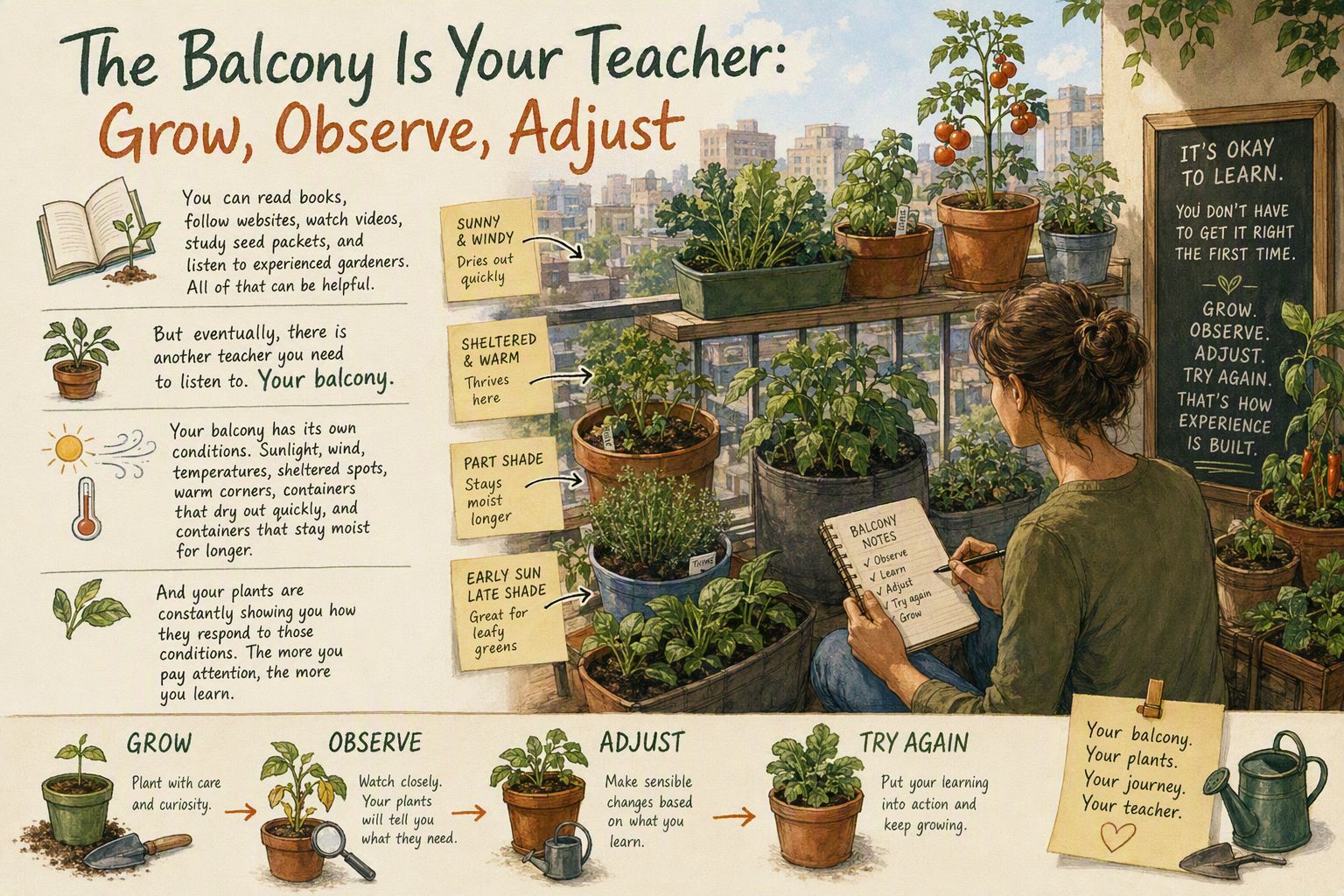
You can read books, follow gardening websites, watch videos, study seed packets, and listen to experienced gardeners.
All of that can be helpful.
But eventually, there is another teacher you need to listen to.
Your balcony.
Because your balcony has its own conditions. Your balcony is unique.
It has its own amount of sunlight. Its own wind exposure. Its own temperatures, sheltered spots, warm corners, containers that dry out quickly, and containers that stay moist for longer.
And your plants are constantly showing you how they respond to those conditions.
The more you pay attention, the more you learn.
You don’t have to get everything right the first time. In fact, you probably won’t.
How could you?
The important thing is to grow, observe what happens, make sensible adjustments, and then try again.
That is how experience is built.
Your Balcony Is Not A Textbook
Gardening advice often comes in the form of rules.
Plant this here.
Water this often.
Put that crop in full sun.
Sow this in this month.
Feed that plant every few weeks.
Some of these recommendations are good starting points. Absolutely.
But they are still general recommendations.
Your balcony isn’t general.
It is your balcony.
Two people can live in the same town and have completely different growing conditions.
One balcony may receive sunshine for most of the day. Another may be shaded by surrounding buildings.
One may be relatively sheltered. Another may be exposed to strong winds, like mine is.
One may have containers that dry out quickly. Another may have containers that stay damp for much longer.
Even different parts of the same balcony can behave differently.
I know they do here in my garden on the 10th floor.
This is why I think gardening advice works best when you treat it as a starting point rather than a set of instructions that must always be followed exactly.
Learn the general principles.
Then look at what actually happens in your own growing space.
Your balcony can teach you things that no generic gardening guide can.
Start By Paying Attention
One of the simplest gardening skills is also one of the easiest to overlook.
Pay attention.
You don’t need to spend hours studying your plants every day.
Just look.
What is growing well?
What isn’t?
Which containers dry out quickly?
Which plants seem particularly happy?
Where does the sun reach in the morning?
Where does it reach in the afternoon?
Which areas are exposed to wind?
Which crops seem to struggle when conditions change?
These observations gradually build a picture of your growing space.
And the more you notice, the easier it becomes to make good decisions.
This is particularly helpful for beginner gardeners because it takes some of the pressure away from having to know everything immediately.
You don’t need to diagnose every problem perfectly. You can’t.
You can simply notice that something is different.
Then you can investigate.
Perhaps a plant is wilting more often than expected.
Perhaps one container seems to dry out much faster than another.
Perhaps two identical plants are growing at noticeably different speeds.
Those differences are information.
Pay attention to them.
Learn What Your Balcony Does
Your balcony has a microclimate.
You don’t need to become a meteorologist to understand it.
You simply need to notice its patterns.
Maybe one corner gets the first sunlight of the morning while another remains shaded until later.
Maybe a wall absorbs heat during sunny weather and creates a warmer spot.
Maybe the outer edge of the balcony is much windier than the area closer to the building.
Maybe one location is ideal for a particular crop in spring but becomes too exposed during summer.
These things become much easier to understand once you’ve been growing there for a while.
And they can change how you use your space.
Instead of treating every part of the balcony as identical, you can start matching crops to locations.
A crop that likes more sun can go into that sunnier position.
Something that benefits from a little protection can be placed somewhere more sheltered.
A container that dries quickly can be monitored more closely.
You are no longer simply placing plants wherever there happens to be space.
You are beginning to work with your balcony rather than against it.
That is an important step towards becoming a more effective container gardener.
Your Plants Are Giving You Information

Plants don’t speak, but they do communicate.
Their growth, colour, size, shape, and general appearance can all give you clues about how they are responding to their environment.
A plant that isn’t growing as expected may be telling you that something isn’t quite right.
But that doesn’t automatically mean you have done something wrong.
There can be many possible reasons.
It could be the plant isn’t getting enough light.
It could be it is too wet or too dry.
It could be the temperature isn’t right.
It could be the container is too small.
Maybe the timing was wrong.
Maybe the plant simply isn’t particularly happy in that location.
The important thing is to resist the temptation to immediately panic or start changing everything.
Instead, ask a simple question:
What is this plant telling me?
That question changes the way you approach problems.
You stop seeing every imperfect plant as a failure.
You start seeing it as information.
And not every change needs a response.
Plants aren’t machines. Growth isn’t perfectly uniform.
Leaves can look different from one week to the next, and weather can affect plants in ways that are completely normal.
Observation means learning to distinguish between normal variation and something that actually needs attention.
That comes with experience.
Watering Is Something You Learn
Watering is a good example of why your balcony can teach you more than a fixed schedule.
You will often hear advice about how often to water plants.
But there isn’t one watering schedule that works perfectly for every container.
The need for water depends on many things.
The size of the container.
The potting mix.
The crop.
The weather.
Sunlight.
Wind.
And the time of year.
A container exposed to strong summer sunshine and wind can dry out much faster than a larger container sitting in a sheltered position.
So rather than automatically watering because it is Tuesday or because somebody said plants should be watered every two days, learn to check what is actually happening.
Stick a finger into the soil..
Look at the plants.
Consider the weather.
Notice how quickly that particular container dries out.
After a while, you start to develop a feel for it.
You know which containers need more attention and which ones can go longer.
Watering becomes less of a chore governed by a rigid schedule and more of an informed decision.
That is experience.
Sunlight Is More Than A Number
Sunlight is another area where real-world observation matters.
You will often see crops described as needing “full sun” or “partial shade.”
Those descriptions are helpful.
But they don’t tell you exactly what your balcony looks like.
A balcony can receive sunlight for several hours without every part of it receiving the same amount.
The angle of the sun changes throughout the day.
It changes throughout the year.
Buildings and neighbouring structures can create shadows.
Railings, walls, screens, and even your own containers can affect light.
A location that is sunny in June may be much more shaded in March.
A spot that seems unsuitable for one crop may work surprisingly well for another.
This is why it is worth observing your balcony throughout the seasons.
Simply notice where the sun actually reaches.
Over time, you’ll develop a much better understanding of what “full sun” means on your balcony.
And that knowledge is far more useful than simply knowing a number of hours from a general gardening guide.
Wind And Weather Matter Too
Growing food on a balcony comes with one particular challenge that our gardening friends at ground level may experience differently.
You are exposed.
Depending on the height, position, and design of your balcony, wind can become a significant factor.
Wind can dry containers more quickly.
It can stress plants.
It can damage leaves and snap stems.
And strong weather can make conditions change surprisingly quickly.
This is another reason why observation matters.
You might discover that one area of your balcony is much more protected than another.
You might notice that certain plants cope well with exposure while others struggle.
You might find that a container needs more frequent attention during a period of hot, windy weather.
The answer isn’t always to fight the weather.
Sometimes the better approach is to work with it.
Use more sheltered locations for crops that need protection.
Pay closer attention to containers that dry quickly.
Adjust your expectations when the weather changes.
And most importantly, don’t assume that what happened last week will necessarily happen this week.
Weather is part of the growing environment.
Your job isn’t to control it. You can’t.
It is to understand how your space responds to it.
Don’t Change Everything At Once
When something goes wrong, it can be tempting to start changing everything.
Move the plant.
Give it more water.
Add fertilizer.
Change the potting mix.
Move it again.
Perhaps buy another product to solve the problem.
The trouble is that you then have no idea what actually made a difference.
This is particularly common when you’re starting out.
You want to help the plant, so you try everything.
But sometimes the better approach is much simpler.
Make one sensible adjustment.
Then observe.
If you think a plant isn’t getting enough light, try moving it to a brighter position and see what happens.
If a container is drying out too quickly, look at why that might be happening and adjust accordingly.
If you suspect you are watering too often, pay closer attention to the potting mix before changing anything else. Check below the surface with your finger and if it still feels moist; don’t water today, check again tomorrow.
Small experiments can teach you a great deal.
They also prevent gardening from becoming unnecessarily complicated.
You don’t need to solve every problem immediately.
Sometimes you simply need to make a reasonable adjustment and give the plant time to respond.
Keep A Simple Record Of What You Learn
I do recommend you keep a detailed gardening journal.
But a few notes can already be surprisingly helpful.
Write down what you grew.
Note where you grew it.
Record when you sowed or planted it.
Make a note of whether it performed well.
When you could start harvesting.
When the plant was at the end of its productive life.
And perhaps write down what you would do differently next time.
You can also take photographs.
A photograph of your balcony in spring can be useful when you’re planning the following spring.
A photograph of a particularly successful crop can remind you where it was growing and how it looked.
You may think you’ll remember all of this.
Sometimes you will.
But after several seasons, the details start to blur.
A few simple notes turn your own experience into a personal reference library.
And unlike general gardening advice, this information is specifically relevant to you.
It tells you what happened on your balcony.
Over time, that can become incredibly valuable.
Let Experience Improve Your System
The longer you grow, the more decisions become easier.
You start to know which crops thrive in your space.
You know which containers dry quickly.
You know which areas receive the most sunlight.
You know where the wind causes problems.
You know which crops you enjoy growing and which ones aren’t worth the space they require for you.
You also become better at anticipating what is likely to happen.
That is one of the biggest benefits of experience.
You don’t simply react to problems.
You begin to prevent them.
This is particularly important when you start thinking in terms of a Multi-Harvest Container System.
The system isn’t just about knowing which crop can follow which.
It is also about making good decisions based on the conditions you actually have.
When you know how your balcony behaves, you can make better choices about where to place containers, what to grow, when to make changes, and how to use your limited space.
The system becomes more efficient because your decisions are informed by experience.
And that experience doesn’t have to come from decades of gardening.
You start building it with your very first container.
Grow, Observe, Adjust
Gardening isn’t an exam.
You don’t pass or fail because one crop didn’t work.
You grow something.
You observe what happens.
You learn something.
Then you make an adjustment.
And you try again.
Sometimes the adjustment works.
Sometimes it doesn’t.
Both outcomes can teach you something.
Perhaps a crop wasn’t suited to that location.
Perhaps you planted too early, or too late.
Perhaps the container dried out too quickly, or stayed too wet.
Perhaps the weather simply wasn’t kind.
The important thing is that you don’t have to repeat the same mistake indefinitely.
You can learn from it.
This is why I think one of the most useful gardening habits you can develop is simply paying attention.
Not worrying.
Not constantly interfering.
Not trying to make everything perfect.
Just paying attention.
Your balcony is giving you information all the time.
The plants are giving you information.
The weather is giving you information.
The containers are giving you information.
The more you learn to notice, the better your decisions become.
And gradually, something interesting happens.
You stop needing to follow every piece of advice as a fixed rule.
You have developed your own experience.
You know your growing space.
You understand its strengths and limitations.
You know what has worked before.
You have a better idea of what is likely to work next.
That is how a gardener develops.
Not by knowing everything before starting.
But by growing, observing, adjusting, and growing again.
Your balcony isn’t just the place where your food grows.
It is where you learn how to grow it.
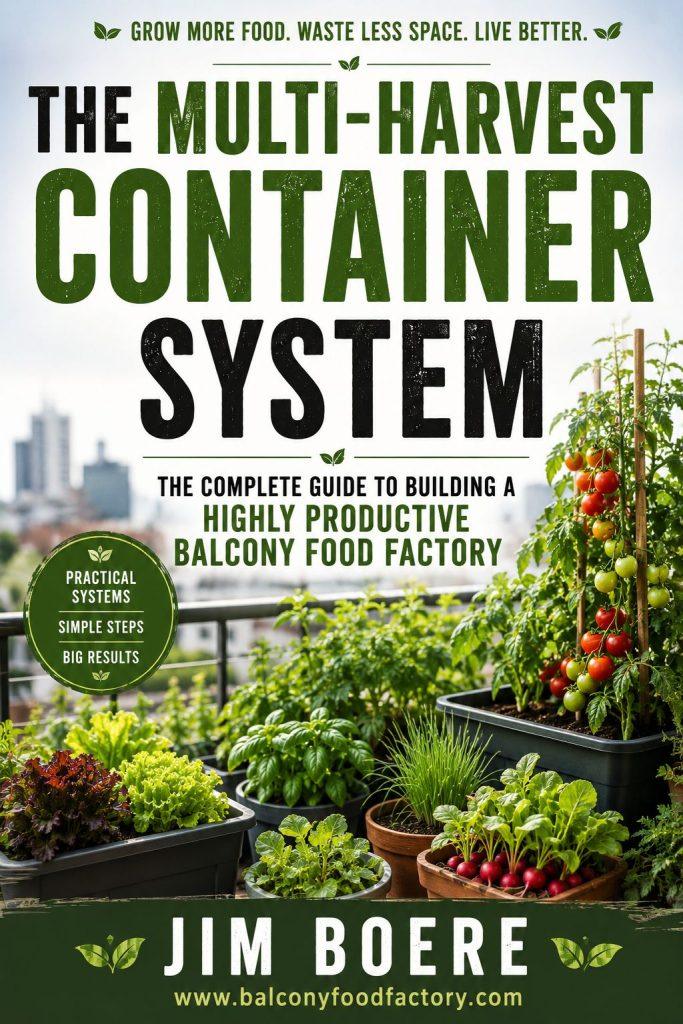
If you want to learn the complete system, my book The Multi-Harvest Container System Starter Guide brings together the principles of succession planting, companion planting, soil management and efficient container growing, along with practical high-yield container setups you can adapt to your own balcony.
Recommended Further Reading
If you found this article helpful, these ones are good places to continue:
Build A Salad Bowl Container That Keeps Producing
One Pot, Multiple Harvests: The Idea Behind The Multi-Harvest Container System
You Don’t Need a Garden to Grow Your Own Food
About Me
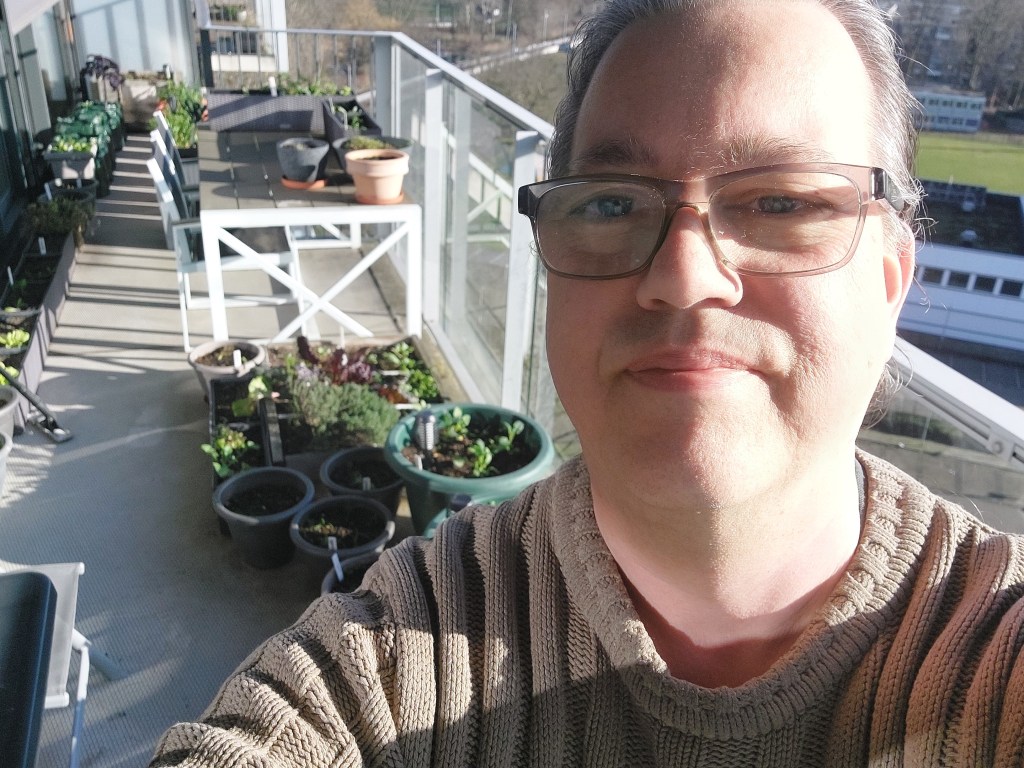
I’m Jim, the gardener behind Balcony Food Factory.
I’ve been growing food for decades, from allotments to my current 10th-floor balcony, where I’ve learned how to grow a surprising amount of food in a surprisingly small space.
Balcony Food Factory is where I share what I’ve learned about growing more food in containers, making the most of limited space, and keeping things practical and manageable.
Want more? Subscribe to the Balcony Food Factory newsletter and I’ll send you practical growing advice, ideas and lessons from my own balcony garden straight to your inbox. You’ll get the below eBook for free too, as a welcome gift. Just click on the image to sign up.
See you there!

A Note About Climate
I garden in Schiedam, the Netherlands, where we have a temperate maritime climate with mild winters, relatively cool to warm summers, and rainfall throughout the year. As a general comparison, my location is approximately USDA Hardiness Zone 8b.
Growing conditions vary considerably between regions, so planting dates, growing seasons, temperatures, and crop recommendations may differ where you live. Please adapt the advice in my articles to your own local climate, weather patterns, and growing conditions.

Leave a Reply