When people talk about growing their own food, there is usually an assumption hiding in the background.
You need a garden.
A piece of ground.
Somewhere to dig, plant rows of vegetables, and let things grow.
If you don’t have that, perhaps you can put a few pots on your balcony or grow some herbs on a windowsill. But that isn’t really the same thing.
Well, I disagree.
You don’t need a traditional garden to grow your own food.
You need somewhere suitable to grow it.
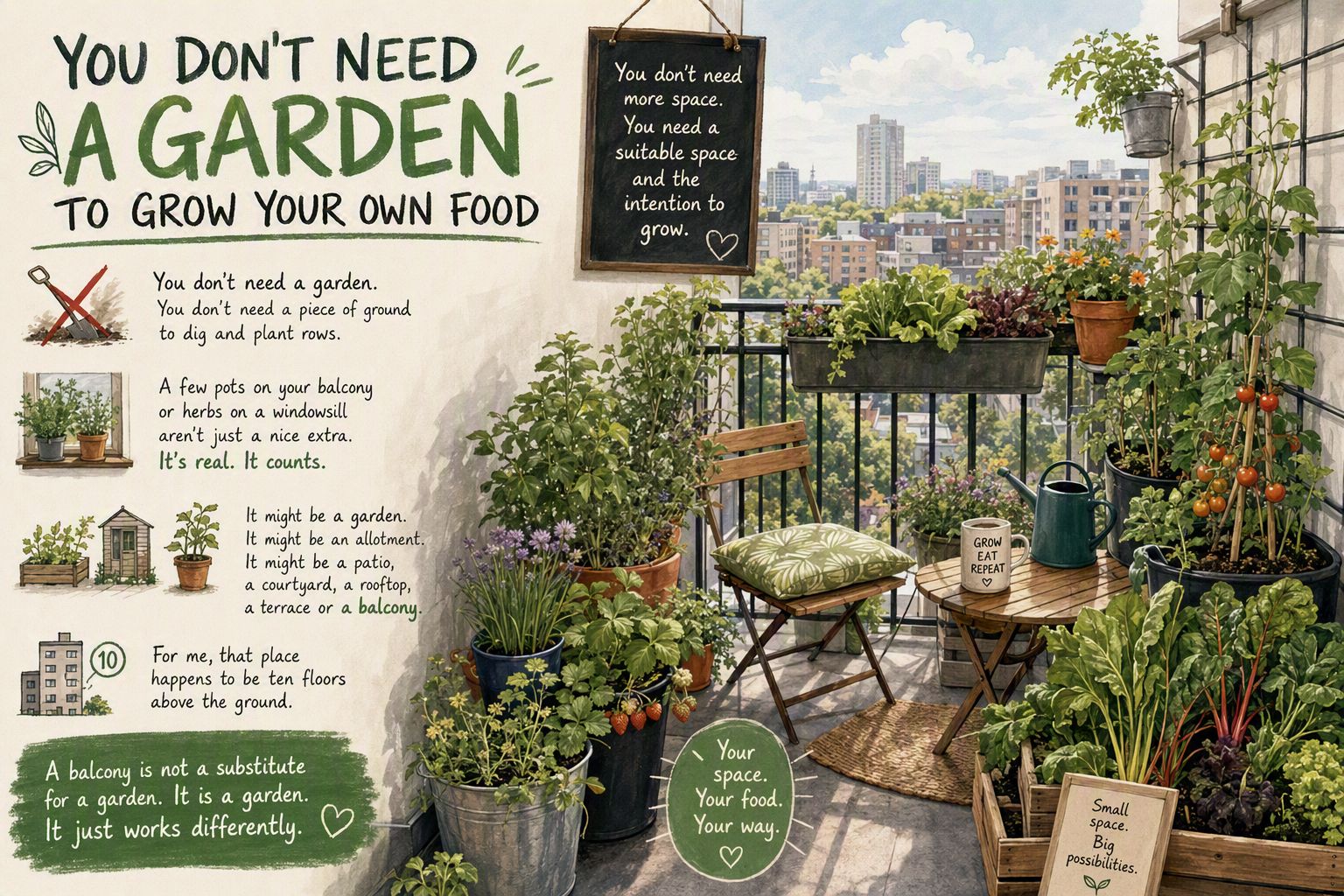
That might be a garden. It might be an allotment. It might also be a patio, a courtyard, a rooftop, a terrace or a balcony.
For me, that place happens to be ten floors above the ground.
And after years of growing food there, I’ve stopped thinking of a balcony as a substitute for a garden.
It is a garden.
It just works differently.
I Had To Rethink What A Garden Meant
I didn’t start out as a balcony gardener.
I’ve been growing food for decades, including on allotments where I had the kind of growing space most people would recognise immediately as a vegetable garden.
Then, in 2011, I moved into an apartment on the tenth floor.
If I wanted to continue growing food, digging a traditional vegetable bed was no longer an option.
So I started growing in containers.
At first, the obvious thing was to think of this as a compromise. And honestly; it did feel like that for a while.
I no longer had a garden, so I would have to make do with pots.
But over time, that way of thinking felt more and more wrong.
The more I grew, the more I realised that I wasn’t simply trying to recreate an allotment in miniature.
I was learning how to grow food in a completely different environment.
And that environment had its own possibilities.
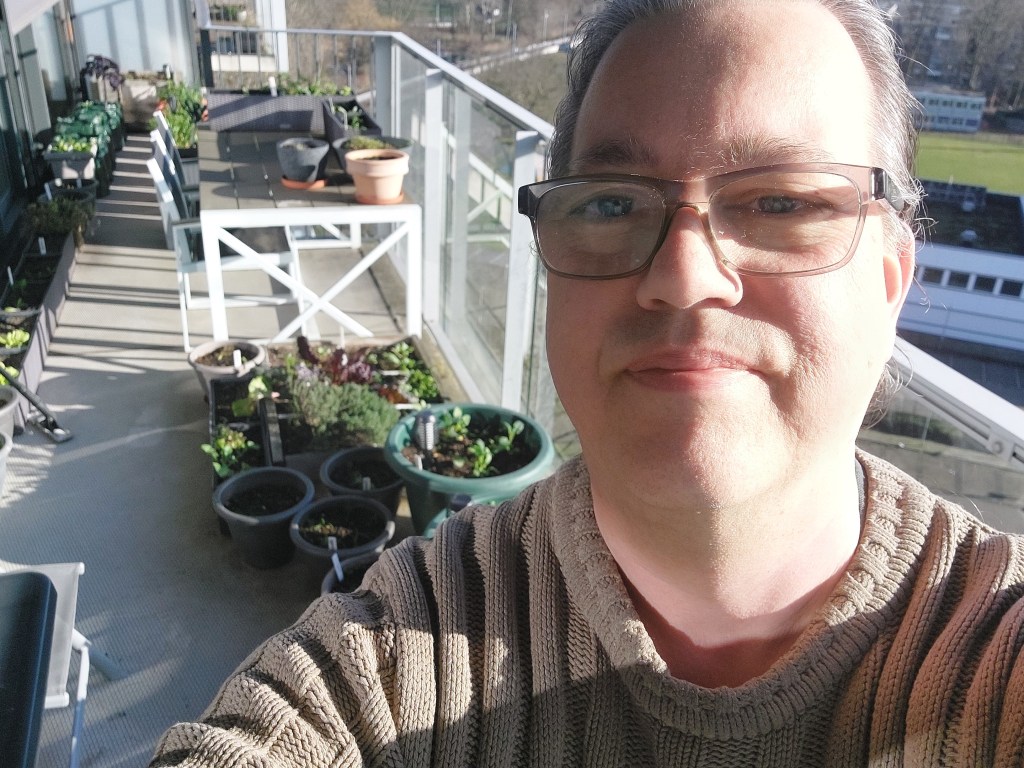
My balcony is about 18 square metres.
Not small for a balcony, certainly. It isn’t a large growing area by traditional gardening standards.
But over the years I’ve grown lettuce, rocket (arugula), spinach, tomatoes, cucumbers, beans, beetroot, eggplant (aubergine), onions, garlic, potatoes, pumpkins, green onions, herbs, strawberries and plenty of other crops in containers.
At some point, I stopped asking myself if I should call it a garden.
It obviously was.
It was simply my garden.
A Garden Isn’t Defined By Being In The Ground

Think about what a vegetable plant actually needs.
It needs suitable growing conditions.
It needs light.
It needs water.
It needs nutrients.
It needs somewhere to put roots down.
It needs appropriate temperatures and protection from whatever environmental conditions might cause problems.
And, of course, it needs someone to look after it.
None of those requirements says that the plant’s roots have to be in the ground.
A container can provide a growing environment too.
That doesn’t mean containers are identical to garden soil.
They aren’t.
Container gardening comes with its own challenges, and those challenges need to be understood. Limitations too, for sure.
But that is different from saying that growing food in containers isn’t “real” gardening.
It is.
The plants don’t care whether you call it a garden.
They care whether you give them what they need.
Containers Change The Equation
Growing in containers does require a different approach.
The amount of soil available to a plant is limited.
Containers can dry out more quickly than ground soil.
They depend more heavily on the gardener for water and nutrients.
The potting mix can become depleted after repeated cropping.
Containers can also be exposed to heat, cold and wind in ways that plants growing in the ground may experience differently.
Those are real limitations.
But containers also give you an enormous amount of control.
You can decide exactly where a crop grows.
You can choose the size and depth of the container.
You can group plants according to their needs.
You can move or reorganise some containers when conditions change.
You can use vertical space.
And perhaps most importantly for the way I garden, you can use the same container for different crops at different times.
That last point is particularly important.
A container doesn’t have to be assigned permanently to one crop.
The Same Space Can Produce More Than Once
Imagine you have a container that produces lettuce in spring.
You harvest the lettuce.
What happens next?
In a conventional way of thinking, the lettuce is finished and perhaps the container becomes part of the summer garden.
But there is another possibility.
Refresh the potting mix.
Plant something else.
Harvest that crop.
Then do it again.
The physical space hasn’t increased.
You haven’t added another square metre of growing area.
You’ve simply used the same space more than once.
This is one of the foundations of what I now call my Multi-Harvest Container System.
I don’t look at a container and ask only what it can grow.
I also ask what it can grow next.
That changes the potential of a small growing space considerably.
You Don’t Need A Huge Amount Of Space
There is another misconception I believe is worth challenging.
Some people think that growing your own food means producing a substantial percentage of everything you eat.
If that’s the definition, almost any small-space gardener is going to feel like a failure.
I don’t think that’s a useful definition.
Growing your own food can mean growing some of your food.
A few containers can provide regular salad.
A herb pot can provide fresh herbs for months.
A tomato plant can produce a substantial summer harvest.
Fast-growing crops can provide repeated smaller harvests.
Other crops can take their place when those crops finish.
You don’t have to grow everything.
You just need to grow something that matters to you.
And those smaller harvests do add up.
Grow What Gives You The Most Value
Limited space makes this especially important.
If you only have a handful of containers, every container is using valuable resources.
It occupies space.
It uses water.
It needs soil and nutrients.
It needs your attention.
So why grow something simply because you can?
Why grow something because some ‘Youtuber’ claims you’d be ‘crazy not to grow this’?
No.
Instead, think about what you actually eat. Grow that.
If you regularly eat salads, lettuce and rocket may be useful crops.
If you frequently cook with fresh herbs, herbs can earn their space very quickly.
If you enjoy tomatoes throughout the summer, tomatoes may deserve one or more valuable containers.
If you use green onions regularly, they can be a very useful addition to a small food garden.
This is one of the ideas I want to emphasise throughout Balcony Food Factory:
The best crop isn’t necessarily the crop that produces the most. It is often the crop that provides the most value to you.
Your balcony doesn’t need to grow everything.
It needs to grow things you will actually use.
Your Balcony Itself Is Part Of Your Garden
Once you stop thinking of the garden as “the ground,” you start noticing everything else that matters.
Your balcony has its own environment.
There may be parts that receive more sunlight.
There may be areas protected from wind.
Some sections may heat up more quickly.
Some containers may be easier to access than others.
The wall behind your plants may affect temperature.
The railing may provide somewhere for climbing or vertical growth.
The position of a container can make a difference.
These are your balcony’s microclimates.
And learning to use them is part of becoming a good balcony gardener.
This is one reason I don’t believe there is a single perfect balcony gardening setup.
A south-facing tenth-floor balcony in my part of the Netherlands is going to behave differently from a shaded balcony somewhere else.
The principles remain valid.
The exact implementation has to change.
Container Gardening Isn’t About Cramming Plants Everywhere
Once people hear that a balcony can produce more food than they expect, there is an obvious temptation.
Add more pots.
Then more.
And then a few more.
Before long, you’ve created a crowded collection of containers that is difficult to water, difficult to harvest and difficult to maintain.
More containers don’t automatically mean more food.
Sometimes they simply mean more work.
The goal should be to use the space you have intelligently.
That might mean:
- using vertical space;
- combining suitable crops;
- choosing productive crops;
- reusing containers throughout the year;
- planning the next crop before the current one is finished;
- keeping your soil productive;
- making sure containers remain accessible.
The aim isn’t to turn your balcony into a jungle.
It is to make it productive.
A Collection Of Pots Isn’t Automatically A Food Garden
This distinction is important.
You can have ten containers and ten plants and still be growing in a very disconnected way.
Each pot has its own crop.
Each crop has its own harvest.
When it finishes, the container sits empty until you decide what to do next.
There is nothing wrong with gardening that way.
But there is another possibility.
Your containers can work together.
One container may be producing a fast crop while another is producing something that takes longer.
One container may be ready for harvesting while another is being planted.
One crop finishes and creates an opportunity for another crop.
The balcony becomes a collection of connected production cycles rather than a collection of individual plants.
That’s an important distinction.
This is how I manage to grow food and harvest food all year long.
Start Thinking About Production
This is where the idea of a Balcony Food Factory really begins.
A conventional way of looking at your garden might focus on what you have.
How many pots?
How many plants?
How many varieties?
How many different vegetables?
But if your objective is to grow food, another question is more helpful:
What is the balcony actually producing?
That changes the way you make decisions.
A container that produces a handful of herbs every week may be way more valuable to you than a container occupied for months by a crop that gives you one small harvest.
A container that produces lettuce in spring and another crop later in the year is doing more work than a container that sits empty for months.
A container that supports several compatible crops can make better use of the available space than one containing a single plant with lots of unused room around it.
This is not about squeezing every possible plant into every possible container.
It is about making deliberate choices.
You Don’t Have To Grow Everything Yourself
I think this is worth saying clearly because the phrase “grow your own food” can create unrealistic expectations.
You don’t have to become completely self-sufficient.
You don’t have to grow your own wheat.
You don’t have to produce all your potatoes.
You don’t have to replace every supermarket trip.
And you certainly don’t have to grow every vegetable you eat.
Your balcony can simply become one source of food.
Maybe it supplies your salad.
Maybe it provides fresh herbs.
Maybe it gives you tomatoes throughout the summer.
Maybe it produces greens during parts of the year when you would otherwise buy them.
Maybe it supplies something small but useful several times a week.
That is still growing your own food.
And there is something very satisfying about being able to walk outside, harvest what you need and bring it straight into the kitchen. I love it!
The Limitations Are Real
I don’t want to pretend that balcony gardening solves every problem.
It doesn’t.
Your balcony may have very little sunlight.
It may be extremely windy.
You may have limited space.
Watering may be inconvenient.
There may be restrictions on what you can attach to walls or railings.
There may be building regulations and weight limits that you need to consider before adding large numbers of containers.
These things matter.
They should be considered before you start filling your balcony with soil and pots.
But limitations aren’t the same as impossibility.
They simply define the system you can build.
So yes, a shaded balcony will require different crop choices from a sunny one.
A very exposed balcony may need a different approach from a sheltered courtyard.
A tiny balcony may need more careful prioritisation than a larger one.
That’s all perfectly normal.
You can still grow food in any of these conditions.
There is no single ideal food garden.
There is only the growing space you have and the system you build around it.
What Makes A Balcony Garden Successful?
You don’t need an enormous list of equipment or a complicated setup.
But you do need to pay attention to a few fundamentals.
Choose Crops That Suit Your Conditions
Not every crop will thrive on every balcony.
Work with your available sunlight, climate and exposure rather than fighting them.
Give Your Plants A Good Growing Environment
Container plants are dependent on the soil or potting mix you provide.
Good-quality growing media, organic matter and appropriate feeding are important.
Use Your Space Deliberately
Think beyond the footprint of the container.
Consider vertical space, combinations of crops and the different growing conditions across your balcony.
Think Beyond One Harvest
When a crop finishes, don’t automatically consider that container finished too.
Ask what could follow it.
Pay Attention To Your Soil
Repeated cropping places demands on container soil.
A productive container needs to be maintained rather than treated as a disposable potting mix.
Learn Your Balcony
The longer you grow, the more you will understand where your balcony is sunny, windy, warm, sheltered or difficult.
That knowledge is valuable.
Your balcony itself becomes one of your most useful gardening tools.
The Garden Is Wherever You Grow The Food
At some point, I realised I was asking the wrong question.
I had spent years thinking about whether I still had a garden.
I did.
It just wasn’t a garden in the traditional sense.
It was a collection of containers on a balcony.
But those containers held soil.
The soil grew plants.
The plants produced food.
I harvested that food and brought it into my kitchen.
What else would you call it?
A garden doesn’t become a garden because it has a lawn around it.
It becomes a garden because you deliberately use the space to grow things.
And if you deliberately use that space to grow food, then you have a food garden.
They way I see it, it really is that simple.
From Balcony Garden To Balcony Food Factory
Once you accept that your balcony can be your garden, the next question becomes much more interesting.
How do you make the most of it?
That’s where my approach to balcony food production starts to differ from simply putting vegetables into pots.
I want the containers to work together.
I want to use the same space more than once.
I want to think about what happens before and after each crop.
I want to use companion planting where it makes sense.
I want to maintain the soil rather than constantly replace it.
And I want to increase production without automatically increasing the amount of work.
Those ideas eventually came together into what I call the Multi-Harvest Container System.
The system is built around a simple idea:
Don’t just grow plants. Build a system that keeps producing food.
That system can be adapted to different balconies, different climates and different levels of experience.
It doesn’t require a perfect balcony.
It doesn’t require a huge number of containers.
And it doesn’t require you to grow everything.
It starts with the space you already have.
You Already Have Enough To Begin
If you’ve been putting off growing food because you don’t have a garden, perhaps you don’t need to wait any longer.
You don’t need an allotment.
You don’t need a backyard.
You don’t need a greenhouse.
You don’t even need a large balcony.
Start with one suitable container.
Choose something you actually want to eat.
Give it a good growing environment.
Pay attention to what happens.
Then, when the crop is finished, don’t immediately put the container away.
Ask:
What could grow here next?
That question is the beginning of a different way of gardening.
And once you start looking at your balcony as a food-producing space rather than a place where you happen to keep some pots, you may find that you have more possibilities than you thought.
Your balcony doesn’t have to be a compromise.
It can be your garden.
And with the right approach, it can become a remarkably productive one.
Want To Take The Next Step?
The Multi-Harvest Container System Starter Guide takes the ideas introduced here much further. It shows you how to combine succession planting, companion planting, soil management and efficient gardening into a practical system for producing more food from the containers and space you already have.
Learn more about the Multi-Harvest Container System Starter Guide →
Recommended Further Reading
Want to explore this idea further? These articles are a good place to continue:
How Productive Can A Balcony Container Really Be?
Build A Salad Bowl Container That Keeps Producing
One Pot, Multiple Harvests: The Idea Behind The Multi-Harvest Container System
About Me
I’m Jim, the gardener behind Balcony Food Factory.
I’ve been growing food for decades, from allotments to my current 10th-floor balcony, where I’ve learned how to grow a surprising amount of food in a surprisingly small space.
Balcony Food Factory is where I share what I’ve learned about growing more food in containers, making the most of limited space, and keeping things practical and manageable.
Want more? Subscribe to the Balcony Food Factory newsletter and I’ll send you practical growing advice, ideas and lessons from my own balcony garden straight to your inbox. You’ll get the below eBook for free too, as a welcome gift. Just click on the image to sign up.
See you there!

A Note About Climate
I garden in Schiedam, the Netherlands, where we have a temperate maritime climate with mild winters, relatively cool to warm summers, and rainfall throughout the year. As a general comparison, my location is approximately USDA Hardiness Zone 8b.
Growing conditions vary considerably between regions, so planting dates, growing seasons, temperatures, and crop recommendations may differ where you live. Please adapt the advice in my articles to your own local climate, weather patterns, and growing conditions.

Leave a Reply