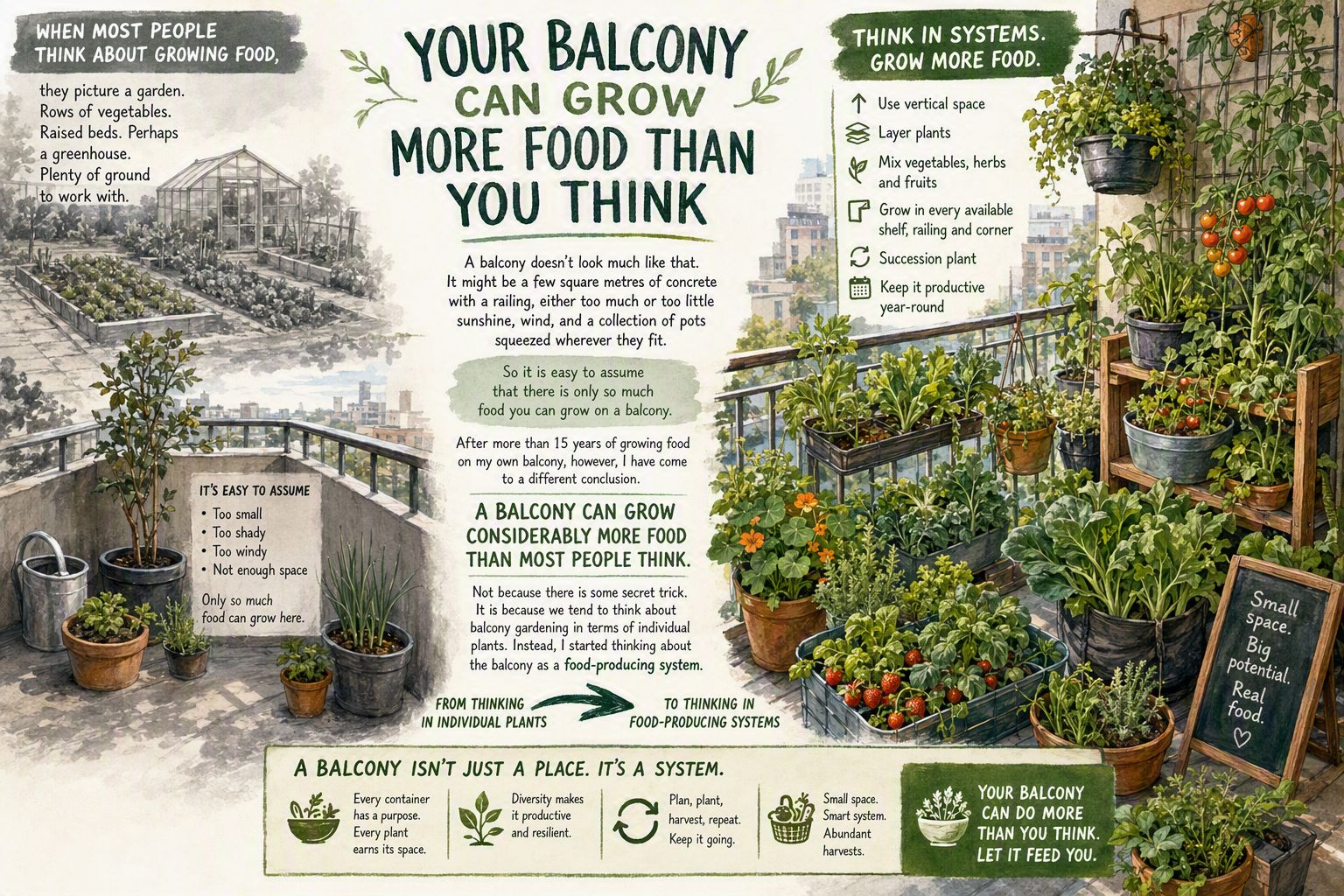
When most people think about growing food, they picture a garden.
Right?
Rows of vegetables. Raised beds. Perhaps a greenhouse. Plenty of ground to work with.
A balcony doesn’t look much like that.
It might be a few square metres of concrete with a railing, either too much or too little sunshine, a wind, and a collection of pots squeezed wherever they fit.
So it is easy to assume that there is only so much food you can grow on a balcony.
I used to think about the space that way too.
After more than 15 years of growing food on my own balcony, however, I have come to a different conclusion.
A balcony can grow considerably more food than most people think!
Not because there is some secret trick that magically creates more space.
It is because we tend to think about balcony gardening in terms of individual plants and individual containers.
I eventually stopped thinking that way.
Instead, I started thinking about my balcony as a food-producing system.
And that changed everything.
My Garden Is On The Tenth Floor
I didn’t start gardening on a balcony.
Like many gardeners, I began with more conventional growing spaces. I had access to allotments and the kind of space where you could simply put something in the ground and let it grow.
Then life changed, and in 2011 I moved into an apartment on the tenth floor.
Suddenly, the ground was no longer an option.
If I wanted to continue growing food, I had to work with what I had.
That meant containers.
My balcony is about 18 square metres, and over the years I have learned how much food can actually come from a space like that. Or from 6 square metres. Or from just 1.
I grow things such as lettuce, rocket (arugula), spinach, beans, tomatoes, cucumbers, beetroot, onions, garlic, green onions, kale, herbs and strawberries.
Not all at once, of course.
And that distinction is important.
The productivity of my balcony doesn’t come simply from putting as many containers as possible on it.
It comes from making those containers productive again and again.
That was one of the biggest changes in the way I approached growing food.
Your Balcony Has More Growing Potential Than Its Floor Area Suggests
When you look at an 6-square-metre balcony, you see 6 square metres.
But that isn’t really the amount of growing space you have.
You have the surface area occupied by containers, but you also have vertical space. You have different levels of sunlight. You have the space between and around larger plants. You have containers that can be used for different crops at different times of the year.
And, most importantly, you have time.
That last one is easy to overlook.
A container doesn’t have to be productive for only one growing season.
It doesn’t even have to be productive for only one crop.
What do I mean?
Imagine planting lettuce in a container in spring.
You harvest it.
That doesn’t mean the container has finished its job.
You can refresh the potting mix and plant something else.
Later in the year, another crop can take its place.
The container has produced food more than once from the same physical space.
That is a very different way of looking at a container garden.
A Pot Doesn’t Have To Grow Only One Crop
Traditional gardening often encourages us to think in terms of crops and growing seasons.
We plant something.
It grows.
We harvest it.
Then eventually the season ends.
On a balcony, that approach can leave a surprising amount of potential unused.
A container that produces one crop and then sits empty for several months is still taking up exactly the same amount of balcony space. Doing nothing for us.
The container hasn’t changed.
The opportunity hasn’t changed.
Only the way we are using it has changed.
This is one of the ideas behind my Multi-Harvest Container System.
Instead of asking only:
What can I grow in this pot?
I ask:
What can this pot produce over the course of the year?
A simple example might be a spring crop of lettuce, followed by a summer crop (like tomatoes), followed by autumn or winter greens (such as kale or spinach).
The exact crops you (can) grow will depend on your climate, your balcony and what you actually like to eat.
The principle is what matters.
Harvest one crop. Refresh the container. Grow another.
Sow –> grow –> harvest –> replant.
Then do it again.
That turns a container from a one-crop growing space into a small production cycle.
Stop Thinking About “The Growing Season”
This is one of the biggest changes in thinking I want to introduce at Balcony Food Factory.
Instead of asking:
“What am I going to grow this year?”
try asking:
“What could this container be doing this month?”
That sounds like a small change, but it has major consequences.
A tomato plant might occupy a container for a large part of the summer.
But what was growing there before the tomato?
And what could grow there after it?
Could something else grow alongside it?
Could the space around it be used?
Could the container be productive earlier in the year?
Could it produce something again later?
Once you start thinking this way, you stop seeing a container as something assigned permanently to one crop.
You start seeing it as a piece of productive space that can have several jobs.
This is the essence of multi-harvest growing.
More Food Doesn’t Have To Mean More Pots
When people want to grow more food, the obvious solution is often to add more containers.
And sometimes that is exactly what you should do.
But it isn’t always the best first solution. Or even a possibility.
Your balcony has limits.
There is only so much floor space. There is only so much weight the balcony should carry. There is only so much time you want to spend watering, feeding, maintaining and harvesting.
Adding another twenty pots doesn’t necessarily make your food garden better.
It might simply make it more work.
Instead, start by asking whether the containers you already have are being used as productively as they could be.
Can you grow more than one crop in them over the year?
Can you use vertical space?
Can you combine compatible crops?
Can you replant promptly after harvesting?
Can you choose crops that provide regular harvests rather than occupying a container for months for one relatively small harvest?
Can you organise your containers so that something is always coming into production?
This is where productivity becomes less about having more and more about using what you have well.
Grow Food You Actually Want To Eat

There is another part of this that is easy to overlook.
A productive garden isn’t necessarily one that grows the greatest possible number of vegetables.
It is one that produces food that is useful to you.
If you regularly eat lettuce, growing several harvests of lettuce can be more valuable than growing an unusual vegetable simply because it looks interesting.
If you use fresh herbs every week, a productive herb container can earn its space many times over.
If tomatoes are something you look forward to every summer, they deserve space on your balcony.
The question isn’t simply:
How much can this plant produce?
It is also:
How much value does this crop provide to me?
That changes the way you choose what to grow.
Your balcony doesn’t need to become a miniature version of a farm.
It needs to become your food-growing space.
Small Harvests Add Up
I think there is another reason balcony gardening is often underestimated.
We tend to notice individual harvests.
A bowl of lettuce doesn’t look like much.
A handful of green onions doesn’t look like much.
A few tomatoes don’t look like much.
A harvest of spinach doesn’t look like much.
But add those harvests together over weeks and months, and the picture changes.
The goal doesn’t have to be one enormous harvest that fills the kitchen table.
In fact, for a balcony gardener, I think there is often more value in having something useful to harvest regularly.
A handful of herbs today.
Salad tomorrow.
Tomatoes later in the week.
More greens after that.
Something else coming along behind them.
The cumulative result can be surprisingly meaningful.
And perhaps more importantly, it becomes part of how you feed yourself rather than simply being an occasional gardening event.
A Productive Balcony Is Not Necessarily A Crowded Balcony
There is a temptation, once you discover how much you can grow in containers, to keep adding more.
Been there, done that! I understand that temptation.
But I learned that maximum container count isn’t the same thing as maximum productivity.
A balcony food garden needs room to function.
You need access to your plants.
You need to be able to water them.
You need to harvest without knocking things over.
You need to be able to see what is happening.
You want a place to sit and enjoy your outdoor space, too.
And you need to consider things such as sunlight, wind, drainage and the weight of containers and growing media.
So, the aim isn’t to cover every available inch with plants.
The aim is to make the available space work well.
Sometimes that means fewer containers that are used very effectively.
Sometimes it means using vertical space.
Sometimes it means combining crops.
Sometimes it means removing a crop that isn’t earning its place and growing something more useful instead.
A productive balcony is a designed system, not a storage area for pots.
The Four Things Every Productive Balcony Needs
Over the years, I’ve come to think about balcony food production in terms of four basic resources:
Time. Space. Soil. Effort.
Your balcony is limited in all four.
The trick isn’t to pretend those limits don’t exist.
It is to use them intelligently.
Time
If a container can produce two or three useful crops over a year instead of one, you’ve made better use of the same time and space.
Space
Use the space above the container as well as the space inside it. Think about how crops can coexist and how containers can be used successively.
Soil
Container plants depend heavily on the potting mix available to them. Repeated production means the soil needs attention, organic matter and appropriate feeding.
Effort
More productivity shouldn’t automatically mean more work.
A good system should make it easier to manage the balcony, not create an endless list of gardening jobs.
These four resources are connected.
If you use your space better, you may not need more containers.
If you plan your crops better, you may get more food without adding work.
If you look after your soil, the soil will look after your plants, and you can keep using the same containers productively.
That’s the kind of thinking that turns individual gardening tasks into a system.
Your Balcony Food Garden Doesn’t Have To Be Perfect
There is also no such thing as one perfect balcony food garden.
My balcony is on the tenth floor and faces south. That gives me plenty of sunlight, yes, but it also creates challenges.
Wind matters. My balcony is often a windy place.
Heat matters. Not all plants thrive when they are baking in full sun all day.
Watering matters. In the summertime I am often watering plants daily.
The conditions on my balcony are not going to be identical to those on a shaded balcony in another part of the country.
And that’s fine.
The Multi-Harvest Container System isn’t about following a rigid recipe regardless of where you live.
The principles can be adapted.
You may grow different crops.
Your growing seasons may be different.
You may have less sunlight.
You may have more wind.
You may have fewer containers.
You may have a much smaller balcony.
The important thing is learning what your own growing space can do and building your system around that.
There is no such thing as a perfect balcony.
There is only the balcony you have.
And that is enough to start.
You Don’t Need To Grow Everything
One of the most useful lessons I’ve learned is that you don’t need to grow every crop you possibly can.
In fact, trying to do so is one of the quickest ways to make gardening unnecessarily complicated.
Instead, I recommend you think about the foods you actually use.
Think about the crops that grow well in your conditions.
Think about which crops provide repeated harvests.
Think about which ones are worth the space they occupy.
And think about which crops can follow one another.
A handful of carefully chosen crops can provide a surprisingly large amount of useful food when they are grown at the right times and the containers are reused.
That’s a very different approach from buying seeds for fifty different vegetables and trying to find somewhere to put them all.
From A Collection Of Pots To A Food-Producing System
This is ultimately the shift I want to encourage.
You can have twenty pots on a balcony and still have twenty completely separate gardening projects.
Or you can have twenty pots that work together as a system.
The difference is how you think about them.
Instead of:
“This is my tomato pot.”
You start thinking:
“This container is producing tomatoes now. What was here before the tomato, and what will follow it?”
Instead of:
“My lettuce has finished.”
You think:
“The lettuce has finished. What can I grow here next?”
Instead of:
“I need more space.”
You ask:
“Am I using the space I already have as effectively as I could?”
And instead of:
“What should I grow this year?”
you start asking:
“What could my balcony be producing next?”
That is the beginning of the Food Factory way of thinking.
So, How Much Food Can You Actually Grow On A Balcony?
There isn’t one number I can give you.
It depends on your balcony.
It depends on sunlight, climate, containers, soil, crop choices and how intensively you want to grow.
It also depends on what you mean by “a lot of food.”
A balcony is unlikely to replace a large allotment or provide complete food self-sufficiency for a family.
That’s not the claim I’m making.
The more useful question, in my opinion, is:
Can a balcony regularly produce food that you will actually eat?
Absolutely!
And I think many people underestimate just how much that can amount to over an entire year.
I can harvest something from my balcony garden almost every week of the year. Something I enjoy eating, and is good for me. That is exactly what I want.
The mistake is looking at one container and asking how much food it can produce.
The more interesting question is:
How much food can this container produce over time?
Then multiply that across the containers you have.
That is where the potential starts to become interesting.
Your Balcony Can Become A Food Factory
The name Balcony Food Factory isn’t about pretending that a balcony is an industrial farm. It’s not and I wouldn’t want it to be.
It’s about changing the way we think about a small growing space.
A food factory is a place where inputs are turned into useful output.
Your balcony already has many of the things you need:
Sunlight.
Containers.
Potting mix.
Water.
Plants.
And your time and attention.
The question is how efficiently you can put those resources to work.
Instead of treating your balcony as a collection of decorative pots, you can start treating it as a small food-producing system.
Instead of thinking about one growing season, you can think about production cycles.
Instead of growing one crop and moving on, you can think about what comes next.
Instead of adding more containers every time you want more food, you can first look at whether the containers you already have are earning their space.
And instead of chasing the biggest possible harvest, you can aim for something much more valuable:
regular, meaningful harvests from the space you already have.
That is what I mean by a Balcony Food Factory.
And that is the idea behind the Multi-Harvest Container System.
Start With The Space You Already Have
If you have a balcony, you don’t need to wait until you have a garden.
You don’t need dozens of containers.
You don’t need a perfect setup.
You don’t need to grow everything.
Start with one container.
Grow something you actually want to eat.
Harvest it.
Pay attention to what happened.
Then ask the question that changes everything:
What could this container be doing next?
That simple question is where multi-harvest growing begins.
And once you start looking at your balcony that way, you may discover that you have considerably more food-growing potential than you thought.
Actually, I’m betting on it.
Want To Build The Complete System?
This article introduces the thinking behind the Multi-Harvest Container System. The system goes much further, showing you how to use succession planting, companion planting, soil management and efficient gardening to turn a collection of balcony containers into a coordinated food-producing system.
My book The Multi-Harvest Container System Starter Guide takes you through the complete approach, from assessing your balcony and choosing containers to planning multi-harvest crops and building productive container systems.
Learn more about the Multi-Harvest Container System Starter Guide →
Recommended Further Reading
Want to explore this idea further? These articles are a good place to continue:
You Don’t Need a Garden to Grow Your Own Food
How Productive Can A Balcony Container Really Be?
About Me
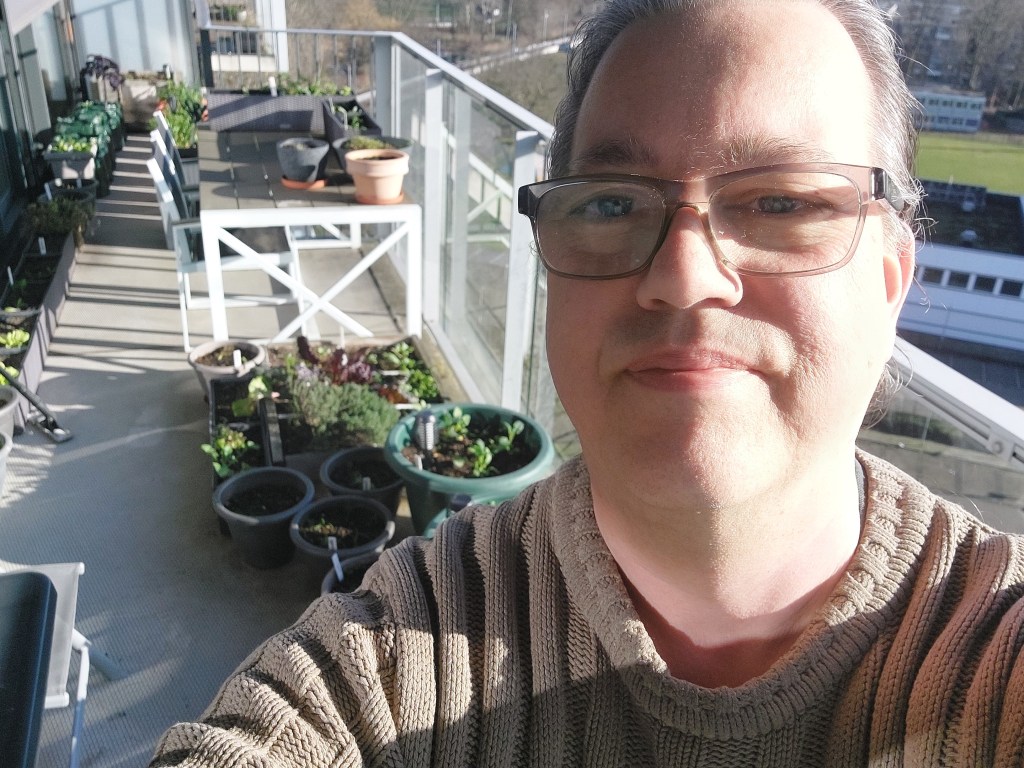
I’m Jim, the gardener behind Balcony Food Factory.
I’ve been growing food for decades, from allotments to my current 10th-floor balcony, where I’ve learned how to grow a surprising amount of food in a surprisingly small space.
Balcony Food Factory is where I share what I’ve learned about growing more food in containers, making the most of limited space, and keeping things practical and manageable.
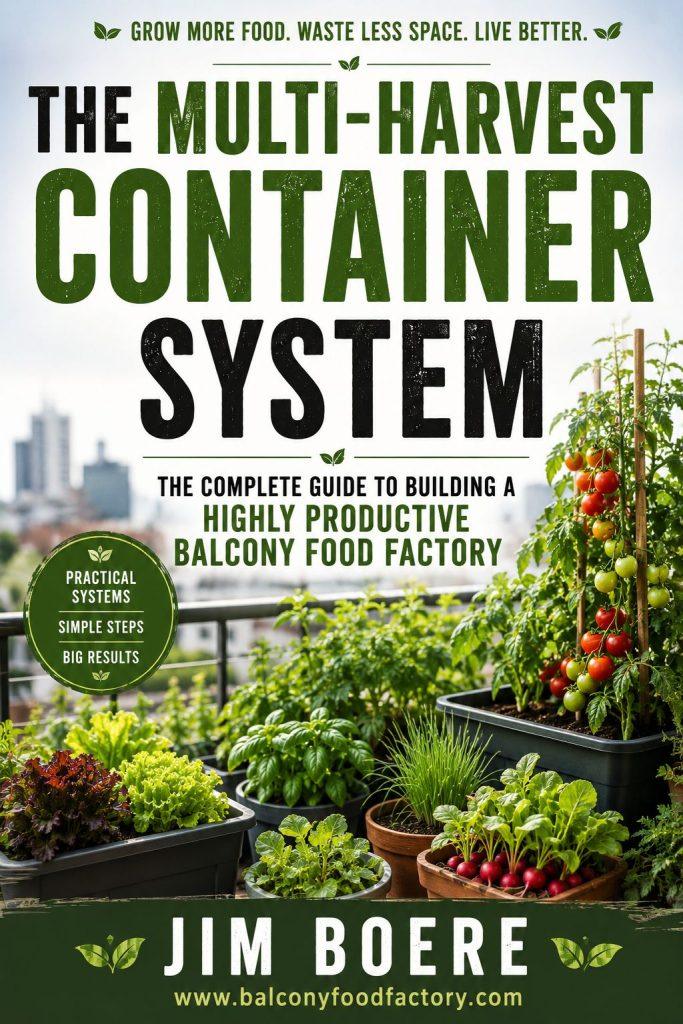
Want more? Subscribe to the Balcony Food Factory newsletter and I’ll send you practical growing advice, ideas and lessons from my own balcony garden straight to your inbox. You’ll get the below eBook for free too, as a welcome gift. Just click on the image to sign up.
See you there!

A Note About Climate
I garden in Schiedam, the Netherlands, where we have a temperate maritime climate with mild winters, relatively cool to warm summers, and rainfall throughout the year. As a general comparison, my location is approximately USDA Hardiness Zone 8b.
Growing conditions vary considerably between regions, so planting dates, growing seasons, temperatures, and crop recommendations may differ where you live. Please adapt the advice in my articles to your own local climate, weather patterns, and growing conditions.

Leave a Reply