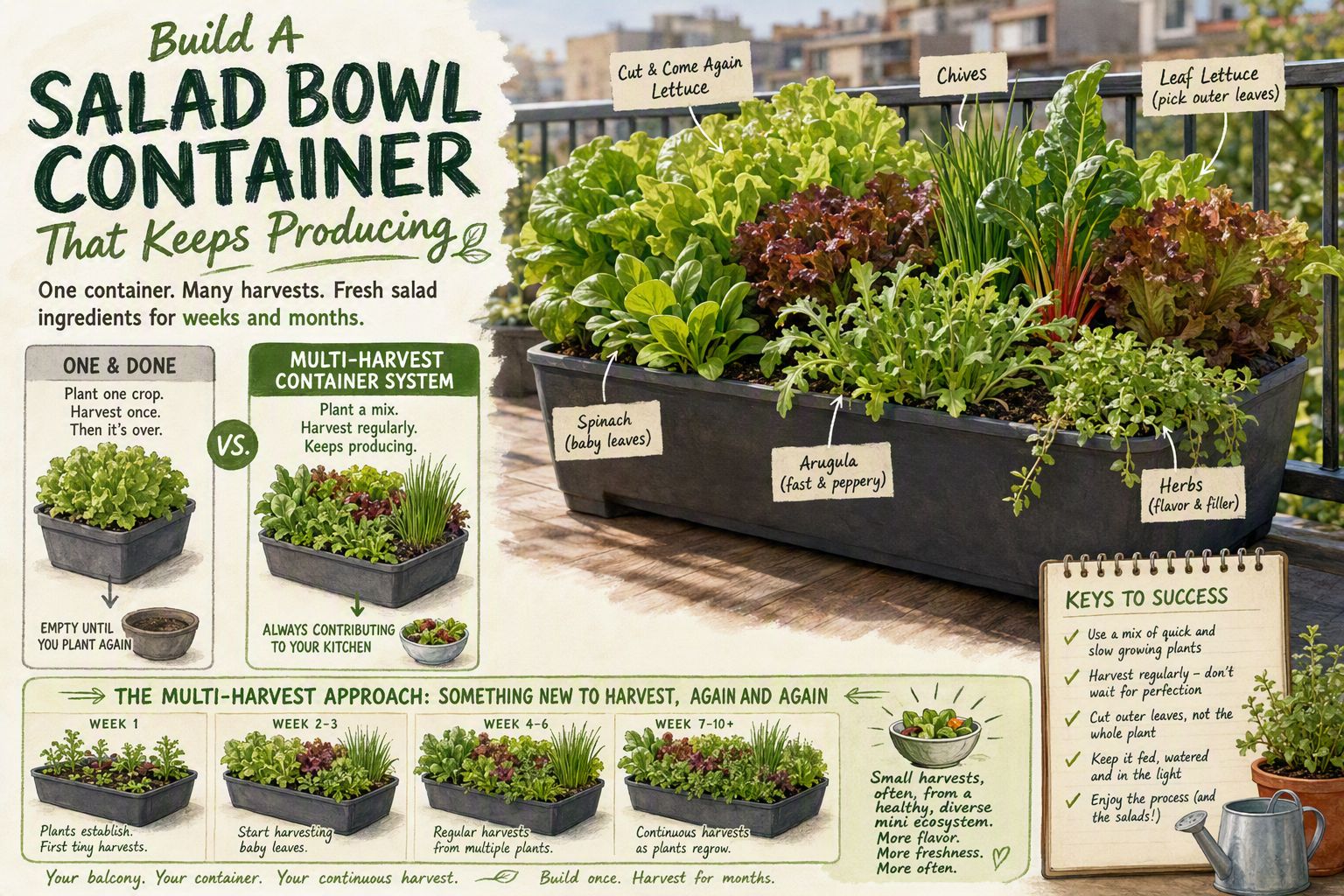
A container filled with lettuce is nice.
A container that keeps producing salad ingredients over an extended period is much more interesting.
That difference is at the heart of the Multi-Harvest Container System.
Instead of planting one crop, harvesting it and considering the container finished, we can think about how the same growing space can provide several harvests, and eventually several different crops.
Salad crops are particularly good for demonstrating this idea.
They don’t necessarily need huge containers, many can be harvested regularly, and several can be combined in ways that make good use of the available space.
The result can be a simple container that regularly contributes something to your kitchen rather than producing one harvest and then sitting empty.
What Is A Salad Bowl Container?
A Salad Bowl Container is simply a container designed to provide you with a regular supply of salad ingredients.
There is nothing complicated about it.
You choose a container, fill it with good potting mix, and grow a combination of crops that you enjoy eating.
But there is one important difference between a normal salad container and the way I approach a Salad Bowl Container.
I don’t think of it as a container that gets planted once.
I think of it as a productive piece of growing space.
That means I am thinking about what I can harvest from it now, what will be ready next, and what could grow there after the current crops have finished.
The exact crops will depend on what you eat, your climate, the season and the conditions on your balcony.
The principle is much more straightforward:
Use one container to produce food repeatedly.
Why Salad Crops Work So Well In Containers
Salad crops make a lot of sense for balcony growing.
For one thing, many of them are relatively compact.
You don’t need a huge amount of space to grow something that can contribute to a meal.
Some salad crops are also quick to mature, while others can be harvested repeatedly.
That gives us several opportunities to make better use of the same container.
There is also another advantage that is sometimes overlooked. You don’t need a huge harvest for a salad crop to be worthwhile.
A few leaves of lettuce.
A handful of rocket (arugula).
A couple of radishes.
Some green onions.
Those small harvests can go directly into the kitchen.
And because these are foods you may use regularly, they can provide a much better return in practical terms than growing something simply because it happens to be capable of producing a large harvest.
That is one of the ideas I come back to often:
Grow according to value, not curiosity.
If you love a particular crop and eat it regularly, doesn’t that have real value on your balcony?
Think In Layers, Not Just In Plants
A Salad Bowl Container is also a good way to understand the idea of growing in layers.
When we look at a container, we tend to see its surface.
But there is more to it than that.
Different crops can occupy different amounts of space and mature at different rates.
A lettuce plant may take up more space as it develops.
Rocket can be harvested repeatedly.
Radishes develop underground while their leaves occupy relatively little space.
Green onions remain compact and can fit into spaces that would otherwise contribute very little to your harvest.
This doesn’t mean you should cram as many plants as possible into one pot.
Overcrowding is not productivity.
Plants still need enough room, light, water, nutrients and air circulation to grow properly.
The idea is simply to make sensible use of the available space.
Think about the different jobs each crop can do rather than looking at the container as one empty surface that needs to be filled.
Build Your First Salad Bowl
You don’t need a special container.
Choose one that is large enough for the crops you want to grow, has adequate drainage and is practical for your balcony.
Good drainage is particularly important in containers because excess water has nowhere to go except through the drainage holes.
Fill the container with a good-quality potting mix and prepare it before planting or sowing.
Then choose the crops.
This is where I would resist the temptation to copy somebody else’s container exactly.
Start with what you actually eat.
If you don’t like rocket, don’t grow rocket.
If you eat lettuce several times a week, give lettuce a prominent role.
If you regularly use green onions in your cooking, they may deserve space in the container.
The Salad Bowl Container is not a decorative planting exercise. It is meant to produce food that ends up on your plate.
Once you know which crops you want, think about how they can share the container.
Place larger or slower-growing plants where they have enough room to develop.
Use smaller and faster crops to make sensible use of the surrounding space.
And leave enough room for everything to grow properly.
The objective isn’t to make the container look full on day one.
The objective is to make it productive over time.
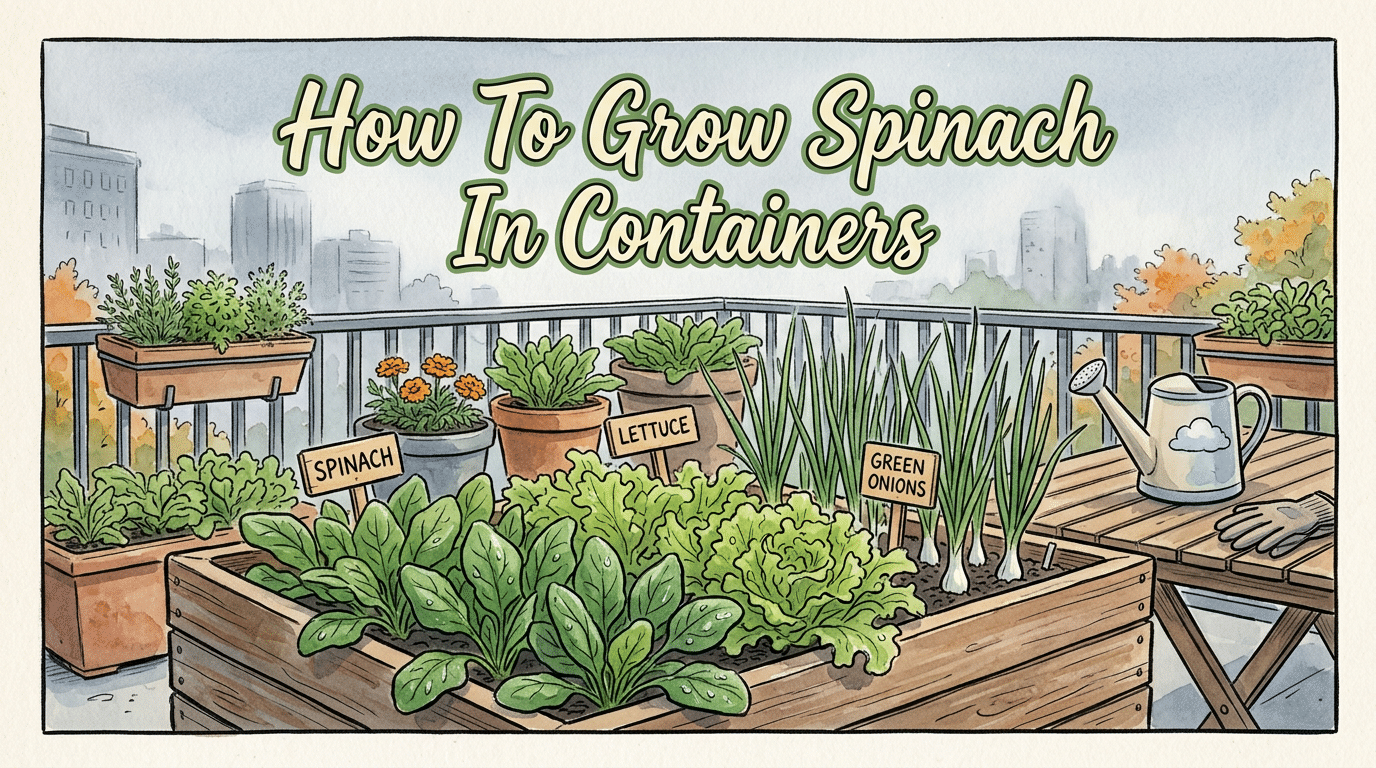
A Simple Combination: Lettuce, Rocket, Radishes And Green Onions
One combination I really like for illustrating the idea is lettuce, rocket, radishes and green onions.
Each crop brings something slightly different to the container.
Lettuce can provide the main body of your salad harvest. Depending on the variety and how you harvest it, you may be able to take individual leaves rather than removing the whole plant immediately.
–> Click here for my How To Grow Lettuce In Containers: A Complete Balcony Growing Guide
Rocket is great because you can harvest it regularly, and it can provide leaves while other crops are still developing.
–> Click here for my guide How To Grow Rocket In Containers
Radishes are a relatively quick crop and make use of space below the surface while the other plants are developing around them.
Green onions are compact and productive over a longer period. They can occupy parts of the container that might otherwise contribute little to the harvest.
The combination isn’t mandatory.
It isn’t the only combination that works.
And it won’t necessarily be the best combination for every balcony.
What matters is why these crops can work together.
They have different characteristics, different harvest patterns and different space requirements. That gives the container more than one way to produce food.
Don’t Harvest Everything At Once

One of the easiest ways to turn a salad container into a source of regular food is to change the way you harvest.
If you remove everything at once, you get one harvest.
If you harvest selectively, the same plants may continue producing for longer.
With lettuce, for example, you can often harvest outer leaves while leaving the plant to continue growing, depending on the variety and its condition.
Rocket can be picked regularly rather than waiting for one large harvest.
Green onions can be harvested as needed.
Radishes are different because the root itself is the harvest, so eventually that plant leaves the container.
That is not a problem.
It is part of the system.
Some crops continue producing while others are harvested and removed.
This gives you a mixture of ongoing and one-time harvests from the same container.
And that is exactly what we want.
The First Harvest Is Not The End
This is where the Salad Bowl Container starts becoming a true Multi-Harvest Container.
Imagine you sow or plant several salad crops.
Some mature faster than others.
You harvest the radishes.
You continue harvesting rocket.
You take lettuce leaves as you need them.
The green onions continue growing.
At some point, one of those crops reaches the end of its productive life.
That doesn’t automatically mean the container has finished producing.
The space that has become available can be used again.
You can remove the finished crop, refresh the potting mix if necessary, and plant or sow something else.
The container has now moved into another production cycle.
This is the important distinction.
The goal isn’t to make one planting last forever.
The goal is to make the container itself produce for as much of the year as reasonably possible.
From Salad Bowl To Multi-Harvest Container
The first planting is only one part of the story.
A Salad Bowl Container might begin with a combination of salad crops.
As the faster crops are harvested, gaps appear.
Those gaps can be used again.
As the remaining plants reach the end of their productive period, the container can be refreshed and replanted.
The next crop might be another salad crop.
Or it might be a different crop altogether.
The choice depends on the time of year and your growing conditions.
Instead of asking:
“What should I plant in this pot for the season?”
you can ask:
“What can this container produce next?”
That is a very different question.
It turns the container from a one-season growing space into a piece of space that can have several productive lives.
A container on my balcony will usually have at least 3 such, often 4.
Make the containers you already have work harder for you.
Feed The Potting Mix As You Go
There is another part of this process that is easy to overlook.
Every harvest takes something from the potting mix.
If you are asking a container to produce repeatedly, you cannot simply keep removing crops without paying attention to what is happening below the surface.
Container soil needs ongoing care.
Depending on what you have grown and how heavily the container has been used, that may mean adding compost, organic fertilizer or otherwise refreshing the potting mix before the next crop.
The exact approach will vary according to the soil you use and your own growing system.
The principle is simple:
Feed the soil, not just the plant.
A productive container needs a healthy foundation.
If you want repeated harvests from the same space, maintaining fertility becomes even more important.
Keep The Container Producing Without Making It Complicated
It would be easy to turn all of this into a complicated planting schedule.
I don’t think you need one.
The Multi-Harvest Container System is supposed to help you make better use of your space, not create another job.
So keep it simple.
Choose crops you actually eat.
Harvest regularly.
Pay attention to what is finishing.
Think about what could follow.
Refresh the potting mix when needed.
Replant when there is a practical opportunity.
And don’t feel that you have failed because a container is temporarily between crops. Sometimes there simply isn’t a sensible crop to grow at that particular moment. The aim is to reduce unnecessary empty periods, not eliminate every empty day.
There is an important difference.
What If You Don’t Like One Of The Crops?
You don’t have to grow the combination I have described.
In fact, I would encourage you to change it.
The best Salad Bowl Container is one that reflects your kitchen.
Maybe you eat a lot of lettuce but hardly ever add rocket.
Grow more lettuce.
Maybe you use green onions constantly.
Give them more space.
Maybe you prefer spinach or another leafy green.
Try that instead.
The principles of the Multi-Harvest Container System don’t depend on a fixed list of crops.
They depend on thinking about how crops can share space, how they can be harvested, what follows them and how the container can remain productive.
Your climate and growing conditions matter too.
A combination that works well on my balcony may not perform the same way on yours.
That is normal.
There is no single perfect Salad Bowl Container.
There is the one that works for you.
How Long Can A Salad Bowl Keep Producing?
There isn’t a universal answer to this question.
A Salad Bowl Container might produce for a long period, but exactly how long depends on many factors.
Your climate.
The time of year.
The crops you choose.
The container size, sunlight, watering, feeding and how you harvest.
Some crops will finish quickly.
Others will continue for much longer.
Some will tolerate repeated harvesting.
Others are harvested once and removed.
That is why I prefer to think about production cycles rather than promising that one planting will provide salad for a certain number of weeks or months.
The point isn’t to make one planting last indefinitely.
The point is to keep the container going by moving from one productive phase to the next.
The Salad Bowl Container Is A Small Food Factory
A good Salad Bowl Container demonstrates several of the ideas behind the Multi-Harvest Container System in one relatively simple example.
You are using the available space efficiently.
You are combining crops that can coexist.
You are thinking about layers rather than just the surface.
You are harvesting regularly.
You are watching for crops that are finishing.
You are thinking about what comes next.
You are maintaining the potting mix.
And when one crop is finished, you can use that space again.
In other words, the container is not simply holding plants.
It is producing food.
That is why I like the Salad Bowl Container as a starting point.
You can see the principles happening right in front of you.
And once you understand what is happening in one container, you can start applying the same way of thinking to the rest of your balcony.
Start With One Salad Bowl
You don’t need to build five of these.
You don’t need to redesign your balcony.
And you certainly don’t need to buy a collection of new containers before you start.
Build one.
Choose a container you already have.
Think about the salad ingredients you actually like to eat.
Choose a few crops that can work together.
Give them enough space to grow properly.
Harvest regularly.
Watch what happens.
Notice which crops grow quickly and which take longer.
Notice which combinations work well on your balcony.
When something finishes, ask what could follow it.
That last question is perhaps the most important one. Because once you start asking what comes next, you are no longer thinking about one planting. You are thinking about the productive life of the container.
Build A Container That Keeps Giving
A salad container doesn’t have to produce one crop and then become an empty pot.
With sensible crop selection, good spacing, regular harvesting, succession planting and proper care of the potting mix, the same container can provide repeated harvests and move through several production cycles.
And that is the bigger lesson.
You are not trying to grow the maximum number of plants in one container.
You are trying to get the most food you can from the space you have, over the time available to you.
The exact crops will change.
The timing will change.
Your container will change.
But the principle remains:
Don’t just plant a container. Make the container productive.
A Salad Bowl Container is a great place to start.
And once you have one working, you can begin asking the same question about every other pot on your balcony:
What could this container be doing next?
If you want to take this idea further, The Multi-Harvest Container System Starter Guide includes a wide range of practical high-yield container setups and explains how to combine succession planting, companion planting, soil management and efficient container growing into one complete system.
Recommended Further Reading
Want to explore this idea further? These articles are a good place to continue:
The Tomato Companion Pot: More Than Just A Tomato Plant
How To Grow More Food Without Adding More Pots
Why Autumn Is Your Second Spring
About Me
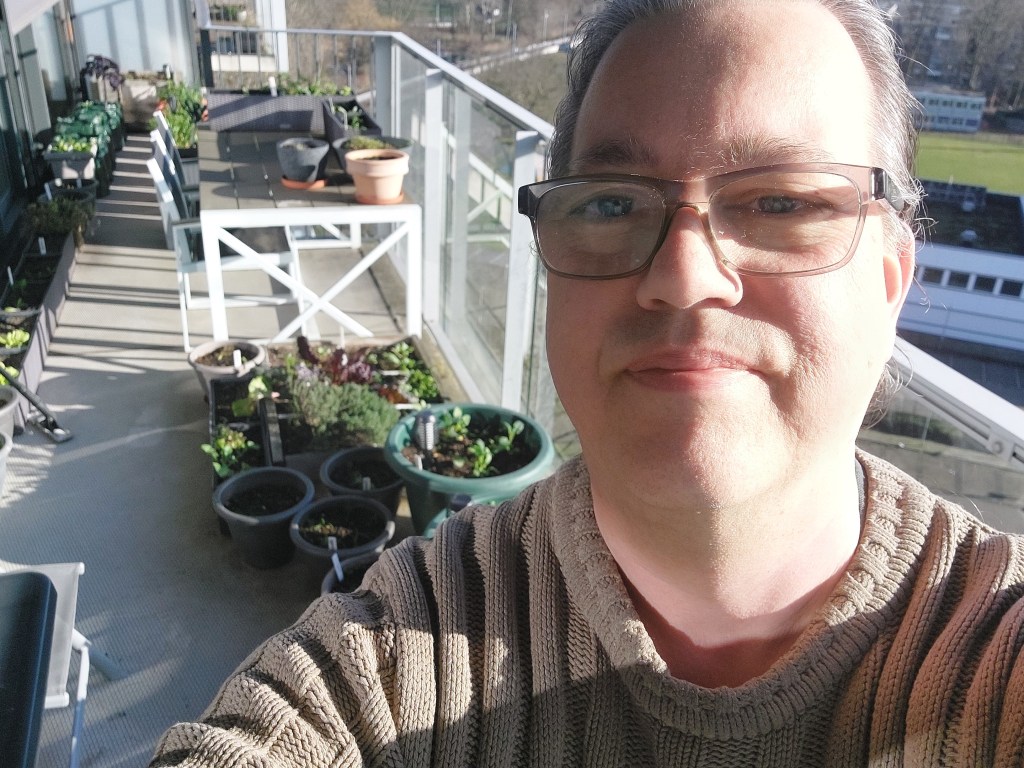
I’m Jim, the gardener behind Balcony Food Factory.
I’ve been growing food for decades, from allotments to my current 10th-floor balcony, where I’ve learned how to grow a surprising amount of food in a surprisingly small space.
Balcony Food Factory is where I share what I’ve learned about growing more food in containers, making the most of limited space, and keeping things practical and manageable.
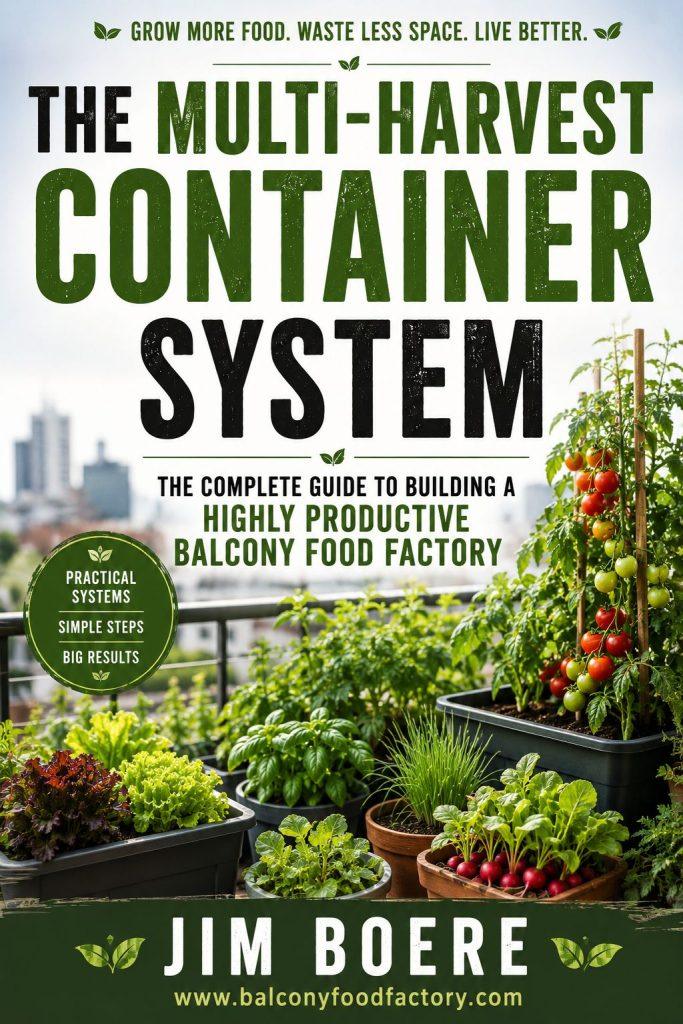
Want more? Subscribe to the Balcony Food Factory newsletter and I’ll send you practical growing advice, ideas and lessons from my own balcony garden straight to your inbox. You’ll get the below eBook for free too, as a welcome gift. Just click on the image to sign up.
See you there!

A Note About Climate
I garden in Schiedam, the Netherlands, where we have a temperate maritime climate with mild winters, relatively cool to warm summers, and rainfall throughout the year. As a general comparison, my location is approximately USDA Hardiness Zone 8b.
Growing conditions vary considerably between regions, so planting dates, growing seasons, temperatures, and crop recommendations may differ where you live. Please adapt the advice in my articles to your own local climate, weather patterns, and growing conditions.

Leave a Reply