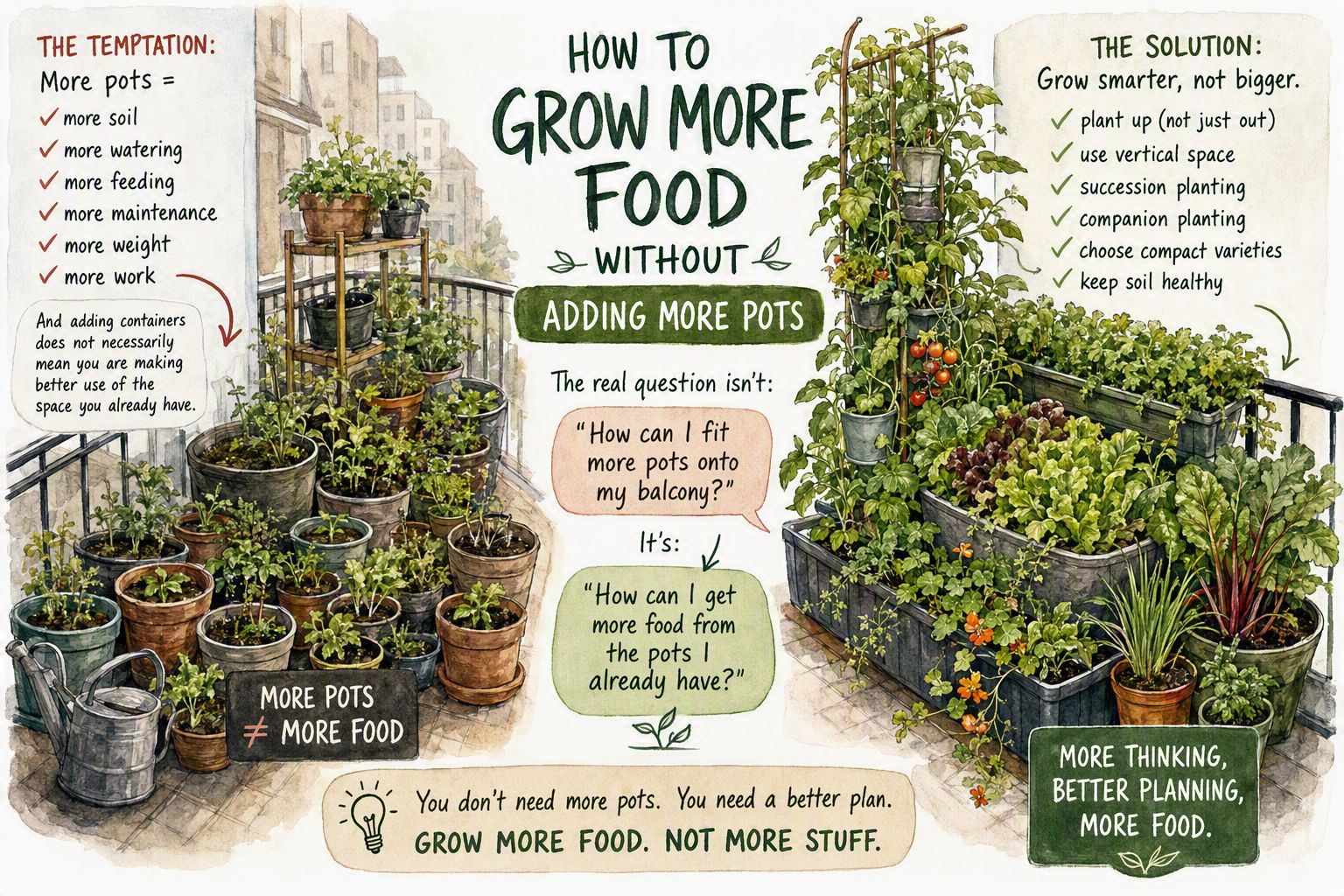
If you want to grow more food on a balcony, the obvious solution seems simple: add more pots.
I understand the temptation.
You grow something successfully, you enjoy the harvest, and then you start thinking about what else you could grow. So you buy another container. Then another. Before long, the balcony starts filling up.
But there is a problem with this approach.
More pots mean more potting mix, more watering, more feeding, more maintenance, more weight and, eventually, more work.
And adding containers does not necessarily mean you are making better use of the space you already have.
After years of growing food in containers, I have learned that one of the most interesting questions you can ask is not:
“How can I fit more pots onto my balcony?”
It is:
“How can I get more food from the pots I already have?”
That change in thinking can make a surprisingly big difference.
It changed the way I container garden completely.
Look At Your Existing Pots Differently
A container can look full while still having unused potential.
Perhaps there is only one crop growing in it.
Perhaps that crop occupies the container for several months, followed by a period when nothing is growing there.
Perhaps there is empty space around the main plant.
Or perhaps the container is being used perfectly well, but only for one short harvest during the year.
None of this means you are doing anything wrong.
It simply means there may be more production available without increasing the physical size of your garden.
This is one of the biggest differences between simply growing plants in pots and thinking about your balcony as a food-producing system.
Instead of looking at a container and seeing only what is growing in it today, I like to ask:
What else could this container do?
Could it produce something before the main crop?
Could another crop grow alongside it?
Could something follow it later in the year?
Could some of the unused space be productive?
Could the potting mix be refreshed and the container planted again?
Once you start asking those questions, the number of pots becomes much less important.
Make Each Container Work For More Of The Year
One of the most valuable resources on a balcony is something we often overlook:
time.
You cannot make your balcony physically larger.
You cannot magically create another ten square meters of floor space.
But you can use the same growing space at different times.
What do I mean?
Imagine a container that grows one crop for three months and then sits empty for the rest of the year.
Now imagine another container that produces an early crop, is replanted with a summer crop, and then produces something again in autumn or winter.
They occupy the same amount of physical space.
But they are not producing the same amount of food.
This is why I think it is useful to stop looking at a container as having one permanent job.
A container can have several jobs during the year.
That does not mean you need to keep it constantly planted regardless of the conditions. There will always be periods when production slows down or when a container needs attention.
The point is simply to recognize that the growing year contains more opportunities than one crop.
Stop Letting Containers Sit Empty
An empty container is not necessarily a problem.
Sometimes it needs to be empty.
Perhaps you have just finished harvesting a crop and need to refresh the potting mix. Perhaps the weather is not yet right for the next crop. Perhaps you are waiting for the right time to plant.
But unnecessary empty periods can quietly reduce the amount of food your balcony produces.
This is why I like to think about the next crop before the current crop has completely finished.
If I know what I want to grow next, I can prepare for that transition rather than suddenly finding myself with an empty container and no plan.
This does not have to become complicated.
You do not need a detailed spreadsheet for every pot.
It can be as simple as looking at a container and thinking:
“What comes next?”
That one question can change the way you use your growing space.
Instead of thinking about planting as a series of isolated events, you start thinking about continuity.
Sow.
Grow.
Harvest.
Remove.
Refresh.
Replant.
And then do it again when conditions allow.
Grow More Than One Crop In A Container
Another way to increase production without adding pots is to stop assuming that one container has to grow one crop.
This does not mean cramming as many plants as possible into every available space.
Overcrowding creates its own problems.
Plants compete for light, water, nutrients and physical space. Air circulation can suffer, and harvesting becomes more difficult.
The idea I propose is different.
Look at the container in three dimensions and consider whether crops with different growth habits can share the space.
A lettuce plant does not have to occupy exactly the same space as a radish.
A green onion does not have to occupy the same space as a tomato.
Basil can use space around a tomato plant that would otherwise contribute little to your harvest.
This is the thinking behind companion planting in the Multi-Harvest Container System.
The goal is not to create a complicated list of plants that supposedly have magical relationships with one another.
It is to make better use of the space that is already there.
My Salad Bowl Container is a simple example.
Lettuce, rocket (arugula), radishes and green onions can be combined in a container because they occupy space differently and can provide different types of harvest.
Likewise, the Tomato Companion Pot uses the space around a larger tomato plant rather than treating the entire container as though the tomato must occupy every available inch.
The important question is not:
“How many plants can I fit in here?”
It is:
“Can I use this space more intelligently without making the plants compete with each other?”
Use The Vertical And Lower Space

When we look at a container, we often think about its surface.
That makes sense. It is where we see the soil and where most plants begin growing.
But a container is three-dimensional.
Some plants grow upwards.
Others stay low.
Some spread out.
Some grow mainly below the surface.
This gives you opportunities to use different parts of the same growing space.
A tall crop can occupy the upper part of a container while a lower-growing crop makes use of space underneath or around it.
A crop grown for its roots uses a different part of the container from a plant harvested mainly above the potting mix.
Vertical growing can also allow you to make better use of the space above the container, provided the structure is safe and appropriate for your balcony.
Again, the goal is not maximum density.
It is better use of available space.
There is a big difference between making a container productive and making it overcrowded.
A productive container should still give plants enough room to grow well and should remain practical to water, feed and harvest.
Choose Crops That Earn Their Space
If space is limited, crop selection matters.
You could grow almost anything if you had unlimited room.
But you do not.
That means every crop is making a choice for you.
A container occupied by one crop for months is not available for something else during that time.
So I think it is worth asking what you actually want from your crops.
Do you eat them regularly?
Do they give you repeated harvests?
Do they provide something that would otherwise be expensive or inconvenient to buy?
Do they make good use of the conditions on your balcony?
Do you enjoy growing them?
That last question matters too.
Food production is important, but a balcony garden should still be enjoyable.
I do not think you should remove every flower or experimental plant simply because it is not producing the maximum possible amount of food.
A vegetable garden needs flowers. They bring pollinators and other good creatures (natural pest control) into the garden. We need them.
On my own 10th floor balcony I always make room for flowers. Each year I also experiment with at least 2 or 3 crops that are new to me, simply because it gives me joy.
But if your main goal is to grow more food without adding more containers, then growing according to value is important.
You do not need to grow everything.
You need to make good choices about what deserves the space you have.
Think In Harvests, Not Just Plants
One of the biggest changes in my own thinking has been to stop measuring productivity simply by counting plants.
A tomato plant is one plant.
But it can provide harvests over a long period.
A container of lettuce, radishes, rocket (arugula) and green onions may contain several crops, each contributing something different.
And a container that goes from one crop to another can produce several separate harvest periods during the year.
So when I look at a container, I am interested in more than how many plants are growing in it.
I want to know:
How often can I harvest from this space?
That is a different way of measuring productivity.
A single huge harvest can be satisfying for sure, but regular smaller harvests can have enormous value in a kitchen.
A few leaves for a salad.
A handful of rocket.
Several radishes.
Fresh green onions.
Herbs whenever you need them.
These harvests may not look impressive when measured individually, but they can add up to a substantial contribution to the food you actually eat.
And that is ultimately what I want my balcony garden to do.
Produce food that gets eaten.
Combine Succession And Companion Planting
This is where two of the central ideas behind the Multi-Harvest Container System work particularly well together.
Succession planting makes better use of time.
Companion planting makes better use of space.
Put the two together and the same container can become considerably more productive without becoming physically larger.
For example, you might use part of a container for a quick early crop and then follow it with another crop later.
You might grow several compatible crops together so that the available space is used more effectively.
You might do both.
That is the basic idea behind a multi-harvest container.
The container does not have to be dedicated to one crop, one harvest or one moment in the year.
It can have a sequence of roles.
This is one reason I do not think of the Multi-Harvest Container System as a rigid planting formula.
The exact crops and timing will change according to your climate, balcony conditions, container size, sunlight, what you eat and what you want to grow.
The principle remains the same:
Make better use of the space and time you already have.
Improve The Potting Mix Instead Of Expanding The Garden
There is another part of this that is easy to overlook.
If you ask your existing containers to produce more food, you also need to keep them capable of doing so.
Container gardening is different from growing in the ground because the plants are working within a limited volume of potting mix.
When you repeatedly grow and harvest crops, nutrients are removed from that mix.
That means potting mix care becomes part of the production system. Crucial to it.
After a heavy crop, I may refresh the potting mix, add compost and provide organic nutrients as needed before planting again.
The exact approach will depend on the mix, the crops and the condition of the container.
But the principle is straightforward.
If you want a container to keep producing, you cannot treat the potting mix as though it has an unlimited supply of nutrients.
This is one of the reasons the Multi-Harvest Container System includes Soil Reset And Organic Feeding as one of its four pillars.
The objective is not simply to squeeze another crop into the container.
It is to maintain the conditions that allow the container to continue producing.
More Food Does Not Have To Mean More Work
This may sound slightly backwards.
If you want more food, surely you need to do more gardening?
Not necessarily.
Adding more pots certainly creates more work.
Every additional container needs to be filled, watered, fed, monitored and eventually emptied or refreshed.
If you have five containers, adding ten more does not just give you ten more opportunities to grow food.
It also gives you ten more containers to manage.
That is why I like the idea of improving productivity before expanding the garden.
Make better use of the containers you already have.
Plan transitions.
Choose crops carefully.
Combine compatible crops.
Use vertical space where appropriate.
Keep the potting mix productive.
Harvest regularly.
These are not necessarily more jobs.
In many cases, they simply make the jobs you are already doing more worthwhile.
The goal is not to create a balcony that requires constant attention.
The goal is to get a better return from the attention you already want to give it.
What This Looks Like On A Real Balcony
Imagine you already have several containers on your balcony.
You do not need to add anything yet.
Instead, look at what each one is doing.
Perhaps one contains a tomato plant.
Could there be a suitable companion crop using some of the lower space?
Perhaps another container has produced lettuce and is now coming to the end of its crop.
What could follow it?
Perhaps another container is growing herbs.
Could it continue producing for much longer than a short-lived vegetable crop?
And perhaps one container has been empty since the previous harvest.
Is there a reason?
Or has it simply been forgotten?
Now look at all of those containers together.
You may discover that you already have more potential than you thought.
You do not need every container to be productive in exactly the same way.
One might be producing tomatoes.
Another might be producing salad.
Another might be producing herbs.
Another might be between crops.
Another might be holding something that will remain productive through the colder months, or become productive next year.
The important thing is that the balcony as a whole is doing something.
That is the shift from thinking about individual plants to thinking about a food-producing system.
You Don’t Need To Maximize Every Container
There is a danger in taking productivity too far.
Once you start seeing unused space everywhere, it can become tempting to fill every gap.
I do not recommend that.
A balcony garden is not a factory in the industrial sense.
It is still a garden.
There should be room for things you enjoy.
There should be room for flowers.
There should be room for trying something simply because you are curious.
And there should be enough space to move around and actually enjoy being there.
My idea of a Balcony Food Factory is not a balcony packed so tightly with vegetables that gardening becomes a chore.
It is a space where the containers have a purpose and where the available resources are used intelligently.
Some containers may be highly productive.
Others may be there because you like what grows in them.
That is perfectly fine.
The important thing is to make those choices consciously.
The Real Question Is Not “How Many Pots Do I Need?”
When you feel the urge to buy another container, stop for a moment and look at the ones you already have.
Ask yourself:
Are my existing containers being used throughout the year?
Could I get another harvest from one of them?
Could I combine crops without overcrowding them?
Could I make better use of vertical or lower space?
Am I growing crops that I actually want to eat?
Could I improve the potting mix before adding another container?
Is another pot really the best way to increase my food production?
Sometimes the answer will be yes.
There comes a point when adding another container really is the sensible thing to do.
But I would rather reach that point because I have made good use of the space I already have, rather than simply filling every available corner because I think more pots automatically mean more food.
More containers are one way to increase production.
They are not the only way.
Grow More From The Balcony You Already Have
One of the most encouraging things about growing food on a balcony, I found, is that you do not necessarily need to make your balcony bigger to make your harvest bigger.
You can make better use of it.
You can use the same container at different times of the year.
You can combine crops that share the space well.
You can use different layers and growing habits.
You can choose crops according to what you actually value.
You can keep the potting mix fertile and productive.
And you can think about what happens after every harvest.
That is the thinking behind the Multi-Harvest Container System.
It is not about forcing every container to produce as much food as physically possible.
It is about making your existing growing space work harder without making your gardening harder.
Before you add another pot, look at the ones you already have.
There may be more food waiting to come from them than you think.
And once you start seeing your containers this way, your balcony begins to look different.
Not as a collection of pots.
Not as a fixed amount of growing space.
But as a food-producing system with opportunities spread across both space and time.
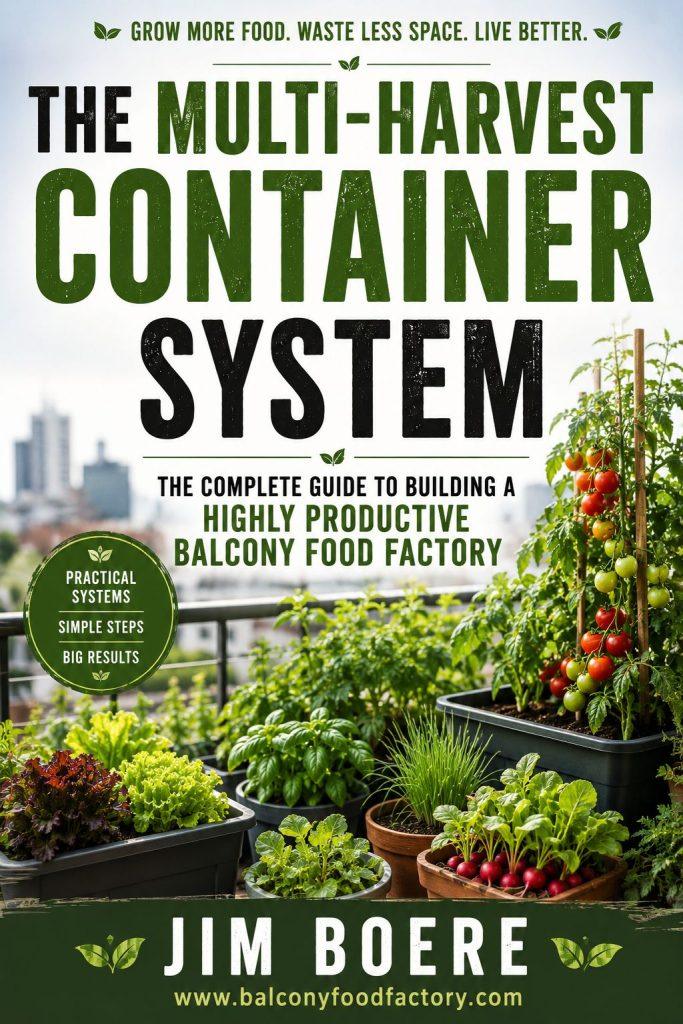
If you want to take that way of thinking further, my book The Multi-Harvest Container System Starter Guide explains the complete system, including succession planting, companion planting, soil reset and organic feeding, efficient gardening, productive container setups and the principles I use to turn limited balcony space into a continuous source of food.
About Me
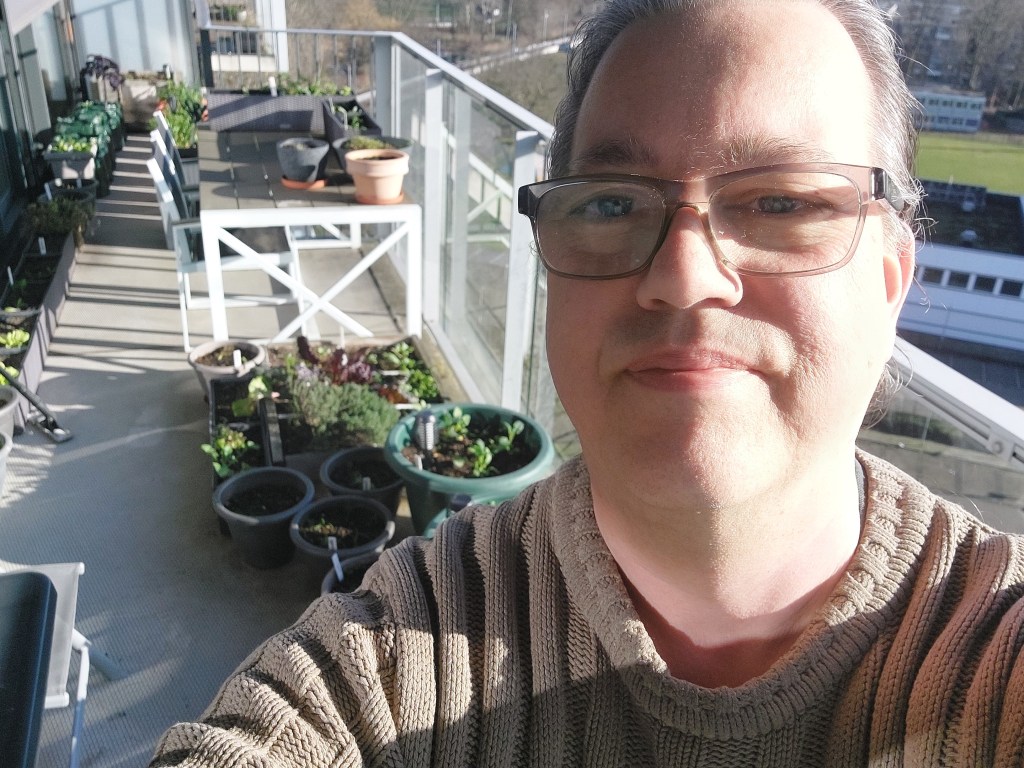
I’m Jim, the gardener behind Balcony Food Factory.
I’ve been growing food for decades, from allotments to my current 10th-floor balcony, where I’ve learned how to grow a surprising amount of food in a surprisingly small space.
Balcony Food Factory is where I share what I’ve learned about growing more food in containers, making the most of limited space, and keeping things practical and manageable.
Want more? Subscribe to the Balcony Food Factory newsletter and I’ll send you practical growing advice, ideas and lessons from my own balcony garden straight to your inbox. You’ll get the below eBook for free too, as a welcome gift. Just click on the image to sign up.
See you there!

A Note About Climate
I garden in Schiedam, the Netherlands, where we have a temperate maritime climate with mild winters, relatively cool to warm summers, and rainfall throughout the year. As a general comparison, my location is approximately USDA Hardiness Zone 8b.
Growing conditions vary considerably between regions, so planting dates, growing seasons, temperatures, and crop recommendations may differ where you live. Please adapt the advice in my articles to your own local climate, weather patterns, and growing conditions.

Leave a Reply