
A tomato plant can take up a surprisingly large amount of space.
Give it a decent container, plenty of sunlight, adequate water and good nutrition, and before long you may have a substantial plant occupying one of the most valuable growing spaces on your balcony.
And that is perfectly fine.
Tomatoes are productive plants, and if you enjoy eating them, they can certainly earn their place.
But there is another question worth asking:
Does the tomato plant have to be the only thing that grows in that container?
Not necessarily.
With some thought, the space around the tomato can contribute additional harvests without turning the container into an overcrowded jungle.
That is the idea behind what I call the Tomato Companion Pot.
It isn’t about finding a magical combination of plants.
It is about making better use of the space you already have.
The Tomato Plant Is The Main Event
Let’s start with an important point.
The tomato is the main crop.
When I put a tomato plant into a container, I want the tomato to have enough room to grow properly.
That means adequate root space, good light, sufficient water and enough nutrients to support a plant that can become surprisingly demanding during the growing season.
The purpose of adding companion crops is not to compromise the tomato.
It is to look at what else the container can produce once the tomato has been given what it needs.
A mature tomato plant uses a lot of vertical space.
Its stems and leaves can eventually occupy an area well beyond the original footprint of the container.
But that doesn’t mean every part of the container is being used equally.
There may be space around the base of the plant.
There may be room between the tomato and the edge of the container.
There may be periods early in the season when the tomato itself is still relatively small.
Instead of automatically leaving all of that space unused, we can ask whether another crop could make a contribution.
That I think is a much more practical way of looking at companion planting.
What Makes A Good Companion Crop?
The term “companion planting” is often surrounded by elaborate claims about which plants supposedly benefit one another.
I take a simpler approach.
For me, a good companion crop is one that can share the container without creating unnecessary competition and that provides something worthwhile in return for the space it occupies.
There are several things I consider.
Space requirements matter.
A compact plant is generally easier to accommodate alongside a large tomato than another plant that wants to become large itself.
Growth habit matters too.
A crop that stays relatively low can make better use of the space around a tomato than something that is going to compete for the same vertical space.
Timing is another consideration.
If the companion crop can provide harvests before the tomato reaches its full size, it may make particularly good use of the early part of the season.
Light requirements matter.
The tomato shouldn’t be placed in a situation where its companion crop blocks the light it needs, or vice versa.
And then there is of course that important question I am always encouraging you to ask:
Will I actually eat it?
There is little point, in my view, growing a companion crop simply because somebody says it belongs with tomatoes.
If it gives you food that you enjoy eating, it has a much stronger reason for being there.
Why Basil Works So Well With Tomatoes
Tomatoes and basil are probably one of the most familiar combinations in the vegetable garden.
There is a practical reason I like the combination for a container as well.
Basil is relatively compact compared with a tomato plant.
It can make use of some of the growing space around the tomato without attempting to become another large plant competing for the same space.
And, of course, basil is something many of us actually like to use in the kitchen.
A tomato plant can provide a substantial summer crop while basil provides repeated smaller harvests.
That makes the container more productive in a very practical sense.
I am deliberately not going to tell you that basil has to be grown next to tomatoes because it will magically protect the tomato plant or improve the flavor of your tomatoes.
There are plenty of claims like that in gardening.
You don’t need them to make the combination worthwhile.
The combination already makes sense because two crops that you enjoy eating can share a growing space without requiring the same amount of room.
That is enough reason for me.
Look At The Space Below The Tomato

This is where the idea of layers becomes important.
When you look at a tomato plant later in the season, you see the leaves, stems and fruit.
It can look as though the plant occupies the entire container.
But look down.
The tomato’s growth is largely vertical and above the surface.
The soil around its base is a different kind of growing space.
That doesn’t mean every inch needs to be filled.
Plants still need room.
But there may be an opportunity to grow a smaller crop around the tomato without significantly interfering with the main plant.
This is one of the reasons I like thinking in layers.
We tend to think about a container as a flat surface.
In reality, it has depth, height and time.
A tomato can occupy the upper layer and vertical space.
A smaller crop can make use of some of the space closer to the soil surface.
And a crop that matures quickly may make use of the container during a period when the tomato is still getting established.
The objective is not maximum density.
It is sensible use of space.
A Tomato Companion Pot In Practice
Building a Tomato Companion Pot does not require a complicated design.
Start with an appropriately sized container with good drainage.
The tomato needs enough room to establish a healthy root system, so don’t choose a container that is too small simply because you want to squeeze in another crop.
Fill it with a good potting mix and prepare it properly.
Then establish your tomato plant.
Once you know how much room the tomato needs, consider whether there is space for one compact companion crop.
Basil is one obvious choice.
Depending on your conditions and the time of year, other compact crops may also work. It can be marigolds. It can be lettuce. Or something else.
The important thing is to consider the relationship between the plants rather than simply adding whatever happens to fit.
Give the tomato the position it needs.
Make sure the companion has adequate light.
Something like lettuce could actually benefit from being placed in a partially shady place. The tomato could provide the shade.
Leave enough space around the plants for air movement.
And remember that the plants will become larger than they are when you first put them into the container.
A container that looks comfortably spaced in May can look very different a few months later.
That is why I prefer to think ahead rather than judge spacing only on planting day.
Don’t Overcrowd The Container
There is a temptation with small-space gardening to fill every available gap.
I understand why.
When space is limited, every square centimeter looks valuable.
But more plants do not automatically mean more food.
Too many plants can mean more competition for water and nutrients.
It can reduce air circulation.
It can make harvesting more difficult.
It can make watering harder.
And if the tomato itself suffers, the whole exercise has defeated its purpose.
The Tomato Companion Pot is therefore not an invitation to put five different crops around a tomato.
Sometimes one tomato and one companion is enough.
Sometimes the tomato is best grown on its own.
Sometimes a smaller companion crop can make sense for part of the growing season and then be removed.
There is no prize for having the most plants in one container.
The goal is to get a good return from the space without creating unnecessary problems.
Think About Harvests, Not Just Plants
This is another important shift in thinking.
It is easy to look at a container and count plants.
One tomato plant.
Two basil plants.
Perhaps a few other plants.
But plant numbers don’t tell you very much about productivity.
What matters is what those plants actually produce.
The tomato might provide the largest harvest.
The basil might provide small harvests repeatedly throughout the season.
A fast-growing companion crop might provide something early, before the tomato reaches peak production.
Suddenly, the container has a much more interesting harvest pattern.
Instead of:
One container → one crop → one harvest
you have something more like:
One container → several crops → repeated harvests
That is a much better use of limited growing space.
And once you start looking at your containers this way, you stop asking only how many plants you can fit into them.
You start asking what food they can provide.
The Container Can Have More Than One Production Cycle
There is yet another opportunity that becomes obvious when you think beyond the tomato itself.
Eventually, the tomato plant will finish.
The growing season will move on.
And the tomato will eventually leave the container.
But why should the container necessarily then become empty?
This is where the Tomato Companion Pot connects directly with the Multi-Harvest Container System.
The tomato is one production cycle.
What comes after the tomato can be another.
Once the tomato has finished and been removed, you can assess the potting mix and refresh it as necessary.
Then, depending on the season and your climate, another crop may be able to take over.
That could be a leafy green, herbs, kale, garlic or another crop that makes sense for the conditions at that point in the year.
The exact sequence will vary.
The principle doesn’t.
The tomato does not have to be the final crop in the container.
This is how companion planting and succession planting can work together.
Companion planting helps you make better use of the space while the tomato is growing.
Succession planting helps you make better use of the container after the tomato is finished.
Feeding The Tomato Companion Pot
Tomatoes are hungry plants.
Growing one in a container already requires more attention to fertility than growing many crops in open ground.
Add another crop, and there is even more demand on the potting mix.
This is why soil management is an important part of the Tomato Companion Pot.
I don’t see soil as something you fill a container with once and then forget about.
A productive container is a living growing environment that needs attention.
As crops grow and harvests are removed, nutrients are taken out of the container.
When a production cycle ends, the potting mix often needs refreshing before the next one begins.
That might involve adding compost, organic fertilizer or other amendments according to your particular potting mix and growing system.
There isn’t one feeding schedule that I would recommend to every balcony gardener, but when it comes to tomatoes I do have a personal routine:
- I start with really good soil.
- I also make sure it received some compost and slow releasing fertilizer before plants go in.
- When the tomato plant starts producing I start to apply a liquid fertilizer (interval and quantity per product instructions) and I maintain this throughout the plants production cycle.
- After the tomato plant has been cleared from the pot I refresh the soil by adding some new soil and compost and some slow releasing fertilizer, and then
- the container is ready for a new production cycle.
Your soil, container, climate, watering habits and crops all matter.
But the underlying principle remains:
Feed the soil, not just the plant.
If you want a container to produce repeatedly, you need to maintain the foundation that makes that production possible.
Watering Becomes A Shared Responsibility
When several plants share one container, they also share the available water.
This sounds obvious, but it is worth thinking about.
A mature tomato can use a substantial amount of water, particularly during warm and sunny weather.
A smaller companion plant growing beside it is sharing the same potting mix.
That means you need to pay attention to the container as a whole.
Give the tomato what it needs, because that is the main crop and we don’t want to compromise it.
At the same time, don’t forget the smaller companion because the tomato is the obvious plant in the container.
Maintain consistent moisture levels for the tomato because that is what a tomato needs, but keep an eye on the companion crop to make sure it is not suffering (too wet or too dry) either.
Good drainage is equally important.
The aim is to provide enough moisture without leaving the potting mix permanently saturated.
Container gardening always involves a balance between water availability and drainage.
With a companion pot, both plants are part of that balance.
The Companion Doesn’t Have To Be Basil
Basil is a good example.
It is not a rule.
Your Tomato Companion Pot should reflect your own growing conditions and your own kitchen.
Perhaps you like basil.
But if you don’t, there is propably a different compact crop that makes more sense for you.
This is your garden.
The question I would ask is not:
“Which plants are ‘officially’ compatible with tomatoes?”
I would ask:
“What can I grow alongside this tomato without creating unnecessary competition, and will I actually use the harvest?”
That gives you much more freedom.
You can experiment.
You can compare different combinations.
You can discover what works particularly well on your balcony.
And you can change the combination from one year to the next, as well.
This is important because balcony gardening is full of variables.
Sunlight, wind, temperature, container size and climate all affect how plants behave.
What works perfectly on one balcony may not be the best choice on another.
Your own experience is therefore part of the system.
Your garden. Your rules.
What The Tomato Companion Pot Teaches Us
A single tomato container can demonstrate several of the principles behind the Multi-Harvest Container System.
Companion Planting — Maximize Space
The tomato remains the main crop while another plant makes productive use of available space.
Growing In Layers
The tomato occupies substantial vertical space while a smaller crop can use some of the lower growing area.
Grow According To Value
The companion earns its place because it produces something you actually want to eat.
Succession Planting
When the tomato finishes, the container can potentially move into another production cycle.
Feed The Soil, Not Just The Plant
Repeated production means paying attention to the fertility of the potting mix.
Every Pot Must Earn Its Place
The container isn’t simply holding a tomato.
It is contributing to the overall food production of the balcony.
None of this requires a complicated setup.
That is one of the things I like about the concept.
You can see several system principles operating in one ordinary container.
More Food Without More Pots
This is perhaps the biggest lesson.
When us balcony gardeners want to grow more food, the first solution that often comes to mind is adding more containers.
Sometimes that is the right answer.
But there is a limit.
Your balcony has a certain amount of physical space.
There comes a point when adding another pot simply makes the balcony more crowded without making it substantially more productive.
Before adding more containers, it is worth asking whether the containers you already have are being used well.
Can a container produce more than one crop?
Can a smaller companion make use of space around a larger crop?
Can you harvest one crop while another continues growing?
Can the container be replanted when the main crop finishes?
These questions can lead to more food without adding more pots.
That is a much more interesting way of dealing with limited space.
Build Your Own Tomato Companion Pot
If you want to try this idea, keep it simple.
Start with one container.
Choose a tomato variety that works for your growing conditions and the amount of space you have.
Give the tomato enough room to grow properly.
Then choose one compact companion crop that you actually eat.
Basil is an obvious example, but it doesn’t have to be your choice.
Give both plants enough room.
Pay attention to sunlight and airflow.
Water according to the conditions rather than following an automatic schedule.
Feed and maintain the potting mix as necessary.
Then observe.
How quickly does the tomato grow?
Does the companion remain productive?
Do the plants compete for space as the season progresses?
Is the container easy to water and harvest?
Does the combination actually give you more food?
And when the tomato season ends, ask one more question:
What could this container produce next?
That final question is what turns a companion pot into part of a Multi-Harvest system.
One Tomato Pot Can Do More
A tomato plant can be the main event without being the only thing happening in the container.
That is the idea behind the Tomato Companion Pot.
You give the tomato what it needs.
Then you look at the remaining space and ask whether another crop can make a worthwhile contribution without creating unnecessary competition.
You harvest from both.
You maintain the potting mix.
And when the tomato eventually finishes, you look at the container again and consider what could follow.
It is a simple idea, but it changes the way you look at a container.
You are no longer asking:
“What plant should I put in this pot?”
You are asking:
“How can I make this growing space produce more food?”
That is a much bigger question.
And it is one of the questions at the heart of the Multi-Harvest Container System.
The Tomato Companion Pot is one practical example of how you can maximize the space you already have without simply adding more containers.
If you want to explore the complete system, The Multi-Harvest Container System Starter Guide brings together the principles of succession planting, companion planting, soil management and efficient container growing, along with practical high-yield container setups you can adapt to your own balcony.
Recommended Further Reading
Want to explore this idea further? These articles are a good place to continue:
Build A Salad Bowl Container That Keeps Producing
How To Grow More Food Without Adding More Pots
Why Autumn Is Your Second Spring
About Me
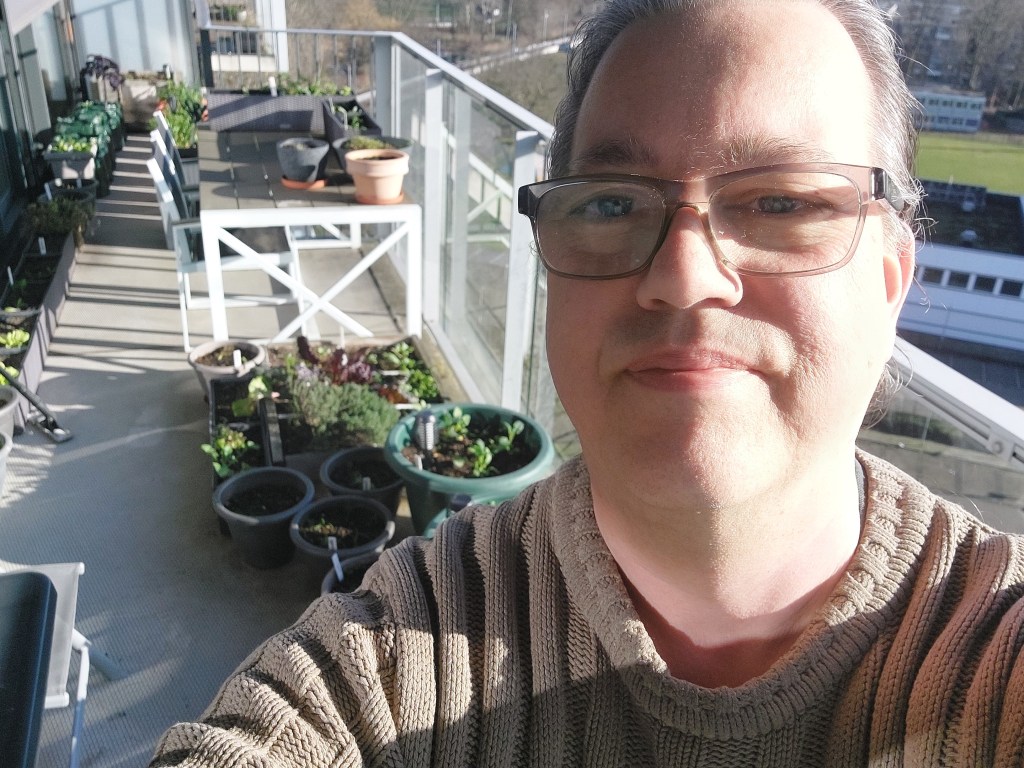
I’m Jim, the gardener behind Balcony Food Factory.
I’ve been growing food for decades, from allotments to my current 10th-floor balcony, where I’ve learned how to grow a surprising amount of food in a surprisingly small space.
Balcony Food Factory is where I share what I’ve learned about growing more food in containers, making the most of limited space, and keeping things practical and manageable.
Want more? Subscribe to the Balcony Food Factory newsletter and I’ll send you practical growing advice, ideas and lessons from my own balcony garden straight to your inbox. You’ll get the below eBook for free too, as a welcome gift. Just click on the image to sign up.
See you there!

A Note About Climate
I garden in Schiedam, the Netherlands, where we have a temperate maritime climate with mild winters, relatively cool to warm summers, and rainfall throughout the year. As a general comparison, my location is approximately USDA Hardiness Zone 8b.
Growing conditions vary considerably between regions, so planting dates, growing seasons, temperatures, and crop recommendations may differ where you live. Please adapt the advice in my articles to your own local climate, weather patterns, and growing conditions.

Leave a Reply