
There is a particular moment in the growing year that can catch you by surprise.
For weeks or even months, your balcony has been producing food.
You have been picking lettuce, harvesting beans, cutting herbs, collecting tomatoes, pulling radishes and enjoying the feeling that your little collection of containers is actually producing a meaningful amount of food.
Then, almost without noticing, things begin to change.
One crop finishes.
Then another.
The tomatoes slow down.
The beans disappear.
The lettuce bolts or becomes exhausted.
And suddenly you look around your balcony and realize that there isn’t much left to harvest.
Your food factory has gone from plenty to almost nothing.
This is one of the biggest challenges of growing food in a small space.
But the problem isn’t necessarily that you don’t have enough containers.
Often, it is that too much of your production was happening at the same time.
When everything starts together, everything can finish together too.
The answer isn’t necessarily to grow more plants.
It is to keep the production moving.
The Zero Point Is Easier To Reach Than You Think
When you have limited space, it is very tempting to plant everything at once.
I have fallen into this trap too, in my early gardening days.
You have a sunny weekend.
The weather looks good.
You have your seeds and seedlings ready.
So you fill the containers.
It feels productive.
And it is productive.
For a while.
The problem comes later.
If you planted three containers of lettuce at roughly the same time, those three containers will also reach the end of their productive period at roughly the same time.
If you planted all your beans together, the bean harvest can arrive in a big wave and then decline rapidly.
If several summer crops were started at the same time, you can eventually have several containers becoming available at almost exactly the same moment.
That creates what I call the zero point.
Not necessarily a literal zero harvest.
But a point where a large part of your balcony stops producing food at the same time.
This can be particularly frustrating because the balcony may still look full.
You can have plenty of green leaves and pots everywhere and yet have very little food to bring into the kitchen.
That is an important lesson.
A balcony full of plants is not necessarily a balcony full of food.
What matters is the movement from planting to growth to harvest and then on to the next crop.
The more evenly you can spread that movement, the less likely you are to experience a complete production collapse.
Don’t Put Everything On The Same Schedule
There is nothing wrong with planting a lot of things at once.
Sometimes it makes sense.
You have the time.
The conditions are right.
And getting several containers planted in one session is convenient.
But convenience at planting time can create inconvenience later.
If everything is planted on the same weekend, you can end up with a large amount of work at the same time, a large harvest at the same time, and then a large amount of empty space at the same time.
You don’t necessarily need to avoid this completely.
Instead, try to avoid making it your default approach.
For crops that are suitable for succession planting, smaller and more widely spaced sowings can be much more useful.
Rather than growing a large amount of something all at once, you can create a sequence.
A little now.
A little later.
And another little bit after that.
This can make the harvest easier to manage.
It can also make the garden easier to manage.
Instead of having everything demanding your attention at the same time, you create a more gradual flow.
This is particularly desirable when your goal is to grow food for your own kitchen rather than produce as much as possible on one particular day.
You probably don’t need ten heads of lettuce ready at the same time.
You need lettuce regularly.
That is a very different goal.
Think About The Next Crop Before The Current One Finishes
One of the simplest habits you can develop is to think one step ahead.
Don’t wait until a container is completely empty before asking yourself what you are going to do with it.
Start thinking about the next crop while the current crop is still producing.
If your lettuce is approaching the end of its productive life, you already know that the container will soon become available.
If your beans are beginning to slow down, you know that their container will eventually be free.
If your tomato plant is clearly reaching the end of its season, you know that a large container is going to become available for something else.
This gives you time.
You can think about what should come next.
You can check whether the potting mix needs attention.
You can decide whether the next crop is suitable for the time of year.
And when the current crop finally finishes, you are ready.
That is a very different approach from clearing a container and then wondering what to do with it. The difference may only be a few days or weeks, but those small gaps matter when you are trying to get the most from limited space.
I like to think of each container as having a sequence of jobs.
The current crop is doing its job.
Soon it will finish.
Then the next crop gets its turn.
That simple way of thinking is at the heart of the Multi-Harvest Container System.
Stagger Your Sowings And Plantings
Succession planting is one of the simplest ways to spread production.
The basic idea is easy.
Instead of sowing everything at the same time, you sow crops at intervals.
This doesn’t mean you have to be constantly sowing things.
You can keep it very simple.
For example, if you know that one sowing will provide more lettuce than you can comfortably use at once, you might make a smaller sowing and then make another one later.
The same principle can work with other suitable crops.
The result is not necessarily more food at any one moment.
It is more food you can actually eat, over a longer period.
And that distinction matters.
Imagine that your balcony produces a huge harvest one week and almost nothing for the next month.
Compare that with a balcony that produces a smaller amount every week.
If you are growing food for yourself, the second situation may actually be much more valuable.
You don’t need your balcony to impress you once.
You want it to feed you repeatedly.
There is also a practical benefit to staggering your plantings.
Your work becomes more spread out.
You don’t have to sow, thin, transplant, harvest and clear everything at the same time.
The garden develops a rhythm.
And that is exactly what you want.
Use Fast Crops To Fill The Gaps

Not every crop needs to occupy a container for months.
This is one of the great advantages of growing food in containers.
You can choose relatively quick crops to make use of shorter windows between larger crops.
Radishes are an obvious example.
So are some types of lettuce and rocket (arugula).
There are many possibilities, depending on your conditions and the time of year.
The important thing is not the specific crop.
It is the principle.
Suppose a large container becomes available in spring but you know it will eventually be needed for a summer crop.
You don’t necessarily have to leave it empty until the summer crop is ready.
If conditions allow it, you may be able to grow a quick crop first.
You harvest it.
Then you prepare the container for the next crop.
You have effectively turned one container into two growing opportunities within the same period.
This is where the physical size of a balcony can be misleading.
A container may only occupy a small amount of floor space, but it can produce food repeatedly.
You are not limited to what can fit in the pot at one particular moment.
You can also make use of what can happen in that pot over time.
That is a major part of making a small growing space productive.
Let Containers Change Jobs
This is perhaps the most important idea behind the Multi-Harvest Container System.
A container does not belong to one crop.
It belongs to your food-producing system.
A container might grow lettuce in spring.
That crop finishes.
The container becomes available.
You grow something else.
That crop finishes.
You grow something else again.
The exact sequence will depend on your climate, the size of the container, the crops you want to grow and the conditions on your balcony.
But the principle remains the same.
One container can have several productive lives.
This is very different from the traditional idea that you plant a crop, grow it, harvest it and then wait until next year to use that space again.
Why would you?
If the conditions are suitable for another crop, why not make use of the space?
Of course, there will be times when you should not plant something.
A container may need refreshing.
The season may be wrong.
The weather may be unfavorable.
Sometimes leaving a container empty for a while is the sensible thing to do.
The point isn’t to force every container into constant production.
The point is to recognise when another productive opportunity exists.
That is a much more effective way of thinking.
Keep Some Things Growing For Later
Keeping your food factory from going to zero isn’t only about what you can harvest next week.
Sometimes you need to think further ahead.
A crop started today may not be ready for a while.
That is perfectly fine.
In fact, it is necessary.
You need crops at different stages of development.
Some are ready now.
Some are growing strongly.
Some are young.
And some have only just been planted.
That is what creates continuity.
Autumn is a good example.
You may start suitable crops as the summer season winds down, not because you expect a huge harvest immediately, but because you want something growing for later in the year.
Some crops can be established before winter and provide harvests during the colder months.
That means your autumn planting is contributing to your future food supply.
The same principle applies throughout the year.
Don’t only ask:
“What can I harvest now?”
Also ask:
“What am I growing for the next harvest?”
That one question helps you avoid the feast-or-famine cycle.
Accept That Production Will Rise And Fall
There is an important reality check here.
You cannot expect a balcony food garden to produce the same amount of food every week of the year.
Nor should you try.
Plants respond to temperature, daylight and weather.
Growth slows down when conditions become difficult.
Some crops naturally have short productive periods.
Winter is not summer.
Spring is not autumn.
There will be peaks.
There will be quieter periods.
That is normal.
The goal is not to eliminate every quiet period.
The goal is to avoid unnecessary periods when everything stops.
There is a big difference between having less food available in winter and having nothing because you allowed all your crops to finish at exactly the same time.
A successful food-producing balcony is not one that produces maximum quantities every day.
It is one that makes good use of the opportunities available.
Sometimes that might mean a basket full of tomatoes.
Sometimes it might mean a handful of salad leaves.
Sometimes it might mean a few radishes or some fresh herbs.
Every harvest counts.
And over time, those smaller harvests add up.
Build A Simple Continuity System
You don’t need a complicated spreadsheet to keep your Balcony Food Factory moving.
A simple mental system is enough to get started.
Know What Is Growing
Take a look around your balcony regularly.
Know what each container is currently producing.
Know What Is Nearly Finished
Some crops give you plenty of warning.
If a crop is slowing down or clearly approaching the end of its productive life, take note.
Know Which Containers Will Become Available
This is your future growing space.
Think of those containers as opportunities rather than empty pots.
Think About What Comes Next
Choose a suitable follow-up crop.
It doesn’t have to be decided months in advance.
Just stay one step ahead.
Stagger Crops
Where succession planting makes sense, don’t put everything in at once.
Spread your sowings or plantings.
Use Shorter Crops When Appropriate
If you have a gap between two larger crops, consider whether something quick could make use of that space.
Keep Crops At Different Stages
Try to avoid having everything ready at once.
Some plants should be mature.
Some should be growing.
Some should be getting started.
That creates the flow you are looking for.
The basic cycle is remarkably simple:
Growing → Harvesting → Clearing → Replanting → Growing Again
The important thing is not to make the process complicated.
It is simply to keep the cycle moving.
The Goal Is Not Zero Empty Pots
There is one thing I want to make clear.
Keeping your food factory from going to zero does not mean that every pot on your balcony must contain a plant at all times.
That would be unnecessary.
And it could actually create more work.
Sometimes a container needs to be cleaned.
Sometimes the potting mix needs to be refreshed.
Sometimes you have reached a point in the season when there is simply nothing sensible to plant.
And sometimes you need a break.
That’s fine. There is no judging here.
An empty container is not automatically wasted space.
The problem is an empty container that could be producing food but isn’t because you haven’t thought about what comes next.
There is an important difference between the two.
You don’t want to become obsessed with filling every available centimetre of your balcony.
That isn’t the purpose of the Balcony Food Factory.
The purpose is to make productive use of the space you have.
Sometimes the most productive decision is to wait.
Sometimes it is to plant.
Knowing which is which is part of becoming a better container gardener.
Keep The Food Factory Moving
Once you start thinking this way, a balcony garden begins to look quite different.
You stop seeing a collection of individual pots.
You start seeing a flow of food.
This container is being harvested.
That one is growing.
Another is nearly finished.
A fourth has just been planted.
And somewhere else, a young crop is getting established for a harvest that is still weeks away.
The balcony is always changing.
And that is exactly what you want.
The goal isn’t to have every container producing at the same time.
The goal is to avoid having every container stop producing at the same time.
That is the difference between maximum production and continuous production.
Maximum production might give you a spectacular harvest.
Continuous production gives you food again and again.
For a small balcony, I know which one I prefer.
So whenever you harvest the last crop from a container, don’t just see an empty pot.
See an opportunity.
Ask yourself:
“What can grow here next?”
That question can keep your Balcony Food Factory moving through the seasons.
Because the secret isn’t necessarily to grow more plants at the same time.
It is to make sure the space keeps producing after each harvest.
And if you can do that, your balcony doesn’t need to be enormous to produce a surprising amount of food.
It just needs to keep moving.
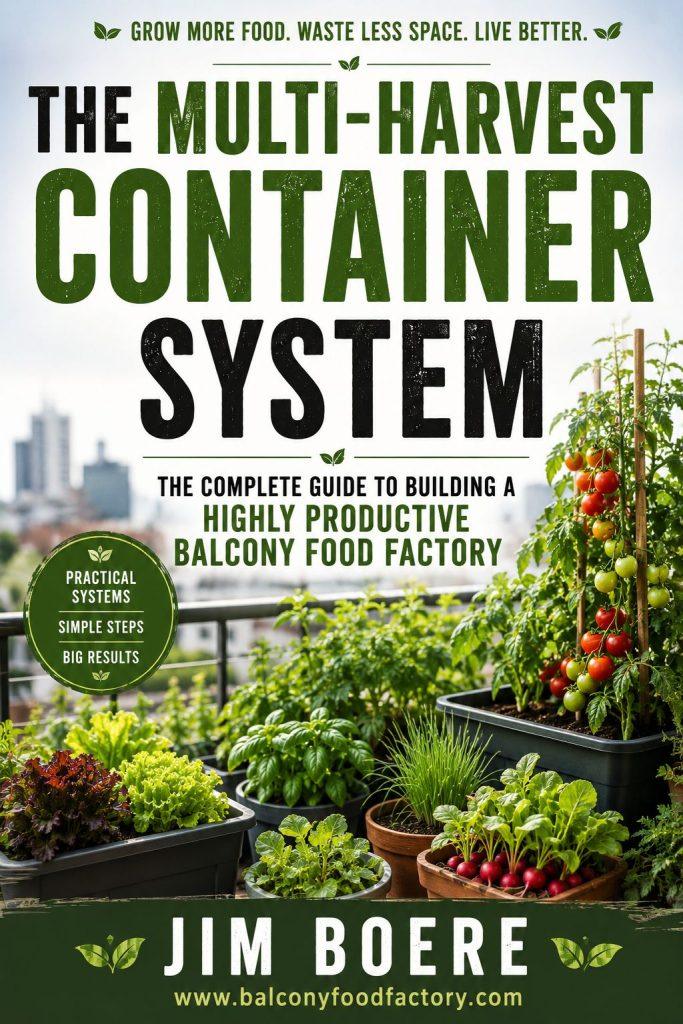
If you want to learn the complete system, my book The Multi-Harvest Container System Starter Guide brings together the principles of succession planting, companion planting, soil management and efficient container growing, along with practical high-yield container setups you can adapt to your own balcony.
Recommended Further Reading
Want to explore this idea further? These articles are a good place to continue:
From A Collection Of Pots To A Food-Producing System
Your Balcony Can Grow More Food Than You Think
How To Grow More Food Without Adding More Pots
About Me
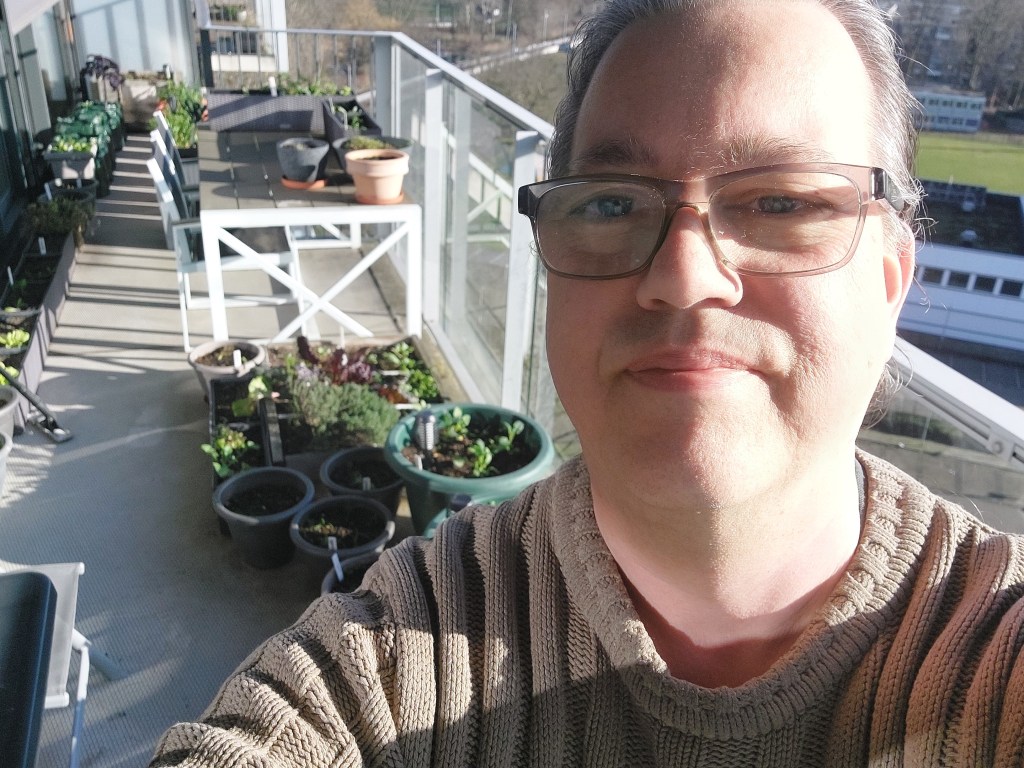
I’m Jim, the gardener behind Balcony Food Factory.
I’ve been growing food for decades, from allotments to my current 10th-floor balcony, where I’ve learned how to grow a surprising amount of food in a surprisingly small space.
Balcony Food Factory is where I share what I’ve learned about growing more food in containers, making the most of limited space, and keeping things practical and manageable.
Want more? Subscribe to the Balcony Food Factory newsletter and I’ll send you practical growing advice, ideas and lessons from my own balcony garden straight to your inbox. You’ll get the below eBook for free too, as a welcome gift. Just click on the image to sign up.
See you there!

A Note About Climate
I garden in Schiedam, the Netherlands, where we have a temperate maritime climate with mild winters, relatively cool to warm summers, and rainfall throughout the year. As a general comparison, my location is approximately USDA Hardiness Zone 8b.
Growing conditions vary considerably between regions, so planting dates, growing seasons, temperatures, and crop recommendations may differ where you live. Please adapt the advice in my articles to your own local climate, weather patterns, and growing conditions.

Leave a Reply