
Most gardeners naturally think in terms of growing seasons.
Perhaps you do as well?
Spring is when you start planting.
Summer is when everything grows.
Autumn is when the growing season winds down.
Winter is when the garden rests.
Then spring comes around again and you start over.
There is nothing wrong with thinking this way. The seasons are real, and they have a huge influence on what you can grow and when you can grow it.
But when you are trying to grow meaningful amounts of food in a limited number of containers, I think there is another way of looking at the year that is much more useful.
Instead of thinking only in terms of growing seasons, start thinking in terms of production cycles.
That means looking at your containers not simply as places where plants grow during a particular season, but as pieces of growing space that can potentially produce several crops over time.
It is one of the ideas at the heart of the Multi-Harvest Container System.
And once you start thinking this way, you may never look at an empty container in quite the same way again.
The Growing Season Is Not The Whole Story
Imagine that you have a large garden.
You have plenty of beds.
You grow some lettuce in spring, tomatoes in summer, perhaps some autumn crops later in the year.
If one bed is empty for a while, you may not be particularly concerned.
You have plenty of other space.
But now imagine that your entire food garden consists of five, ten or fifteen containers on a balcony.
Suddenly, every container matters.
If one of those containers produces food for three months and then sits empty for the next six months, you have lost a significant amount of potential from that piece of space.
The physical container hasn’t changed.
The balcony hasn’t changed.
The amount of sunlight hasn’t necessarily changed.
What has changed is whether you are using the growing space during the time available to you.
That is where production cycles come in.
Seasons Are Useful, But They Are Not Production Cycles
I am not suggesting that you ignore the seasons.
Quite the opposite.
The seasons tell you a great deal about what is possible.
Spring brings increasing light and warmth.
Summer provides the conditions that many warm-season crops need.
Autumn brings cooler temperatures and changing day length.
Winter slows many crops down considerably.
These conditions determine what you can grow.
The season itself doesn’t have to determine when a container starts and stops producing though.
Think of it this way.
The seasons describe the conditions.
Production cycles describe what you do with those conditions.
In spring, you might have the opportunity to grow a fast crop.
When that crop finishes, summer conditions may allow something completely different to take its place.
When summer ends, cooler conditions can open up another opportunity.
And even during winter, suitable crops may continue producing, although at a much slower rate.
So what I am proposing is that rather than thinking:
“This is the spring growing season.”
you can start thinking:
“What production opportunity does spring give me?”
That is a subtle difference, but it changes the way you plan.
The Problem With Thinking In One Growing Season
There is a very common pattern in balcony gardening.
Spring arrives.
You get enthusiastic.
You sow seeds and plant everything you can.
Summer arrives and the balcony is full of plants.
You harvest tomatoes, lettuce, herbs and other crops.
Then the summer crops finish.
Some containers are emptied.
Others are left with tired plants.
The weather gets colder.
Production slows down.
Eventually, much of the balcony is simply waiting for spring.
Then, several months later, the whole process starts again.
There is nothing inherently wrong with this.
But it means you are treating the year as one large production event.
You have a beginning.
You have a peak.
And you have an end.
For a gardener with plenty of space, that may be perfectly acceptable.
For a balcony gardener trying to get the most from limited space, I think it is worth asking whether there is another option.
What if your container didn’t have one growing season?
What if it had several production cycles?
A Container Doesn’t Know When The Season Is Over
One of the simplest ideas in the Multi-Harvest Container System is also one of the most impactful:
When one crop finishes, the container is not finished.
The lettuce may be finished.
The tomato plant may be finished.
The radishes may be harvested.
But the container is still there.
The growing space is still there.
And depending on the conditions, something else may be able to use it.
This is why I often come back to one question:
What could this container be doing this month?
It is a very different question from:
“What should I plant this spring?”
The first question keeps you thinking about the entire year.
The second tends to focus your attention on one particular season.
Neither question is wrong.
But for a productive container garden, the first one can be much more effective.
What Is A Production Cycle?
A production cycle is simply the period from starting a crop to finishing that crop and moving on to the next opportunity.
It can be very simple:
Sow → Grow → Harvest → Remove → Refresh → Replant
Then the cycle begins again.
Not every crop follows exactly the same pattern.
Some crops are harvested once.
Some provide repeated harvests.
Some grow quickly.
Others occupy a container for many months.
Some can share a container with other crops.
Some are better grown alone.
That is why I don’t think of the Multi-Harvest Container System as a rigid schedule.
The system is about recognising the opportunities available in your particular situation.
One production cycle might take six weeks.
Another might take several months.
The important thing is that you recognise when one cycle is ending and start thinking about what can happen next.
Time Becomes Part Of Your Growing Space

This is perhaps the most important idea in the whole concept.
Your balcony has a fixed physical area.
If you have an 6-square-meter balcony, it remains 6 square meters.
You cannot make it physically larger.
But you can use that same space at different times.
A container used for one crop in spring can potentially be used for another crop in summer.
That crop may be followed by something suitable for autumn.
Something else may continue into winter.
The physical space hasn’t increased.
But the amount of production you can get from that space potentially has.
In other words, time becomes another dimension of your growing space.
This is particularly important when you don’t have much space to begin with.
A gardener with a large allotment can solve many problems simply by using another piece of ground.
A balcony gardener doesn’t have that option.
We have to become better at using the space we already have.
One Container Can Have Several Production Cycles
Let’s look at a simple example.
Imagine one reasonably sized container.
In spring, you might grow radishes and rocket (arugula).
Once those crops have been harvested, you could prepare the container for lettuce.
Later, as the weather becomes suitable, the container could be used for a summer crop such as a tomato, perhaps with some companion plants.
When the summer crop finishes, the container could be prepared for spinach or another autumn crop.
Depending on your climate and conditions, winter might bring garlic or winter greens.
So the container has gone through several different stages:
Spring → Early Summer → Summer → Autumn → Winter
It has not produced the same thing throughout the year.
It doesn’t need to.
The point is that the same growing space has remained useful.
This is only an example.
The actual sequence will depend on where you live, your balcony’s exposure, your container size, your climate and the crops you choose.
There is no universal production cycle that everyone should copy.
The principle is more important than the exact crop sequence.
The Most Important Moments Are Often The Transitions
When we think about gardening, we tend to focus on the obvious moments.
Sowing.
Planting.
Growing.
Harvesting.
But in a multi-harvest system, the transitions between crops become extremely important too.
A crop finishes.
What happens next?
This is where a lot of potential productivity can disappear.
Suppose a container becomes available in July.
You don’t think about it.
A few weeks pass.
Then you decide what to grow.
You need to find seeds.
You need to prepare the container.
You finally plant.
Another few weeks have gone by.
The container may have lost a significant part of the growing opportunity that was available.
Now compare that with knowing in advance that your current crop is likely to finish soon.
You already know what could follow it.
You have the seeds.
You know whether the soil needs refreshing.
You are ready to move into the next cycle.
The difference isn’t necessarily more gardening.
It is simply better continuity.
That is why I consider the transition between crops to be one of the most important parts of the system.
Always Have A Next Crop In Mind
This doesn’t mean you need to plan every single day of the next twelve months.
I certainly don’t garden that way.
Gardening is too dependent on weather and actual growing conditions for that kind of precision to be useful.
Instead, I like to just think one step ahead.
If a container is currently growing lettuce, I want to have some idea of what could follow it.
If a tomato is approaching the end of its productive period, I can start thinking about the next (autumn) crop.
If I know that an autumn opportunity is approaching, I can prepare for it before the summer crop has completely finished.
That is enough.
Planning doesn’t have to mean rigidity.
It can simply mean being aware of what comes next.
And that makes gardening much easier.
You aren’t constantly starting from zero.
The Year Is A Series Of Opportunities
Once you start thinking in production cycles, the year begins to look different.
Spring — Building Momentum
As light and temperatures increase, more growing opportunities become available.
This is when you begin building production rather than simply waiting for summer.
Summer — Peak Production
Summer is often the most productive period for many balcony crops.
Warmth, light and long days can support rapid growth.
It is also when watering, feeding and managing vigorous plants can become particularly important.
Autumn — The Second Spring
I have always liked the idea of autumn as a second spring.
Not because the conditions are identical, but because there is another opportunity to establish crops that prefer cooler conditions.
If you treat summer as the end of gardening, you can miss this opportunity completely.
Winter — Maintaining Continuity
Winter is different.
Production is slower.
The days are shorter.
Many crops simply aren’t going to grow at summer speed.
But slower production isn’t the same thing as no production.
Suitable winter crops can continue growing, and some can provide harvests during a period when many people have stopped thinking about their balcony garden altogether.
The important point is that year-round growing does not mean maximum production all year.
It means keeping the system moving in a way that makes sense for the conditions.
You Don’t Have To Force Production
There is an important point I want to make here.
I am not suggesting that you should try to force a crop into every container during every month of the year.
That would be counterproductive.
There will be periods when very little is suitable.
There will be times when a container is better left alone.
There will be crops that need a long growing period.
There will be bad weather.
There will be unexpected failures.
And sometimes the sensible thing to do is simply wait.
The Multi-Harvest approach isn’t about fighting nature.
It is about recognising the opportunities that nature gives you.
If your climate allows a crop to grow at a particular time, use that opportunity.
If conditions are unfavorable, don’t force it.
The system is supposed to make gardening more productive and more manageable, not more stressful.
Climate Changes The Calendar, Not The Principle
A planting date that works for me in the Netherlands may be completely wrong for someone living somewhere else.
Even two balconies in the same city can have different growing conditions.
One may be sheltered.
Another may be exposed to wind.
One may receive several hours of direct sun.
Another may be shaded for much of the day.
So I don’t believe in pretending that there is one perfect calendar for everyone.
What remains valid is the principle.
Harvest one crop. Prepare the space. Move into the next suitable production cycle.
The exact crop and timing are yours to determine.
That is one of the reasons I prefer to think in terms of opportunities rather than fixed dates.
What Happens When You Don’t Think In Cycles?
Once you start looking for production cycles, you can also see what happens when they are missing.
You may find yourself with:
- containers that sit empty after harvest
- too many crops all maturing at the same time
- huge harvests followed by long periods with very little to harvest
- summer crops occupying space long after they have stopped producing well
- autumn opportunities that are missed
- containers that aren’t replanted because nobody thought about what comes next
- more pots being added simply because existing pots aren’t being used efficiently
Again, none of this means someone is gardening “wrong.”
It is simply what happens when we naturally think in terms of seasons rather than production cycles.
Once you change the way you look at the year, these things become easier to notice.
And once you notice them, you can start changing them.
Production Cycles Change How You Plan
You don’t need an enormous spreadsheet.
You don’t need to know exactly what every pot will contain twelve months from now.
Start with a few simple questions.
What is growing now?
When is it likely to finish?
What could follow it?
What can I prepare now?
Does the container need a soil reset?
What crops suit the conditions that will follow?
What would I actually like to harvest?
Those questions are enough to begin.
You’re no longer planning only what you will plant in spring.
You’re thinking about how the growing space will be used throughout the year.
That is a much more dynamic way of gardening.
Production Cycles Don’t Have To Mean More Work
At first, the idea of growing several crops from the same container might sound to you like more work.
More crops.
More planting.
More harvesting.
More things to think about.
But that isn’t necessarily how it works.
The objective of the Multi-Harvest Container System is not to keep adding tasks.
It is to make better use of the work you are already doing.
You already have to prepare a container.
You already have to water it.
You already have to feed the plants.
You already have to harvest.
If that same container can then move into another useful production cycle, you have gained more from the space without necessarily multiplying the workload.
Of course, more production does require some management.
There is no magic involved.
But efficient gardening is about finding the point where the extra food is worth the extra effort.
That balance matters.
The Goal Is Continuity, Not Maximum Production
This may be the most important distinction of all.
The goal isn’t to force your balcony to produce as much food as physically possible every single month.
That would be exhausting.
And it would probably make the balcony a much less enjoyable place.
The goal is continuity.
You want the food factory to keep working whenever sensible.
Some months will be highly productive.
Some will be slower.
Some crops will provide large harvests.
Others will provide small but regular harvests.
That is perfectly normal.
Think of it as a rhythm rather than a straight line.
Build → Produce → Harvest → Transition → Continue → Slow Down → Build Again
The balcony doesn’t have to operate at maximum capacity all year.
It simply shouldn’t have to disappear completely for half the year either.
From Growing Seasons To Production Cycles
Once you understand the difference, you may find yourself asking different questions.
Instead of:
“It’s spring. What should I plant?”
you start thinking:
“What production opportunity does spring give me?”
Instead of:
“The summer season is over.”
you start thinking:
“This summer crop is finished. What can follow it?”
Instead of:
“There isn’t much growing in winter.”
you start thinking:
“Production is slower now. What will still grow?”
Instead of:
“This container is empty.”
you start thinking:
“What could this container be doing next?”
That is the mental shift.
The seasons haven’t disappeared.
You simply stop allowing them to define the entire life of your containers.
The Multi-Harvest Container System In Practice
This way of thinking is one of the foundations of the Multi-Harvest Container System.
Succession planting helps you move from one crop to another.
Companion planting helps you make better use of space.
Soil management helps you maintain the container between production cycles.
Efficient gardening keeps the whole process manageable.
But production cycles are what connect those ideas across the year.
You’re not simply growing a collection of plants.
You’re using a limited amount of space to create a sequence of useful harvests.
That is what makes the system different from simply putting vegetables into pots.
It is a way of thinking about production.
Start Looking At Your Balcony Differently
You don’t need to redesign your entire balcony to try this.
Pick one container.
Ask yourself:
What is growing here now?
When will it probably finish?
What could follow it?
Does the soil need attention?
What would I actually like to harvest next?
Don’t try to create the perfect twelve-month plan.
Just look one step ahead.
When you get used to doing that, look two steps ahead.
Then try it with two containers.
Eventually, you will start seeing opportunities that you might previously have missed.
A container that is about to become empty won’t simply look empty anymore.
It will look available.
And that is a very different way of looking at your balcony.
Your Balcony Has More Time Than You Think
Your balcony has a fixed amount of space.
But that space exists every day of the year.
The seasons change.
The crops change.
The weather changes.
Your plans will change.
But the containers remain.
That means you have more growing time available than you might realize.
A container doesn’t have to be a lettuce container.
It doesn’t have to be a tomato container.
It doesn’t have to belong permanently to one crop or one season.
It can be part of a sequence.
One crop can make way for another.
One harvest can lead to the next production cycle.
And gradually, your balcony can move from a collection of pots that happen to contain vegetables to something much more organised and productive.
You are still gardening with the seasons.
You are simply no longer stopping when one season ends.
You’re looking at the year differently.
You’re looking at your containers differently.
And you’re asking a better question:
What could this container be doing next?
That question is at the heart of the Multi-Harvest Container System.
And once you start applying that thinking to several containers at the same time, something else happens.
You stop seeing your balcony as a collection of individual pots.
You start seeing it as a food-producing system.
If you want to learn the complete system, my book The Multi-Harvest Container System Starter Guide brings together the principles of succession planting, companion planting, soil management and efficient container growing, along with practical high-yield container setups you can adapt to your own balcony.
Recommended Further Reading
Want to explore this idea further? These articles are a good place to continue:
From A Collection Of Pots To A Food-Producing System
Spring: How To Get Your Balcony Food Factory Moving
How To Keep Your Balcony Food Factory From Going To Zero
About Me
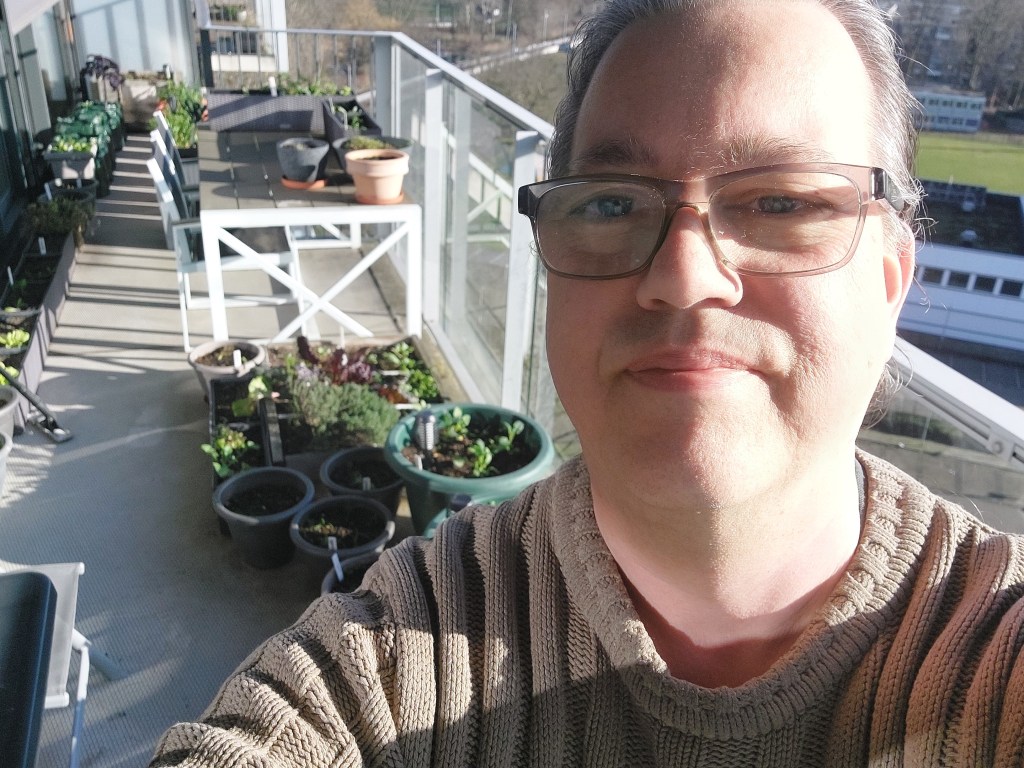
I’m Jim, the gardener behind Balcony Food Factory.
I’ve been growing food for decades, from allotments to my current 10th-floor balcony, where I’ve learned how to grow a surprising amount of food in a surprisingly small space.
Balcony Food Factory is where I share what I’ve learned about growing more food in containers, making the most of limited space, and keeping things practical and manageable.
Want more? Subscribe to the Balcony Food Factory newsletter and I’ll send you practical growing advice, ideas and lessons from my own balcony garden straight to your inbox. You’ll get the below eBook for free too, as a welcome gift. Just click on the image to sign up.
See you there!

A Note About Climate
I garden in Schiedam, the Netherlands, where we have a temperate maritime climate with mild winters, relatively cool to warm summers, and rainfall throughout the year. As a general comparison, my location is approximately USDA Hardiness Zone 8b.
Growing conditions vary considerably between regions, so planting dates, growing seasons, temperatures, and crop recommendations may differ where you live. Please adapt the advice in my articles to your own local climate, weather patterns, and growing conditions.

Leave a Reply