
This s a 4-minute conversation about a blog article I recently posted, wich discusses how to keep your potting mix healthy throughout the year.
Being a man of the written word myself, this audio is fully AI-generated. It’s not me talking, it’s all AI. But it explains my long article well, in just over 4 minutes.
Are you very busy right now? Or do you learn better through audio?
Then I do believe this audio can be really helpful to you.
Hope you enjoy.
And here’s the transcript as well:
Pip: If you’ve ever wondered whether the dirt in your pots has feelings about being ignored, Jim Boere at Balcony Food Factory has some news for you — and it’s not great for the neglecters.
Mara: This episode follows one extended, practical guide on keeping container potting mix healthy across an entire growing year — covering structure, nutrition, reuse, and what the mix is actually telling you when things go wrong.
Pip: Let’s get into the soil.
How To Keep Your Potting Mix Healthy All Year
Pip: The central question here is whether container gardeners are paying enough attention to what’s in the pot before the plant goes in — and whether all that replacing and refreshing is actually necessary.
Mara: The post frames it plainly from the start: “If we take good care of the soil, the soil will take good care of our plants. That gardening wisdom applies to container gardening too.”
Pip: And the upshot is that most gardeners are probably doing too much of one thing and not enough of another — tossing out usable mix while skipping the actual inspection that would tell them what the mix needs.
Mara: Right. The post breaks potting mix health down to three things that have to work together: good structure so roots get oxygen, moisture management that retains water without waterlogging, and available nutrients that don’t just drain away with every watering. Any one of those failing quietly can tank a harvest even when everything else looks fine.
Pip: The structure point is the one that gets buried — pun fully intended. A nutrient-rich mix that’s compacted is still a bad mix.
Mara: The post is clear on that. It also pushes back on a couple of common habits: adding gravel to the bottom of pots for drainage, which the post says doesn’t solve the underlying problem and can actually trap water above the layer, and automatically replacing all potting mix every spring without checking whether it actually needs it.
Pip: So the expensive annual soil purge might be theater.
Mara: In many cases, yes. The post argues that reuse is often practical when the mix is still in reasonable condition and disease hasn’t been a problem. The framework it proposes is three-stage care — before planting, during growth, and between crops — rather than one big annual intervention.
Mara: Between crops is where the post puts the most emphasis. When a plant finishes, you inspect the mix: check texture, smell, drainage, root density, volume. Then you decide whether it needs a light refresh or something more substantial before the next crop goes in.
Pip: And the crop itself changes what “refresh” means — a tomato plant running for months has completely different demands from a quick radish.
Mara: Exactly. The post walks through leafy crops, fruiting crops, root crops, and herbs separately. Herbs like thyme and rosemary, for instance, can struggle if fed too heavily or kept too wet — conditions that would suit basil just fine.
Pip: One practical detail worth flagging: the post mentions using liquid fertilizer periodically during summer, added to the watering can, but not applied to every pot — some herbs don’t need or want it.
Mara: That fits the broader argument: observe the container, then act. The post lists the warning signs — water draining too slowly, mix drying out unusually fast, significant shrinkage, a dense root mat, plants struggling despite reasonable care — as prompts to investigate rather than automatically reach for fertilizer.
Pip: The whole thing connects to what the post calls the Multi-Harvest Container System — the idea that each harvest-to-replant moment is also a maintenance moment, built into the cycle rather than bolted on.
Mara: Which means potting mix care stops being a separate task and becomes part of how you move from one crop to the next.
Pip: The thread running through all of this is that containers are a closed system — what goes in and what you maintain is all the plant ever gets.
Mara: Observe, refresh where needed, leave well alone where not. More to grow from there.
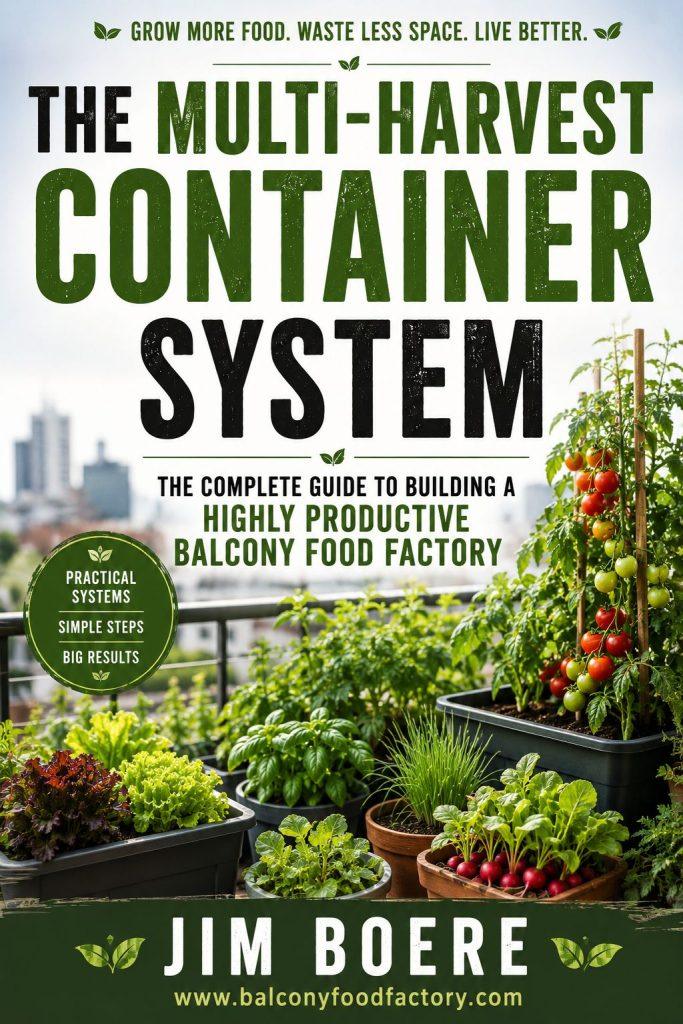
If you want to learn the complete system, my book The Multi-Harvest Container System Starter Guide brings together the principles of succession planting, companion planting, soil management and efficient container growing, along with practical high-yield container setups you can adapt to your own balcony.
Recommended Further Listening:
Audio: The Multi-Harvest Container System Explained
About Me
I’m Jim, the gardener behind Balcony Food Factory.
I’ve been growing food for decades, from allotments to my current 10th-floor balcony, where I’ve learned how to grow a surprising amount of food in a surprisingly small space.
Balcony Food Factory is where I share what I’ve learned about growing more food in containers, making the most of limited space, and keeping things practical and manageable.
Want more? Subscribe to the Balcony Food Factory newsletter and I’ll send you practical growing advice, ideas and lessons from my own balcony garden straight to your inbox. You’ll get the below eBook for free too, as a welcome gift. Just click on the image to sign up.
See you there!

A Note About Climate
I garden in Schiedam, the Netherlands, where we have a temperate maritime climate with mild winters, relatively cool to warm summers, and rainfall throughout the year. As a general comparison, my location is approximately USDA Hardiness Zone 8b.
Growing conditions vary considerably between regions, so planting dates, growing seasons, temperatures, and crop recommendations may differ where you live. Please adapt the advice in my articles to your own local climate, weather patterns, and growing conditions.


Leave a Reply