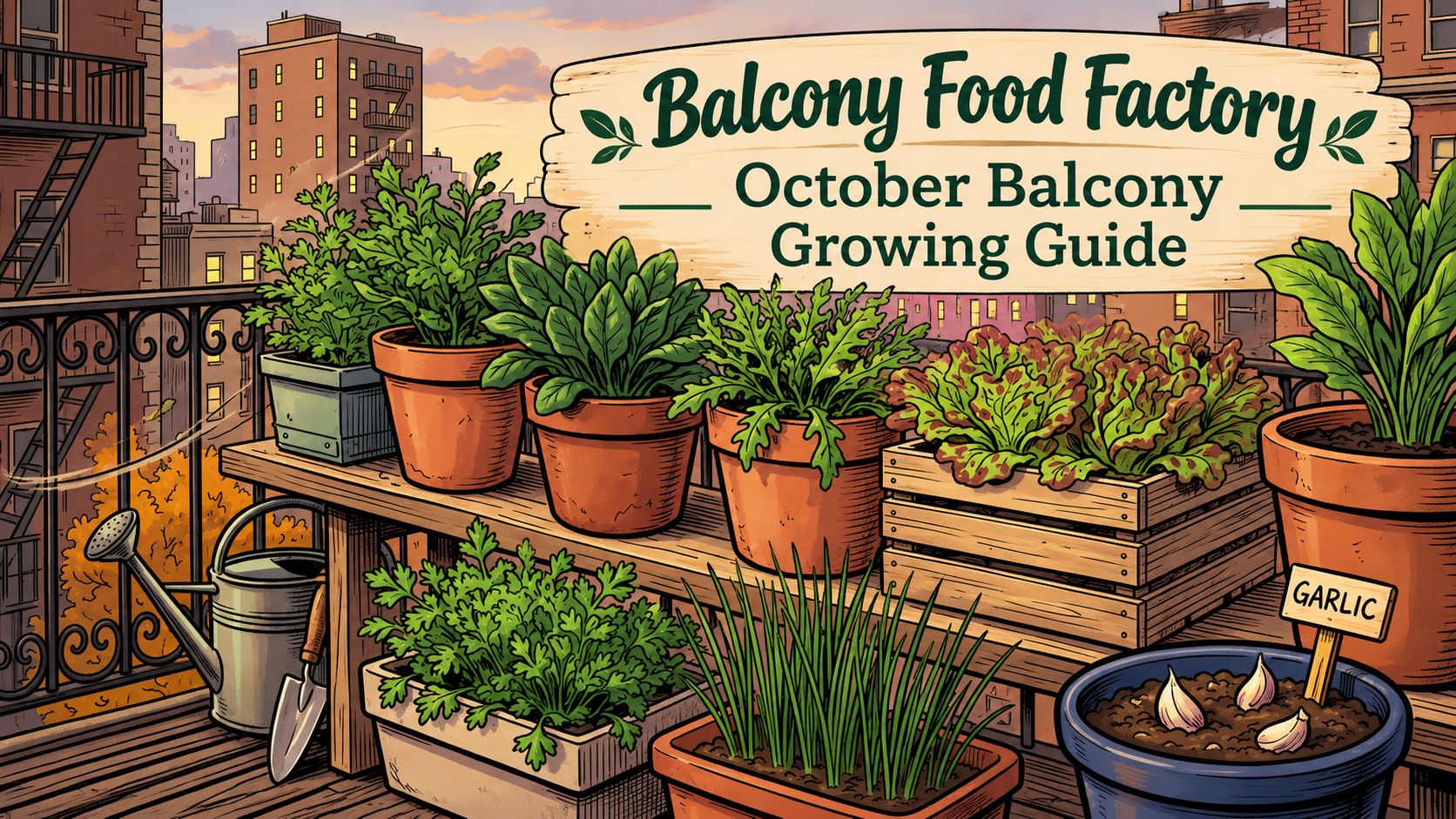
Keep harvesting, plant for winter, and prepare for next year’s harvest:
October is a month of transition on the balcony.
Summer crops are gradually winding down, but there is still plenty to harvest. At the same time, cool-season crops can be established, garlic can be planted for next summer, and containers can be prepared for the colder months ahead.
The aim this month is not to squeeze every last bit of summer out of the balcony. It is to keep production going while smoothly moving from one growing season into the next.
October At A Glance
| Sow | Plant | Harvest | Prepare |
|---|---|---|---|
| Spinach | Garlic | Lettuce | Check drainage |
| Rocket | Onions | Rocket | Secure containers |
| Winter lettuce | Spinach | Protect vulnerable crops | |
| Endive | Radishes | Remove finished crops | |
| Winter purslane | Green onions | Reduce watering | |
| Winter salad mixes | Beetroot | Plan winter production | |
| Kale | Carrots |
October’s Main Job
Keep harvesting what is productive, establish the crops that will carry you into winter, and make sure every available container has a plan.
If You Only Do Five Things This Month
You don’t need to tackle everything at once.
If time is limited, concentrate on these five jobs:
1. Keep harvesting productive plants.
Don’t remove healthy plants simply because it is October.
2. Sow a few cool-season crops.
Spinach, rocket (arugula), winter lettuce and kale are particularly useful choices.
3. Plant garlic and/or onions if you have the space.
An October planting can provide a summer harvest next year.
4. Clear genuinely finished summer crops.
Don’t keep an exhausted plant occupying valuable growing space.
5. Decide what each available container will produce next.
A little planning now prevents empty containers later.
Your Balcony This Month
Before reaching for your seed packets, take a walk around your balcony.
Look at each container and put it into one of three categories.
Still Productive
The plant is healthy and still giving you food.
Leave it alone and keep harvesting.
Nearly Finished
The crop is declining but may still provide another harvest or two.
Keep harvesting it while it remains worthwhile, then prepare the container for its next crop.
Finished
The plant has stopped producing or is clearly declining.
Remove it and decide what should follow it.
This simple check is more helpful than treating October as a date when everything suddenly needs to be cleared.
Sow In October
October is a good month for establishing cool-season leafy crops.
Growth will be slower than it was during summer as daylight decreases. That is perfectly normal. The objective is to establish useful plants for the cooler months rather than expecting midsummer growth rates.
| Crop | Why Grow It Now | October Approach |
|---|---|---|
| Spinach | Productive cool-season crop | Sow modest quantities |
| Rocket | Fast-growing and productive | Small repeated sowings |
| Winter Lettuce | Extends salad production | Loose-leaf types are useful for repeated harvesting |
| Endive | Another cool-season leafy crop | Great for variety |
| Winter Purslane | Suited to cooler conditions | Establish for winter production |
| Winter Salad Mixes | Variety in a small space | Sow only what you can use |
| Kale | Hardy winter crop | Establish for winter production |
A Good October Rule
Sow less, but sow deliberately.
It is easy to become enthusiastic when you see empty space appearing on the balcony. But winter growth is slower, so filling every available container at once isn’t necessarily the most productive approach.
A few smaller sowings can give you a more useful succession of crops.
Plant In October: Garlic

If there is one planting that deserves special attention this month, it is garlic.
Garlic is a remarkably low-maintenance balcony crop because it occupies a container for many months but requires relatively little attention during that time.
How To Plant It
Choose a container with approximately 20–25 cm (8–10 inches) of depth and make sure it drains well.
Then:
1. Separate the cloves.
Use individual cloves rather than planting the whole bulb.
2. Plant pointed end up.
The root end goes down and the pointed end faces upward.
3. Plant several centimetres deep.
Give the cloves enough room to develop without overcrowding.
4. Water it in.
After that, the main job is patience.
Garlic will establish itself before winter and continue developing through the following growing season.
The Garlic Timeline
October
Plant
↓
Autumn & Winter
Establishes and grows slowly
↓
Spring
Active growth resumes
↓
June / July
Harvest
Plant it now. Harvest it next summer.
The Garlic Downside
Yes, there is one and I don’t want to hide it.
Garlic does occupy the container for 9-10 months. Which is a long time.
If you have just one or a couple of containers to work with, this is something you do need to consider.
Several different crops could grow in the same container during this same period. Giving you multiple harvests.
For example, you could grow lettuce in spring, tomatoes in summer, and spinach in autumn. In the same container.
So you have a real choice here. Harvesting your own garlic in July is a treat, don’t get me wrong. I grow garlic every year.
But there is a real downside if your growing space is very limited.
Kale: A Great Winter Crop For Containers

Kale is one of those crops that earns its space on a productive balcony. Sow it in October and you are establishing a crop that can keep going when many summer vegetables have finished.
It is particularly valuable in a Multi-Harvest Container System because you don’t need to harvest the whole plant at once. Pick leaves as you need them and let the plant continue growing.
Harvest In October
There can still be plenty to eat from the balcony this month.
Leafy Crops
- Lettuce
- Rocket
- Spinach
- Winter purslane
- Other established salad crops
Root Crops
- Radishes
- Beetroot
- Carrots
Useful Everyday Crops
- Green onions
- Parsley
- Chives
And Don’t Forget Summer
If tomatoes, peppers or bush beans are still healthy and producing, continue harvesting them.
October does not mean that every summer crop must immediately be removed.
The better question is:
Is this plant still giving me something worth keeping it for?
If the answer is yes, keep harvesting.
If the answer is no, its container can move on to the next crop.
Harvest Little And Often
Many leafy crops benefit from regular harvesting rather than waiting until everything is ready at once.
With loose-leaf lettuce, for example, you can harvest individual outer leaves while leaving the growing centre intact.
Rocket and spinach can also provide repeated harvests when managed this way.
This has another advantage on a small balcony:
You harvest what you actually need instead of creating a large pile of produce all at once.
The October Container Turnover
This is one of the most efficient ways to think about the balcony this month.
When a crop finishes, the container does not have to become an empty container.
It can become the starting point for the next harvest.
The Basic Cycle
Crop finishes
↓
Remove old plant
↓
Refresh the potting mix if necessary
↓
Choose the next crop
↓
Sow or plant
↓
Harvest again
This doesn’t mean that every container must be productive every single day of the year.
It simply means that when growing space becomes available, you think about what could use it next.
Some Simple October Transitions
| When This Happens | Consider This Next |
|---|---|
| A summer crop has finished | Spinach, kale, or winter salad |
| A salad crop has finished | Another cool-season sowing |
| A suitable container becomes available | Garlic |
| You have an existing cool-season crop | Continue harvesting it |
| A container is empty | Decide whether it should produce through winter |
The important thing is not the exact combination.
It is the habit of thinking one crop ahead.
October Herbs
Established herbs can still provide meaningful harvests this month.
| Herb | October Approach |
|---|---|
| Parsley | Continue harvesting |
| Chives | Continue harvesting |
| Thyme | Harvest as needed; keep well drained |
| Rosemary | Harvest as needed; avoid excessive moisture |
| Sage | Continue harvesting |
| Basil | Finish harvesting existing plants as conditions allow |
As autumn progresses, herb growth slows and watering requirements generally decrease.
Pay particular attention to Mediterranean herbs such as thyme, rosemary and sage. Good drainage becomes increasingly important as wet autumn and winter conditions arrive.
Prepare Your Balcony For Winter
October is the right time to deal with the practical side of winter growing.
Check Drainage
Make sure drainage holes are clear and water can escape freely.
Containers that remain wet for long periods are more vulnerable during the colder months.
Secure Your Containers
Autumn storms can bring strong winds.
Check that pots, planters and other growing equipment are stable and cannot easily be knocked over.
Find Sheltered Positions
Where practical, move vulnerable containers toward more sheltered positions.
A wall or other protected position can reduce exposure to wind.
Prepare Protection
Have lightweight fleece or other temporary protection available for periods of particularly cold weather.
You don’t necessarily need to cover everything in advance. It is simply handy to have protection ready when you need it.
Adjust Watering
As temperatures fall and growth slows, plants generally need less water.
Don’t continue following a summer watering routine automatically.
Check first. Water when needed.
Clear Finished And Unhealthy Material
Remove genuinely finished crops and unhealthy plant material.
But don’t confuse this with clearing everything.
Healthy, productive plants should stay.
October Balcony Check-Up
Take five minutes to walk around the balcony and ask yourself these questions.
What Is Still Producing?
Keep harvesting it.
What Has Finished?
Remove it when it is genuinely finished.
What Can I Sow Now?
Choose from the October sowing list.
What Should I Plant For Later?
Garlic is the major October planting. Onions too. If growing space allows it.
Which Containers Will Produce During Winter?
Identify them now rather than waiting until November.
Where Are My Gaps?
If a container is likely to become empty soon, think about its replacement crop now.
Your Winter Production Plan
October is a good time to make a simple plan for the next three months.
You don’t need anything complicated.
| Container | What’s Growing Now? | Still Productive? | What’s Next? |
|---|---|---|---|
| 1 | |||
| 2 | |||
| 3 | |||
| 4 | |||
| 5 | |||
| 6 |
Then think ahead:
November
What should still be producing?
December
Which crops will tolerate the slower conditions?
January
Which containers will still be active?
The goal isn’t to have every container overflowing with plants.
The goal is to avoid unnecessary gaps in production.
October Balcony Food Factory Checklist
Sow
☐ Spinach
☐ Rocket
☐ Winter lettuce
☐ Endive
☐ Winter purslane
☐ Winter salad mixes
☐ Kale
Plant
☐ Garlic / onions
Harvest
☐ Lettuce
☐ Rocket
☐ Spinach
☐ Radishes
☐ Green onions
☐ Beetroot
☐ Carrots
☐ Parsley
☐ Chives
☐ Remaining productive summer crops
Prepare
☐ Check drainage holes
☐ Secure containers
☐ Move vulnerable crops to sheltered positions
☐ Prepare winter protection
☐ Adjust watering
☐ Remove finished crops
☐ Remove unhealthy plant material
Plan
☐ Identify containers that will continue producing
☐ Decide what will replace finished crops
☐ Plan winter production
☐ Plant garlic
☐ Think ahead to November
October’s Main Lesson
October is when it becomes particularly useful to stop thinking about the balcony as a collection of individual pots.
Instead, think about it as a series of growing spaces moving through different stages of production.
One crop finishes.
Another begins.
A container that produced tomatoes in summer may produce spinach in autumn.
A space that looks empty today may become a garlic crop that produces next summer.
A lettuce plant can continue producing leaves while another crop is being started elsewhere.
The individual crops change.
The productive cycle continues.
Looking Ahead To November
November marks a deeper shift into the winter growing season.
Growth slows further and the days become shorter, but established cool-season crops can continue providing harvests.
For now, October’s job is to make that transition as smooth as possible:
Keep harvesting. Sow for winter. Plant garlic. Prepare your containers. And know what each growing space will do next.
October In One Sentence
Don’t shut the balcony down for winter — transition it.
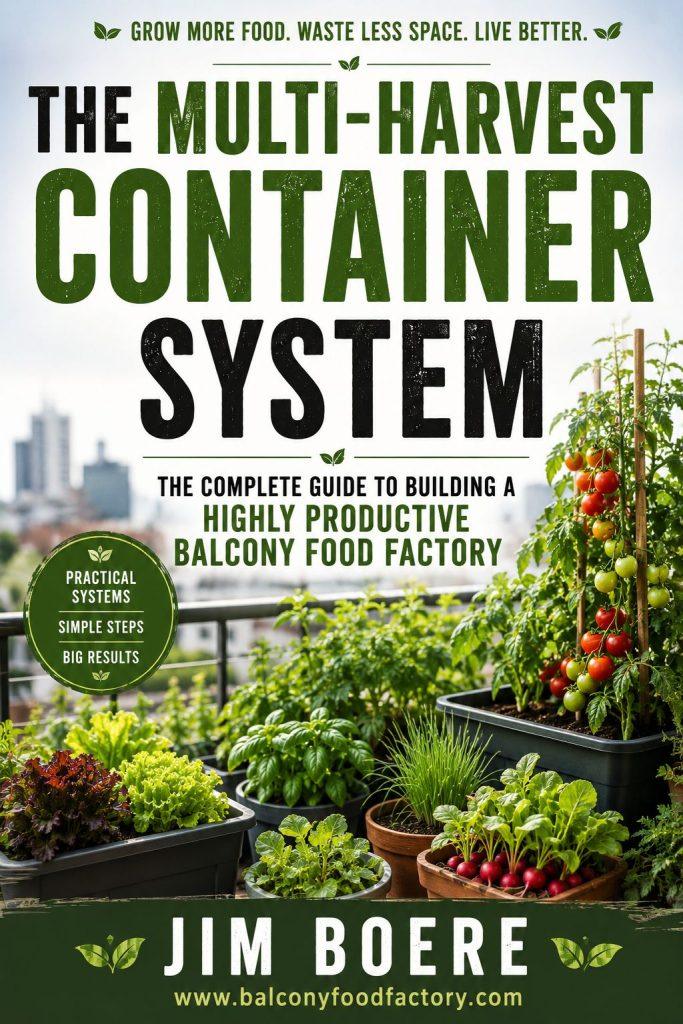
If you want to learn the complete system, my book The Multi-Harvest Container System Starter Guide brings together the principles of succession planting, companion planting, soil management and efficient container growing, along with practical high-yield container setups you can adapt to your own balcony.
Recommended Further Reading
Want to explore this idea further? These articles are a good place to continue:
Why Autumn Is Your Second Spring
How To Keep Your Balcony Food Factory From Going To Zero
Stop Thinking In Growing Seasons, Start Thinking In Production Cycles
Find All My Monthly Balcony Growing Guides On This Page
About Me
I’m Jim, the gardener behind Balcony Food Factory.
I’ve been growing food for decades, from allotments to my current 10th-floor balcony, where I’ve learned how to grow a surprising amount of food in a surprisingly small space.
Balcony Food Factory is where I share what I’ve learned about growing more food in containers, making the most of limited space, and keeping things practical and manageable.
Want more? Subscribe to the Balcony Food Factory newsletter and I’ll send you practical growing advice, ideas and lessons from my own balcony garden straight to your inbox. You’ll get the below eBook for free too, as a welcome gift. Just click on the image to sign up.
See you there!

A Note About Climate
I garden in Schiedam, the Netherlands, where we have a temperate maritime climate with mild winters, relatively cool to warm summers, and rainfall throughout the year. As a general comparison, my location is approximately USDA Hardiness Zone 8b.
Growing conditions vary considerably between regions, so planting dates, growing seasons, temperatures, and crop recommendations may differ where you live. Please adapt the advice in my articles to your own local climate, weather patterns, and growing conditions.



Leave a Reply