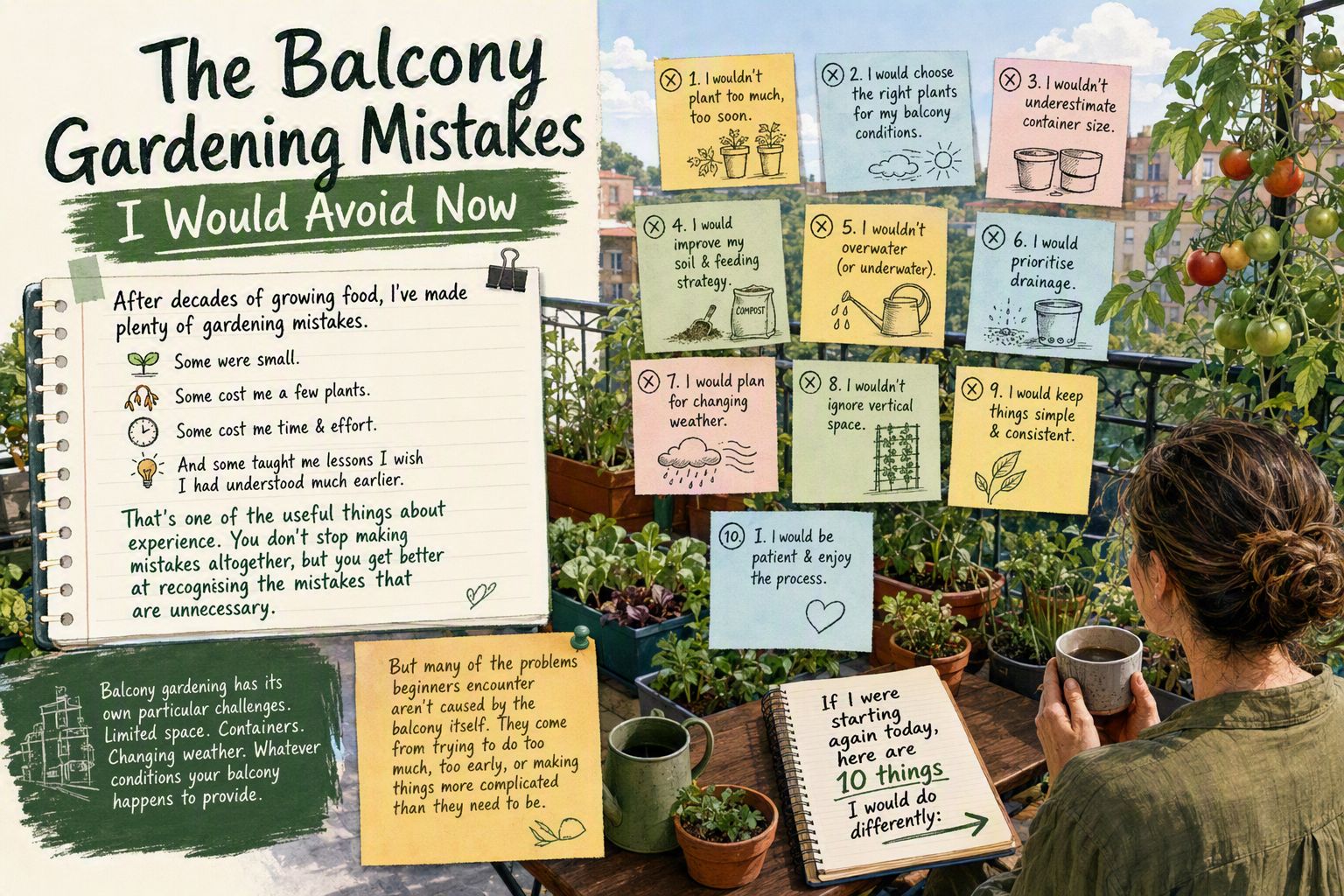
After decades of growing food, I have made plenty of gardening mistakes.
Some were small.
Some cost me a few plants.
Some cost me time and effort.
And some taught me lessons that I wish I had understood much earlier.
That’s one of the useful things about experience, I found. You don’t stop making mistakes altogether of course, mistakes will happen, but you get better at recognising the mistakes that are unnecessary.
Balcony gardening has its own particular challenges. You are working with limited space, containers, changing weather, and whatever conditions your particular balcony happens to provide.
But I do think many of the problems beginners encounter aren’t caused by the balcony itself.
They come from trying to do too much, too early, or making things more complicated than they need to be. So that’s what I want to help you avoid.
If I were starting again today, there are quite a few things I would approach differently.
Trying To Grow Too Much Too Soon
Enthusiasm is a wonderful thing.
It is also one of the easiest ways to make gardening unnecessarily difficult.
When you discover that you can grow food in containers, it is tempting to want to grow everything.
More vegetables.
More herbs.
More varieties.
More containers.
And before you know it, your small growing project has become a surprisingly large amount of work.
Every additional container needs attention.
It needs watering. It may need feeding. It needs harvesting. Crops need monitoring. Containers eventually need clearing and preparing for whatever comes next.
None of those jobs is particularly difficult on its own.
The problem is the accumulation.
If you start with one or two containers, you can learn how your balcony behaves without having to manage an entire collection of plants.
You can discover what works.
You can discover what doesn’t.
And once you have that experience, you can add more containers with a much better understanding of what you are taking on.
If I were starting again, I would resist the temptation to fill the entire balcony immediately.
Because I did add more containers quickly after the first bit of success, and it was a lot to handle.
I would start smaller now, and let the garden grow along with my experience.
Starting Crops Too Early
This is another mistake I would be much more careful about now.
There is a natural temptation to start as early as possible.
The seed packet says you can sow something indoors, so why not start immediately?
Because earlier isn’t automatically better.
A seedling that is started too early may spend a very long time indoors waiting for conditions outside to become suitable.
By the time it can finally be planted out, it may have become tall, weak, or difficult to manage.
And in the meantime, you have spent weeks or even months caring for a plant that wasn’t actually ready to move outside.
This is particularly relevant for warm-season crops.
Starting tomatoes, peppers, and zucchini (courgette) seedlings indoors in February?
I know the advice is all over the internet, but I don’t do that anymore. There is no just need for it and you avoid needless work, stress, and problems.
March is early enough for me, for planting outdoors the second half of May.
There is often more value in starting at the right time than in starting as early as possible.
I would rather have a strong, healthy young plant that is ready to grow when conditions are right than a much older plant that has spent too long struggling for enough light and space indoors.
That is why I prefer to think in terms of a productive start rather than an early start.
The calendar is useful.
But the conditions matter more.
Choosing Crops Without Considering The Space
Another mistake is choosing what to grow without first considering where it will grow.
I understand why I did it, of course. And why you might be tempted to do it.
You look through a seed catalogue or walk around a garden center and see all sorts of interesting vegetables.
You like eating them, so naturally you want to grow them. It’s hard to resist.
But liking a vegetable isn’t necessarily a good reason to grow it on a balcony.
The question is whether your balcony can give that crop what it needs.
How much sunlight is available?
How much room does the mature plant require?
Does it need a large container?
Does it need support?
Is it likely to cope with the wind?
How long will it occupy the container?
And perhaps most importantly, is the amount of food you are likely to harvest worth the space and effort involved?
A balcony is limited space.
That doesn’t mean you can grow very little.
It does mean you need to make choices.
A crop that performs beautifully in a large garden may not be the best use of a small container.
Another crop might give you repeated harvests from the same amount of space.
Over time, you learn to make those choices more intelligently.
If I were starting again, I would think about the growing space first and the crop second.
Underestimating The Importance Of The Container
It is easy to think of a container as simply something that holds the potting mix.
But the container is part of the growing system.
Its size matters.
Its depth matters.
Drainage matters.
Its position matters.
And the material it is made from can influence how quickly it heats up or dries out.
A container that is too small can create problems with roots and moisture.
A container with poor drainage can create an entirely different set of problems.
And a large container filled with potting mix can become very heavy.
That last point is particularly important on a balcony. The combined weight of containers, potting mix, water, and plants should always be taken seriously, and you should follow any relevant building or landlord requirements.
The container is not an afterthought.
It is part of the environment in which the plant has to live.
Get that part reasonably right and you make everything else easier.
Get it wrong and you can spend a lot of time, and money, trying to solve problems that began with the container itself.
Treating Every Container The Same

When you have several containers, it is tempting to manage them all in exactly the same way.
Water everything at the same time.
Feed everything at the same time.
Put everything in the same type of location.
But containers aren’t necessarily the same.
One might be large and another small.
One might receive sunshine for most of the day while another spends part of the day in shade.
One might be sheltered from the wind while another is completely exposed.
One might contain a crop that uses a lot of water while another contains something with very different requirements.
Even two identical containers growing the same crop can behave differently if they are positioned in different places.
This is where observation becomes so important.
Your balcony is constantly giving you information.
If one container dries out faster than another, you learn something.
If one location produces healthier plants, you learn something.
If a particular crop performs poorly in one position but well somewhere else, you learn something.
You don’t necessarily need a completely different system for every container.
But you do need to recognize that they are not all identical.
Watering By Schedule Instead Of Observation
I think this is one of the easiest traps to fall into.
You decide that you will water every morning.
It sounds organized.
And having a routine can certainly be useful.
But plants don’t know what day it is.
I’ve drowned plants by watering them on a strict schedule.
Their need for water depends on the conditions around them.
A hot, sunny, windy day can cause a container to dry much faster than a cool, cloudy, sheltered day.
A small container can dry much faster than a large one.
Different crops have different needs, too.
So instead of treating watering as a fixed calendar task, I now know it is better to develop the habit of checking what is actually happening.
Look at the plants.
Check the potting mix. Don’t just see if the soil looks dry from the top, but use a finger to check below the surface.
Consider the weather.
Think about the container.
Then decide whether water is needed.
This doesn’t mean you need to stand over your plants constantly.
Quite the opposite.
The better you understand your containers, the easier watering becomes.
You stop guessing.
You start recognising their rhythm.
Overcomplicating Feeding And Fertilizing
Gardening can sometimes make you feel as though you need a product for everything.
Something to make the plants grow faster.
Something else to improve flowering.
And perhaps another thing because somebody online says you should add it.
It is easy to end up with a complicated (and expensive) collection of fertilizers and supplements without really knowing whether you need them.
I have learned to value simplicity much more.
Plants need nutrients.
That doesn’t mean they need an elaborate feeding programme involving every product available.
Start with a good potting mix.
Give the plants appropriate nutrition.
Pay attention to how they grow.
And adjust when there is a genuine reason to do so.
More fertilizer doesn’t automatically mean more food.
In some situations, adding more can create problems rather than solve them.
A simple system that you understand is much more helpful than a complicated system that you are constantly trying to manage.
If something can be made simpler without reducing the results, I generally prefer the simpler approach.
Expecting Every Crop To Perform Perfectly
There is another mistake that is harder to avoid because it has more to do with expectations.
You plant something.
You look after it.
And you expect it to work.
Sometimes it does.
Sometimes it doesn’t.
A crop can fail because the timing was wrong.
The weather may have been poor.
A pest may have found it.
The plant may not have liked its location.
The variety may simply not have suited your conditions.
Or sometimes you can do everything well and still get a disappointing result.
That’s gardening. It’s nature.
I used to think of failures more as things that had gone wrong. That maybe I did wrong.
Now I see them more as information.
If a particular crop repeatedly struggles on my balcony, I can either investigate why or decide that the space is better used for something else.
If something performs exceptionally well, I pay attention to that too. I may want to grow more of that on that part of my balcony.
The aim isn’t to make every crop perfect.
The aim is to learn enough to make increasingly good decisions about what deserves your space and effort.
One failed crop doesn’t mean balcony gardening doesn’t work. Or that you failed.
It means that particular attempt didn’t work.
There is a difference.
Forgetting To Think About What Comes Next
This is perhaps one of the biggest lessons behind the Multi-Harvest Container System.
It is easy to think about what you are planting today.
It is much easier to forget what happens when that crop finishes.
You sow some lettuce.
You grow it.
You harvest it.
And then you are left with an empty container.
If you don’t think ahead, that container may remain empty for weeks or months.
But the end of one crop can also be the beginning of another.
As a crop approaches the end of its useful harvest, you can start thinking about what could follow it.
What is suitable for the season?
What can use that container next?
How much preparation will be needed?
You don’t have to force every container to be occupied constantly.
Sometimes a container genuinely needs a rest or some attention before it is ready for another crop.
But it is worth getting into the habit of thinking beyond the current harvest.
The container isn’t necessarily finished when the crop is finished.
It may simply be ready for its next job.
That shift in thinking can make a surprisingly big difference when you have limited space. It had a huge impact on my own garden(ing).
Turning Gardening Into Too Much Work
Perhaps the biggest mistake of all is forgetting why you started.
Growing food should be productive.
It should also be enjoyable.
We must not forget that.
If you create a system that requires constant attention, endless fiddling, and a long list of complicated tasks, eventually it can start feeling like another job.
And that defeats the purpose.
The answer isn’t necessarily to grow less.
It is to grow more intelligently.
Choose crops that are useful to you.
Use containers that make sense for your space.
Keep the system simple.
Learn which jobs actually matter and which ones are simply things you have convinced yourself you ought to be doing.
And accept that your balcony garden doesn’t have to look perfect every day.
There will be periods when everything is growing beautifully.
There will be times when containers are being cleared and replanted.
There will be gaps.
There will be failures.
There will be more work at certain times of year and less at others.
That’s normal.
A good food-growing system should fit into your life rather than take over your life.
What I Would Do Differently Now
If I could go back and give my younger gardening self some advice, I think it would actually be surprisingly simple.
I would start smaller.
I would be more patient.
I would pay more attention to the actual conditions of the growing space.
I would choose crops based on what the space could realistically provide rather than simply growing everything I wanted to grow.
I would give more thought to the container itself.
I would water based on observation rather than blindly following a schedule.
I would keep feeding and fertilizing simpler.
I would worry less when something failed.
And I would think further ahead about what happens after each harvest.
Most importantly, I would spend less time worrying about doing everything “right.”
Because gardening isn’t about getting everything right.
It is about learning. And enjoying the process.
You grow something.
You observe.
You discover what worked and what didn’t.
You adjust.
And then you grow again.
That is how experience accumulates.
And perhaps that is the biggest advantage an experienced gardener has over a beginner.
It isn’t that the experienced gardener never makes mistakes.
It is that they have already made many of them.
They know which problems are worth worrying about.
They know which ones can simply be accepted.
They know when to change something.
And they know when to leave the plant alone and see what happens.
I have learned these lessons and made these adjustments. And I’m very glad I did because it is why I still enjoy balcony gardening so much today.
I hope passing on my experience is in some way helpful to you.
You don’t need decades of experience to start making better decisions.
You simply need to pay attention to what your growing space is teaching you.
And if you can avoid a few of the mistakes I would avoid now, you can save yourself some time, effort, and frustration along the way.
Happy growing on the balcony!
Jim
If you want to learn the complete system, my book The Multi-Harvest Container System Starter Guide brings together the principles of succession planting, companion planting, soil management and efficient container growing, along with practical high-yield container setups you can adapt to your own balcony.
Recommended Further Reading
If you found this article helpful, I think you will like these as well:
Your Balcony Can Grow More Food Than You Think
You Don’t Need a Garden to Grow Your Own Food
One Pot, Multiple Harvests: The Idea Behind The Multi-Harvest Container System
About Me
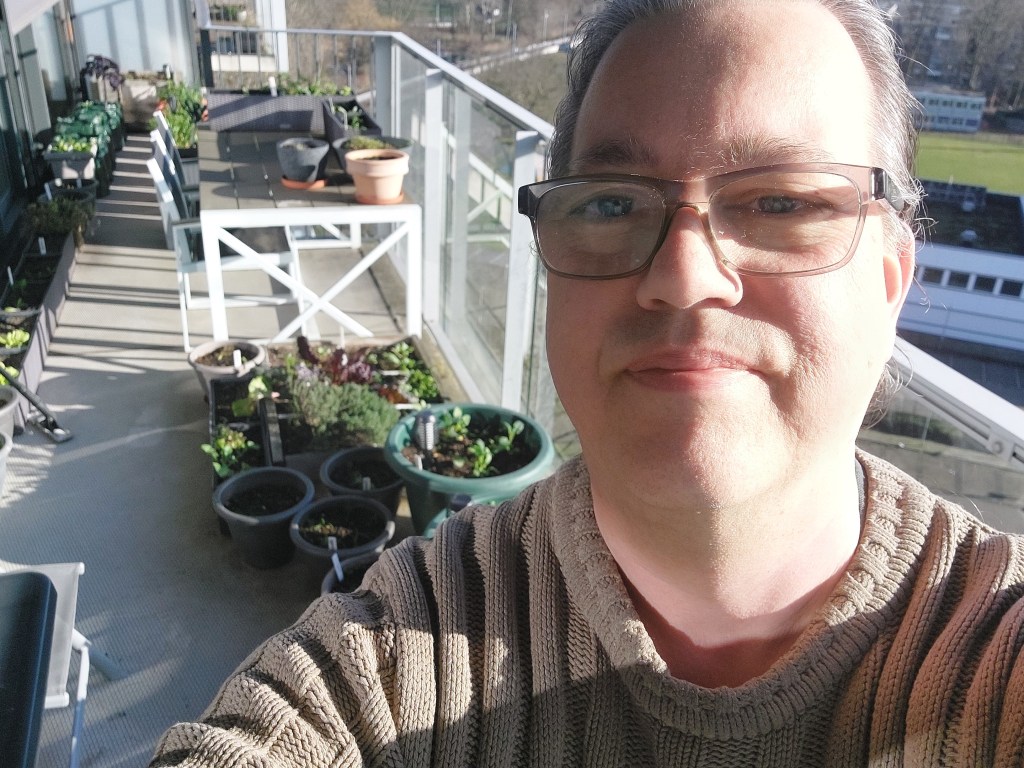
I’m Jim, the gardener behind Balcony Food Factory.
I’ve been growing food for decades, from allotments to my current 10th-floor balcony, where I’ve learned how to grow a surprising amount of food in a surprisingly small space.
Balcony Food Factory is where I share what I’ve learned about growing more food in containers, making the most of limited space, and keeping things practical and manageable.
Want more? Subscribe to the Balcony Food Factory newsletter and I’ll send you practical growing advice, ideas and lessons from my own balcony garden straight to your inbox. You’ll get the below eBook for free too, as a welcome gift. Just click on the image to sign up.
See you there!

A Note About Climate
I garden in Schiedam, the Netherlands, where we have a temperate maritime climate with mild winters, relatively cool to warm summers, and rainfall throughout the year. As a general comparison, my location is approximately USDA Hardiness Zone 8b.
Growing conditions vary considerably between regions, so planting dates, growing seasons, temperatures, and crop recommendations may differ where you live. Please adapt the advice in my articles to your own local climate, weather patterns, and growing conditions.

Leave a Reply