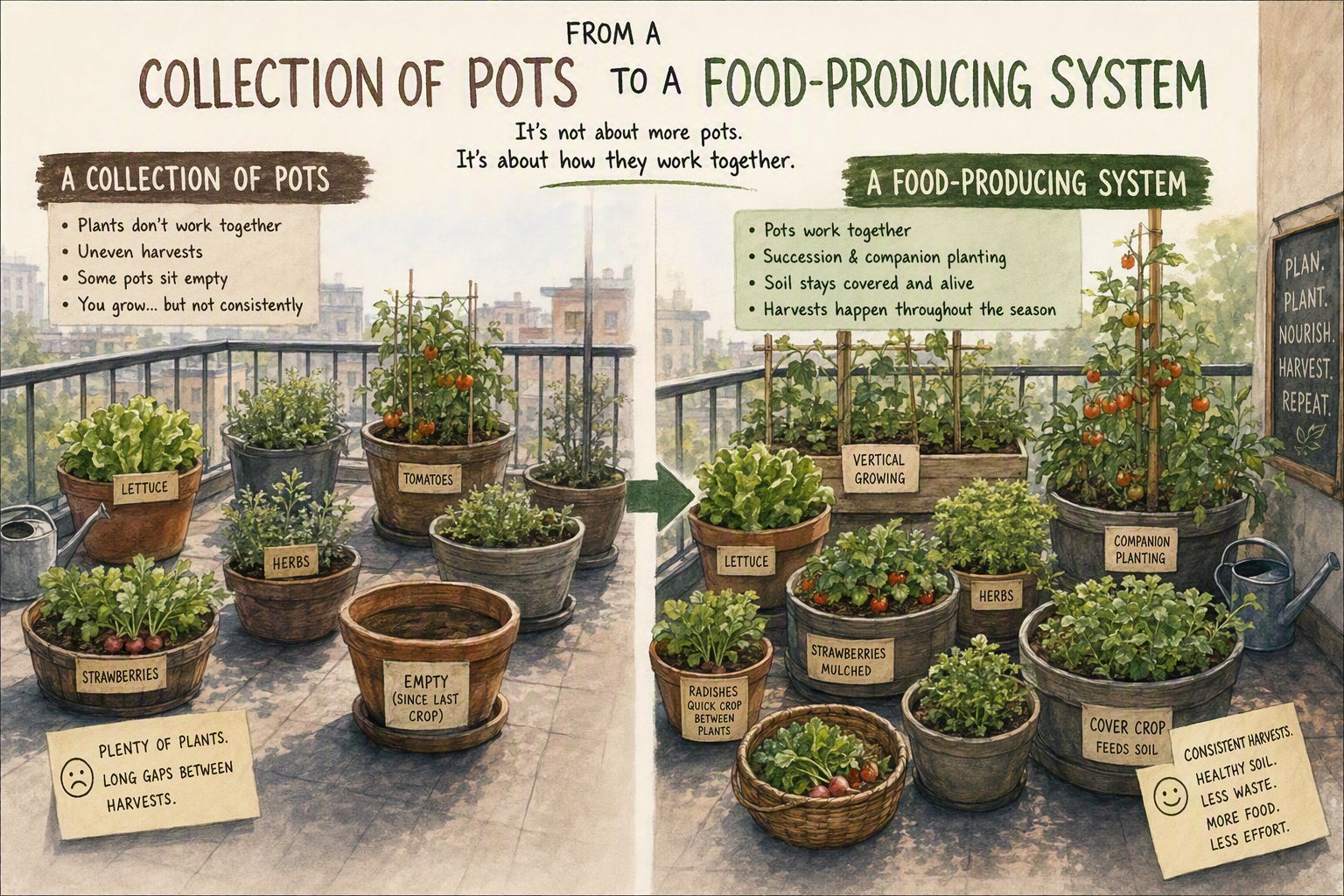
It is very easy to end up with a balcony full of pots.
One pot has lettuce in it. Another has tomatoes. There are a few pots with herbs, perhaps some radishes, a container with strawberries, and another one that has been sitting empty since the last crop was harvested.
You are growing food, so it is certainly a garden.
But is it a food-producing system?
There is a difference.
A collection of containers can produce food without the containers actually working together. You can have plenty of plants and still have long periods when very little is being harvested.
That was one of the things I gradually learned from growing food on my own balcony.
The biggest change wasn’t finding a way to fit more pots onto the balcony. It was learning to look at all those pots as parts of one growing system.
A Collection Of Pots Is Not The Same As A Productive Garden
There is nothing wrong with having a collection of pots, of course.
That is how most of us start.
You buy a container, fill it with potting mix and grow something you would like to eat. Later, you buy another container and grow something else.
Before long, you have a balcony garden.
But if every container is being managed independently, you are missing an opportunity.
One crop might be harvested and then the container sits empty for several months.
Another container might be growing something that takes a long time to mature, while there is unused space elsewhere.
You might have three containers producing at the same time and then very little to harvest for several weeks.
None of this means you are doing anything wrong.
It simply means that your containers are behaving as individual growing spaces rather than parts of a coordinated system.
The difference becomes important when your goal is not just to grow plants, but to produce food consistently from limited space.
That requires you to start looking beyond the individual pot.
Start Looking At The Balcony As A Whole
Instead of asking only:
“What am I growing in this container?”
start asking:
“What is this container doing for my food production?”
That sounds like a small change, but it changes the way you look at your balcony.
You start noticing which containers are producing food right now.
You notice which ones are between crops.
You think about what will follow the crop that is currently growing.
You notice spaces that could be used more effectively.
And you begin to see that your balcony is not simply a collection of pots. It is one growing area made up of many smaller growing spaces.
Those spaces do not all have to be doing the same thing at the same time.
In fact, it is better if they aren’t.
One container might be producing lettuce while another is growing tomatoes. A third might be growing herbs that you harvest regularly. Another might have just been replanted, while another is approaching the end of its current crop.
That is not a lack of organization.
That is how a food-producing system works.
Every Container Has A Role
One of the simplest ways to start thinking this way is to give every container a purpose.
That does not mean every pot needs to produce a huge amount of food.
A container might be used for fast-growing crops that give you relatively quick harvests.
Another might be devoted to a crop that occupies the container for much longer.
Another might be a herb container that you harvest repeatedly.
A large container might support a tomato plant while also producing basil or another companion crop around it.
A container that has just been harvested might be in the process of being refreshed and prepared for its next crop.
And a container growing garlic or another long-term crop might not provide much to harvest today, but it still has an important role in your overall production.
The important thing is that you know why the container is there.
This is one of the ideas behind the principle that every pot must earn its place.
“Earning its place” does not necessarily mean producing food every day. It means that the container has a useful purpose within your balcony garden.
Think About What Happens Before And After Each Crop
This is where the idea of production cycles becomes particularly useful.
When you are growing individual plants, it is easy to think about planting as the beginning and harvesting as the end.
You plant something.
You grow it.
You harvest it.
Finished.
But the harvest does not have to be the end of the container’s productive life.
It can be the beginning of the next cycle.
A productive container might go through something like:
Sow → Grow → Harvest → Remove → Refresh → Replant
The exact crops and timing will vary according to your climate, the container, the season and what you actually want to eat.
The principle does not change.
When one crop finishes, you start thinking about what comes next.
That simple question can make a surprisingly large difference to how much food your balcony produces over a year.
Your Containers Can Work Together

Once you start looking at the whole balcony, something else becomes obvious.
Your containers do not have to produce everything at the same time.
In fact, they shouldn’t.
Different crops grow at different speeds.
Some provide quick harvests.
Some take longer.
Some produce over an extended period.
Some are removed relatively quickly and make room for something else.
This gives you an opportunity to spread your production across the balcony.
Imagine one container producing spring greens while another is being prepared for a summer crop.
A third container might already be producing herbs.
Another could be growing a tomato with companion plants.
Later, the spring container might move into another crop while the tomato container is still producing.
The individual containers are following their own cycles, but together they create a more continuous flow of food.
That is an important distinction.
The Multi-Harvest Container System is not about making every pot identical.
It is about making the different parts of your growing space work together.
Don’t Try To Make Every Pot Do Everything
There is also a danger in taking this idea too far.
Once you understand that a container can produce more than one crop over time, you might start thinking that every pot must always have multiple crops, multiple layers and continuous production.
It doesn’t.
That would turn a useful system into a lot of unnecessary work.
Some crops need their space.
Some containers are better suited to one main crop.
Some combinations simply don’t make sense in your particular conditions.
And sometimes you will grow something because you enjoy growing it, even if it isn’t the most productive use of the container.
That is perfectly fine.
The goal is not to force every possible principle into every container.
The goal is to make the whole balcony productive in a way that remains practical and enjoyable.
Sometimes the best decision is to leave a container alone and let a crop finish properly.
The system should make your gardening more intentional, not more complicated.
The Balcony Becomes A Series Of Production Cycles
Now let’s take the idea one step further.
Instead of looking at one container going through:
Sow → Grow → Harvest → Remove → Refresh → Replant
look at several containers doing different parts of that process at the same time.
One container might be growing.
Another might be producing harvests.
Another might have just been cleared.
Another might be freshly replanted.
Another might contain a crop that will not be ready for some time.
This creates a kind of production flow.
You are no longer waiting for the whole balcony to move from spring to summer to autumn.
Each container can move through its own useful cycles while the others continue doing their jobs.
This is one of the biggest differences between thinking about a balcony as a garden and thinking about it as a food-producing system.
You stop seeing the year as one long growing season.
You start seeing it as a series of opportunities.
Make Your Space Work Across Time
There is one resource on a balcony that is easy to overlook.
Time.
You cannot make your balcony physically larger.
If you have a certain amount of floor space, that is what you have.
But you can use that same space more than once.
A container that produces one crop and then sits empty for the rest of the year has only been used for part of its potential growing time. A container that goes through several well-planned production cycles is using the same physical space repeatedly.
This is why I believe time should be thought of as another dimension of growing space.
You have the space you can see.
Then you have what that space can produce over time.
That changes the calculation considerably.
You do not necessarily need more containers.
You may simply need to make better use of the containers you already have.
What A Food-Producing System Looks Like In Practice
There is no single combination of crops that makes a balcony food-producing system.
Your system should be built around your climate, your balcony, your available time and, perhaps most importantly, the food you actually want to eat.
But imagine a balcony with several containers.
One container starts the year with a fast-growing crop and later moves into another crop.
A second container is used mainly for salad crops and is replanted as space becomes available.
A third supports a tomato plant through the summer, with companion crops making use of some of the surrounding space.
A fourth provides herbs that can be harvested repeatedly.
A fifth moves from one seasonal crop into another as the year progresses.
None of those containers has to follow exactly the same schedule.
The important thing is that there is always something happening somewhere.
While one container is being harvested, another is growing.
While one is being refreshed, another is producing.
While one is waiting for a slower crop to mature, another can provide quick harvests.
That is what makes the whole balcony more productive.
It is not one spectacular container. It is the way the containers work together.
The System Helps You See Empty Opportunities
Once you start thinking this way, empty containers become more noticeable.
Again, there is nothing wrong with an empty pot.
Sometimes a container needs to be left alone.
Sometimes the timing isn’t right for another crop.
Sometimes you simply don’t have the time.
But if a container has been sitting empty for months without a reason, you can start asking a different question.
Could this space be doing something useful?
Likewise, when a crop is approaching the end of its productive life, you can begin thinking about the next step before the container is completely empty.
You might ask:
What is growing here now?
When is it likely to finish?
What could follow it?
Can I prepare for that next crop?
Do I need to refresh the potting mix?
Is there another container that could take over production while this one is between crops?
These questions do not require complicated spreadsheets or a perfect planting plan. They simply make you more aware of what your growing space is doing.
A Food-Producing System Is More Than Maximum Yield
There is another point I think is important.
A food-producing system is not the same thing as a balcony that is packed with plants in an attempt to achieve maximum possible yield.
I don’t want that.
Gardening should still be enjoyable.
There should be room for flowers.
There should be room for experimentation.
There should be room to grow something simply because you like it.
And there should be room for the occasional failure.
The purpose of thinking in systems is not to turn gardening into an industrial process.
It is to make better use of the resources you already have.
If you can grow more food without adding unnecessary work, that is useful.
If you can avoid leaving a container empty for months when another crop could easily follow, that is useful.
If you can harvest something regularly from a small space, that is useful.
And if your system helps you spend less time wondering what to do next, that is useful too.
The best system is one you can actually live with.
Your System Will Look Different From Mine
My balcony is not your balcony.
I have a 18m2 south-facing 10th-floor balcony, and over the years I have learned how my particular space behaves.
You may have a different orientation.
You may have less sunlight.
You may have more wind.
Your containers may be smaller or larger.
Your climate may be different.
You may have only a handful of containers, while someone else may have dozens.
And you may have completely different priorities about what you want to grow.
That is why I don’t think the Multi-Harvest Container System should be treated as a rigid recipe.
The principles can be adapted.
The crops can change.
The timing can change.
The number of containers can change.
What matters is the way you think about the relationship between space, time, crops and harvests.
Your balcony food-producing system should ultimately be your system.
The Shift From Gardener To Food Factory Grower
There is a subtle change that happens when you start thinking this way.
You stop looking at your balcony and seeing:
“I have some pots with vegetables in them.”
Instead, you start seeing:
“I have a growing system that produces food.”
You notice when a container is approaching the end of its current cycle.
You think about what comes next.
You see that one container can support another.
You begin to notice where your space is being used well and where it isn’t.
You start measuring your success not only by how impressive an individual plant looks, but by how much useful food your entire balcony produces over time.
And perhaps most importantly, you begin to understand that productivity does not necessarily come from doing more.
It can come from making better use of what you already have.
That is the heart of the Multi-Harvest Container System.
Start With The Pots You Already Have
You don’t need to redesign your entire balcony to start thinking this way.
In fact, I would recommend that you don’t.
Start with the containers you already have.
Look around your balcony and ask yourself a few simple questions.
What is each container doing right now?
Which containers are producing food?
Which are between crops?
Which crops are approaching the end of their useful harvest period?
What could follow them?
Are there containers that have been sitting unused?
Are there crops you grow repeatedly because you actually eat them?
Are there containers that consistently give you a good return for the space they occupy?
You don’t need to answer all of these questions at once.
Pick one container.
Look at what is growing in it now.
Then think about what happens next.
That is enough to begin changing the way you manage your balcony.
Your Balcony Doesn’t Have To Be Bigger
One of the most important things I have learned from growing food on a balcony is that productivity isn’t simply a question of how much physical space you have.
You can only fit so many containers onto a balcony.
But those containers can do more than one job over the course of a year.
And when several containers are working through different production cycles at the same time, the entire balcony can become far more productive than a simple collection of pots might suggest.
You don’t necessarily need more space.
You don’t necessarily need more containers.
And you certainly don’t need to grow everything.
What you need is a way of looking at the space you already have.
A collection of pots can become a garden.
A garden can become a food-producing system.
And a food-producing system can become your own small Balcony Food Factory.
If you want to learn how I put these ideas together into a practical system of succession planting, companion planting, soil management and efficient container growing, I explain the complete approach in The Multi-Harvest Container System Starter Guide.
Start with the pots you have. Then start making them work together.
Recommended Further Reading
Want to explore this idea further? These articles are a good place to continue:
How To Grow More Food Without Adding More Pots
Stop Thinking In Growing Seasons, Start Thinking In Production Cycles
How To Keep Your Balcony Food Factory From Going To Zero
About Me
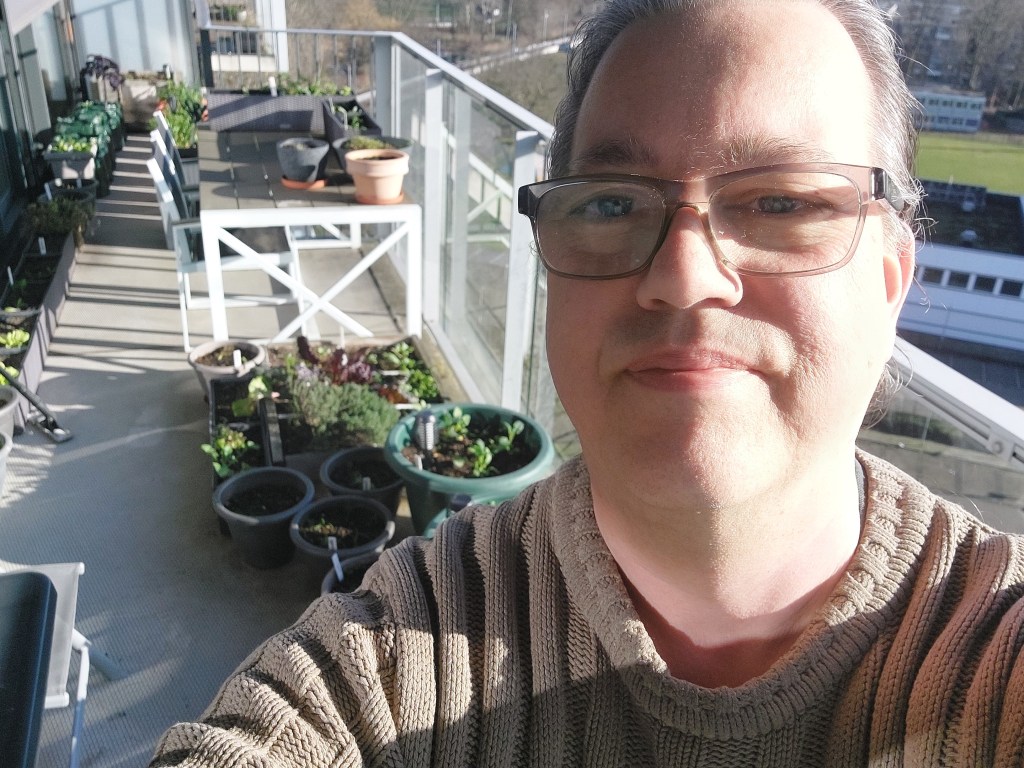
I’m Jim, the gardener behind Balcony Food Factory.
I’ve been growing food for decades, from allotments to my current 10th-floor balcony, where I’ve learned how to grow a surprising amount of food in a surprisingly small space.
Balcony Food Factory is where I share what I’ve learned about growing more food in containers, making the most of limited space, and keeping things practical and manageable.
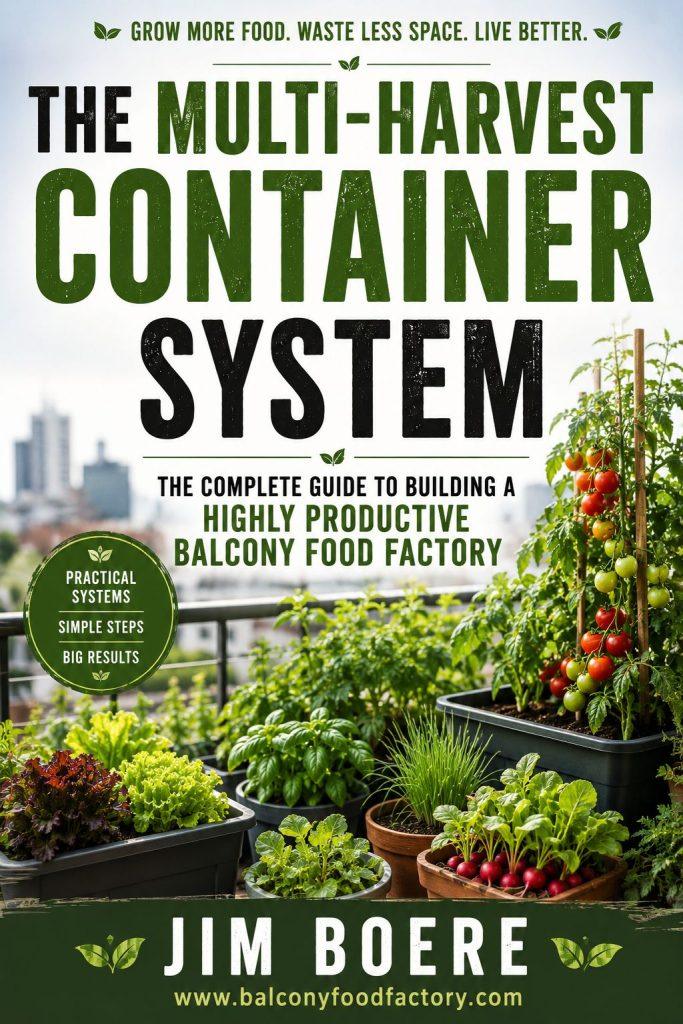
Want more? Subscribe to the Balcony Food Factory newsletter and I’ll send you practical growing advice, ideas and lessons from my own balcony garden straight to your inbox. You’ll get the below eBook for free too, as a welcome gift. Just click on the image to sign up.
See you there!

A Note About Climate
I garden in Schiedam, the Netherlands, where we have a temperate maritime climate with mild winters, relatively cool to warm summers, and rainfall throughout the year. As a general comparison, my location is approximately USDA Hardiness Zone 8b.
Growing conditions vary considerably between regions, so planting dates, growing seasons, temperatures, and crop recommendations may differ where you live. Please adapt the advice in my articles to your own local climate, weather patterns, and growing conditions.

Leave a Reply